
How to Spot a Payline Slot at a Glance
One of the first things you will notice when browsing demo slots is that they do not all look the same before you spin. Some games show numbered indicators along the edges of the reels. Others show a wide open grid with no lines at all. That visual difference usually tells you something important: whether the slot uses paylines or a completely different win system.
Learning to spot a payline slot at a glance is a useful habit because it changes how you read the screen and what you should pay attention to during play. Once you can identify the format quickly, understanding the full slot before you spin becomes much faster and more reliable.
What a payline slot looks like from the outside
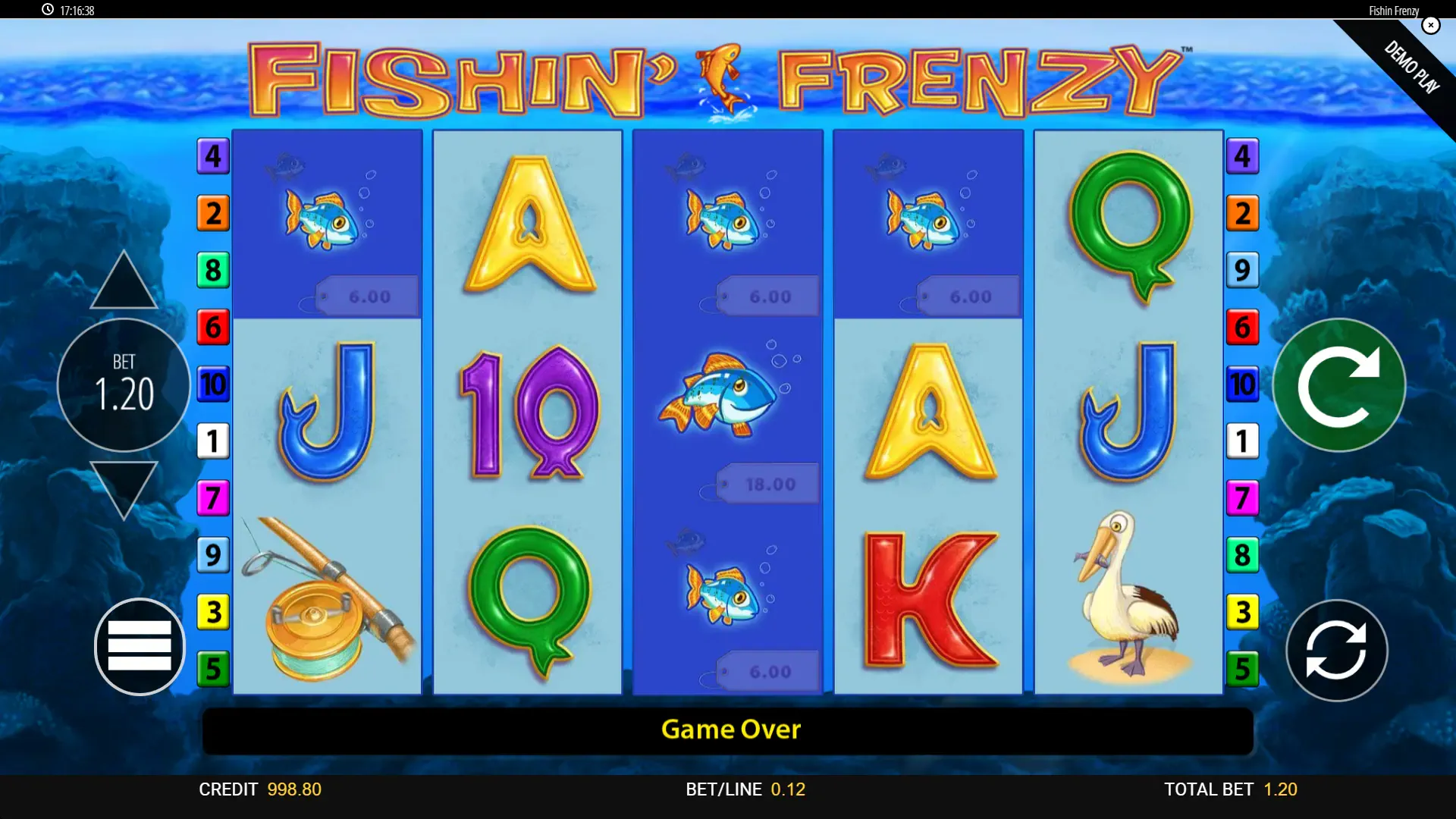
A payline slot uses fixed lines that run across the reels from left to right. When matching symbols land on one of those lines, the game registers a win. The most immediate visual sign of a payline slot is the presence of numbered markers along the left and right edges of the reel area, or sometimes just along one side.
Fishin’ Frenzy is one of the clearest examples of this. The numbered payline indicators run down both sides of the 5×3 reel grid, showing ten lines in total. Even before you read a single rule, the screen already tells you how the game thinks about wins: there are ten fixed paths, each one numbered, and matching symbols need to land on one of those paths to count.
That numbered border is not a decorative detail. It is the game communicating its win logic to you before the first spin.
The reel structure gives it away
Beyond the edge indicators, the reel structure itself is a strong clue. Classic payline slots almost always use a 5×3 layout — five reels, each showing three symbols — because that grid pairs naturally with a manageable number of fixed lines. You can have 10, 20, 25 or even 40 paylines on a 5×3 grid without the screen becoming too dense.
In Fishin’ Frenzy, each reel shows exactly three symbols, and the grid holds 15 symbol positions in total. Nothing changes between spins at the structural level. The same number of positions appear, the same lines are always active, and the result settles in a stable, predictable layout. That consistency is one of the defining features of payline slots and one of the reasons they are often described as easy to read.
The direction of wins
A payline slot almost always pays from left to right, starting from the leftmost reel. That means a winning combination needs to begin on reel 1 and continue across adjacent reels to count. A matching symbol that starts on reel 2 or 3 will not complete a payline win.
This left-to-right logic is worth spotting early because it tells you where to look on the screen after a spin settles. If the game highlights a combination starting from the left edge of the grid, you are almost certainly looking at a payline result. If the game highlights symbols scattered across non-adjacent positions anywhere on the grid, you are looking at a different kind of win system entirely.
In this Fishin’ Frenzy spin, the payline highlights on the right-hand side of the reels show exactly which lines paid. The fish symbols landing across adjacent reels from left to right create wins on specific numbered paths. The payline numbers light up to confirm which lines were active in that result, which makes it very easy to trace why the win happened.
What a non-payline slot looks like by comparison
The easiest way to sharpen your ability to spot a payline slot is to look at what a non-payline slot shows instead.
Sweet Bonanza 1000 uses a 6×5 grid with 30 symbol positions, and there are no numbered edge indicators, no directional arrows, and no line highlights anywhere on the main screen. The game does not pay across fixed lines at all. Instead, it counts how many matching symbols appear anywhere on the grid and pays based on that total. That is a fundamentally different logic, and the absence of payline markers on the screen is the clearest visual signal.
Le Zeus works the same way. The 6×6 grid has no payline numbers, no edge indicators and no directional win logic. The game uses a count-based or collect-based system, and the screen reflects that by showing a clean grid without the structural cues that payline slots always carry. If you want to understand how that kind of slot communicates its own logic, how to recognize a count-based slot covers that format in the same level of detail.
Four things to check before your first spin
Once you know what to look for, identifying a payline slot takes only a few seconds. The quickest method is to check four things in order.
Why payline slots are often better for beginners
Payline slots communicate their win logic visually and structurally in a way that most other formats do not. The numbered lines, the 5×3 grid, the left-to-right direction and the stable layout between spins all give a new player a clear framework to follow before the first result settles.
Even during a free spins round in Fishin’ Frenzy, the payline structure remains exactly the same. The grid does not change shape, the lines stay active in the same positions, and wins highlight in the same way as the base game. That consistency between the base game and the bonus is one of the things that makes payline slots easier to follow all the way through a session, including the parts where new mechanics become active.
That is not to say payline slots are always simple. Some payline games have 40 or more lines, multiple wilds, stacked symbols and feature-heavy bonus rounds. But the structural foundation — fixed lines, left-to-right wins, stable grid — gives a beginner a reliable reading anchor that more dynamic formats do not always provide.
If you want a quick method for choosing between two games before you start, how to compare two slots in 60 seconds gives you a four-question framework that works across payline and non-payline formats. And if you are still building your reading habits from the ground up, starting with what makes a slot easy to read will help you understand why payline structure is one of the strongest beginner-friendly signals a slot can give you.