Wizard’s Trove from Gromada Games is a fantasy-themed video slot built on a standard 5×3 reel matrix. The game stands out mechanically by utilizing 14 fixed paylines that evaluate combinations both horizontally and vertically. Operating on a low volatility math model with a fixed RTP of 90.05%, the slot focuses on frequent, smaller payouts rather than high-variance spikes. The primary gameplay target is the Bonus Trove feature, an interactive pick-em round activated by landing three Key symbols. The maximum win is capped at 1000x the total stake, with wagering options ranging from a minimum of $0.50 up to a maximum of $50.00 per spin.
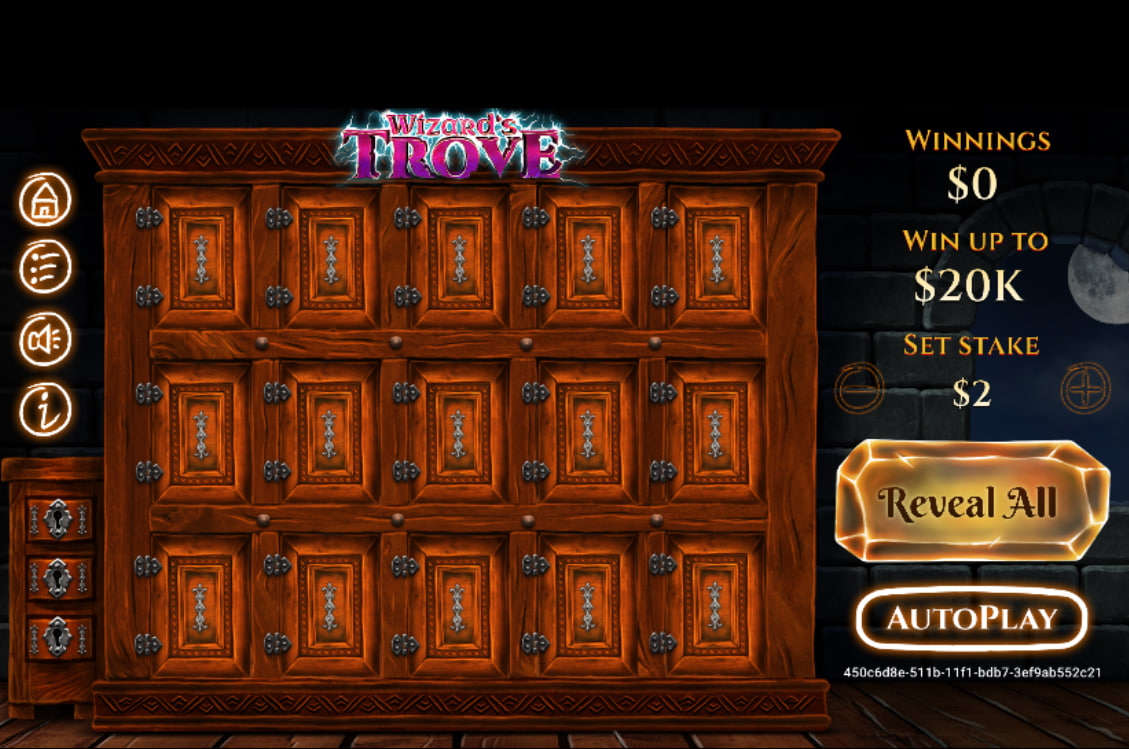
The immediate impression comes straight from the bottom interface panel where the virtual balance sits at $1000.00, waiting to be consumed by a fixed layout. Setting the total bet to $0.50 per spin reveals a steady, rhythmic pacing that does not rely on flashy modern animations to disguise the lack of cascading mechanics. Watching the balance bleed at this stable rate confirms that the math profile does not care about modern presentation trends. The ticker system below the reels flashes standard operational messages like PLACE YOUR BET and PRESS SPIN TO PLAY, stripping away any illusion of narrative depth. It is a raw, uninterrupted gambling environment where every spin costs real capital without offering the structural cushions found in contemporary slot designs.
The defining characteristic of this grid is the implementation of a 14-payline matrix that breaks traditional horizontal conventions. Payouts do not merely clear across the standard left-to-right rows or standard intersecting diagonals. The software reads winning combinations vertically across the three rows, an engineering choice that fundamentally alters symbol interaction. When the central spin button is engaged, the stop patterns create unusual blocking positions where a single missing item kills a multi-line connection. The low-volatility label attached to this title means that minor wins occur frequently, yet these payouts often fail to cover the cost of the spin itself. This creates a psychological trap where the player sees constant action on the screen while the primary balance steadily decreases.
Losing sessions are predictable because the overall theoretical return to player is hardcoded at a restrictive 90.05%. This percentage represents a significant disadvantage for the player, far below the standard industry benchmark of 96% that competitive studios provide. For a casual gambler, this low return combined with minimal variance results in an illusion of safety. The game constantly feeds the balance with small 1x or 2x returns, preventing rapid liquidation but ensuring a systematic drain over extended play. High rollers or variance chasers will find zero utility in this design, as the lack of aggressive multipliers means the upside is permanently locked behind a rigid math ceiling. The visual presentation uses clean animations and colorful gem structures, but this clean design serves strictly as a front for a highly disadvantageous mathematical framework.
Critiquing this payline implementation reveals a major structural flaw from a player perspective. Because vertical paths are active, standard symbol distribution becomes cluttered, meaning that low-paying gems frequently intercept high-value combinations. The Wizard wild symbol provides some relief by filling gaps across these vertical columns, yet its appearance rate is tightly regulated by the random number generator. When a near-miss occurs on the fourth or fifth reel, the game does not trigger dramatic slow-motion effects, choosing instead to drop the symbols instantly. This lack of artificial tension fits a purely analytical approach to play, but it also strips the session of any genuine entertainment value, leaving nothing but the raw numbers.
Why Does the Theoretical Return Create a Closed Economic Loop?
The hardcoded return metric of 90.05% ensures that long-term play is a mathematical losing proposition. In a low-variance environment, this low percentage manifests as a steady erosion of capital rather than sharp, sudden drops. Every sequence of 50 spins demonstrates a clear pattern where small wins of $0.10 or $0.20 on a $0.50 stake create a false sense of sustainability. The lack of an adjustable return range across different casino platforms means this restrictive model is static, leaving no room for finding better odds elsewhere.
This constant trickle of sub-stake payouts fails to compensate for the absence of large base-game multipliers. Because the math model avoids massive swings, the player never experiences the explosive recovery spikes that define high-volatility slots. The session becomes a defensive battle against an automated system designed to retain nearly 10% of every dollar wagered over time. This makes the game highly unsuitable for executing betting progressions or attempting to clear casino wagering requirements efficiently.
How Do the Vertical Paylines Impact Symbol Economy?
Activating 14 fixed lines across a compact 5×3 grid requires a strict spatial arrangement of the symbol library. The inclusion of vertical paylines means that three identical symbols stacked on a single reel constitute a valid winning combination. This mechanical rule sounds beneficial, but it actually increases the frequency of blocker symbols during standard spins. Cheap blue and green gems often stack completely on the first two reels, completely cutting off the paths for the high-value Spell Book symbols.
The Wizard wild symbol holds the technical responsibility of bridging these vertical and horizontal paths simultaneously. When a wild lands on the central position of reel three, it can complete multiple small combinations at once, giving the appearance of a major hit. The ticker will display a BIG WIN! alert, but checking the actual payout window often reveals a total return of less than 5x the bet. The symbol economy is heavily weighted toward these micro-payouts, ensuring that the top-tier symbols rarely align in a pure, un-wild-assisted five-of-a-kind combination.
What Are the Ergonomic Realities for Session Grinders?
The user interface is stripped of modern complexities, prioritizing immediate deployment over customization. Activating the Turbo mode removes the bounce animation from the reels, causing the symbols to snap into place almost instantly. This layout is optimized for high-speed sessions where the goal is to cycle through spins as fast as possible to trigger the primary bonus. The lack of advanced autoplay parameters, such as loss limits or single-win stops, means the player must manually monitor the screen to prevent total balance depletion.
Keyboard integration is limited to standard spacebar functionality for initiating spins, allowing for a fast physical loop during manual sessions. The settings menu, hidden behind a basic gear icon, offers toggles for ambient music and sound effects without providing deeper technical data like historical session statistics. This minimalist approach to ergonomics favors the developer by reducing interface friction, encouraging continuous button engagement without giving the player tools to analyze their current loss velocity.
The Alchemist’s Raw Ledger
The technical core of this fantasy title relies on specific operational rules and interface triggers that remain hidden during casual viewing. Navigating the internal paytables and help menus clarifies exactly how the software handles exceptional states and bonus distributions.
- The system operates under a standard regulatory clause where any technical malfunction completely voids all recorded participation and subsequent payouts.
- The primary bonus trigger requires exactly three Key symbols to land on any visible grid coordinates simultaneously, ignoring payline restrictions.
- The Bonus Trove feature switches the session to an interactive selection screen where the player opens chests containing fixed cash prizes based on the current total bet.
- The Spell Book symbol retains the absolute highest line value in the game, requiring five matching positions for a maximum base-game line return.
- The Wizard wild symbol is completely restricted from substituting for the Key bonus symbol, preventing accidental feature triggers during mixed lines.
- The interface utilizes four distinct low-paying gem symbols, colored red, purple, green, and blue, which share identical or nearly identical payout distributions to compress the variance.
- The game ticker changes state dynamically, displaying specific alerts such as GOOD LUCK! during standard play and flashing structural win values during line completions.
- The wagering limits are strictly bounded between a minimum of $0.50 and a maximum of $50.00 per spin, preventing micro-stakes adjustments or extreme high-roller operations.
FAQ
What is the return percentage of this slot machine?
The game operates with a fixed theoretical return to player set exactly at 90.05%.
How do the unusual vertical line payouts function during play?
Winning combinations are calculated across 14 fixed lines that check for identical matching symbols stacked vertically on the reels alongside standard horizontal paths.
Where can I access the free demonstration version of the game?
The complete free play mode is available directly on the Respinix.com platform.
What is the maximum prize multiplier available on a single spin?
The maximum payout cap built into the software architecture is limited to 1000x the selected total bet.
What mechanism activates the secondary bonus round screen?
Landing exactly three Key bonus symbols anywhere on the grid triggers the interactive Bonus Trove selection game.