Play The Wizard of Oz: We’re Not in Kansas Anymore demo by Light & Wonder. A unique path-building game with 94% RTP, buy options, and a 250x max win.
The “Blockchain™” Mechanic Explained
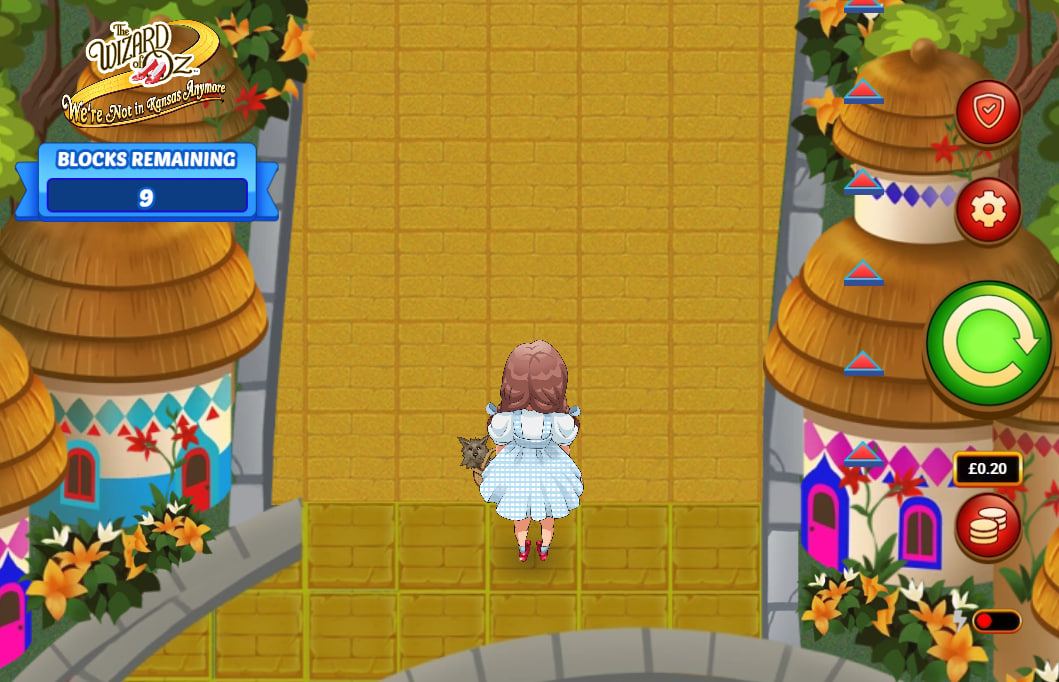
The core engine here is Light & Wonder’s trademarked Blockchain mechanic, which uses a 9-block drop system to generate random path segments.
Unlike cascading reels found in Sweet Bonanza, these blocks don’t explode or disappear; they must physically fit into the grid to extend the road. The game creates a grid where shapes (L-shapes, squares, lines) fall. If a block lands adjacent to the current end of the path and fits within the play area, the road extends. It’s essentially a logic puzzle powered by RNG, distinct from the cluster mechanics of Sugar Rush. The tension comes from the “dead ends”—if the blocks fall in a way that doesn’t connect or goes out of bounds, Dorothy stops, and the round ends unless you choose to intervene.
Prize Ladder & The Emerald City
The payout structure is a vertical ladder consisting of 35 distinct levels, culminating in a fixed jackpot of 250x your stake.
I find the prize distribution here quite brutal for the uninitiated. You don’t just win money for walking; you win specific milestones. The ladder mixes cash prizes (e.g., £0.02 at Level 8, £50 at Level 35) with “Free Block” awards. For instance, reaching Level 23 might award “+2 Blocks” rather than cash, extending your turn. To hit the “Max Win” of 250x, you must reach the very top—the Emerald City. Compared to the massive potential of Money Train 3, a 250x cap feels restrictive. It’s a binary outcome at the peak: you either make it for the big prize or you settle for the lower rungs.
Math Paradox: The Cost of the Extra Step
The paradox of this game lies in the Buy Feature RTP, which is actually higher (94.34%) than the base game (94%), creating a scenario where spending more seems statistically better but increases variance danger.
Here is the trap: The base game RTP is a sluggish 94%. However, when you fail to reach a satisfactory level, the game offers you to “Buy 1, 2, or 3 Blocks”. The price for these blocks is calculated dynamically based on your proximity to the next prize. While the RTP rises slightly to 94.34% during these purchases, the cost can be astronomical relative to the potential gain. I saw a scenario where buying 3 blocks cost £35.60 to chase a potential collect value of £25 or higher. You are often paying a premium for a chance to break even. This risk calculation is similar to the gamble features in Deal or No Deal Go All The Way, but with more granular control.
To Buy or To Collect? A Strategic Dilemma
The primary player agency in this title is the decision to strictly Collect winnings or risk the current payout to Buy more blocks.
This mechanic borrows heavily from the risk/reward concept found in Crash Games but applies it to a magic themed environment. When the initial 9 blocks are exhausted, if you haven’t reached a “Game Over” state, you get a choice.
- Collect: Take the current ladder value.
- Buy: Pay a calculated fee for 1, 2, or 3 extra shapes.
It works exactly like the “Respin” feature in games like Book of Oz or the strategic decisions in Money Coming, where you weigh the cost against the potential payout.
Vlad Hvalov’s Expert Tip:
Never chase the Emerald City from the bottom half of the ladder using the Buy feature. The cost of blocks scales exponentially. Only consider buying 1 block if you are literally one step away from a significant jump in prize money (e.g., moving from a £10 tier to a £20 tier) and the cost is less than 30% of the difference. Otherwise, strictly hit Collect.
“What if?..”: Introducing Multiplier Tiles
Acting as a Lead Game Designer, here is how I would fix the low volatility issue.
What if specific tiles on the Yellow Brick Road contained hidden Multiplier Traps? Currently, the path is flat—a yellow brick is a yellow brick. Imagine if random grid coordinates were marked with “x2” or “x5”, similar to the multiplier spots in Retro Tapes. If Dorothy’s path crosses these specific coordinates, the final ladder prize for that round gets multiplied. This would instantly solve the game’s biggest weakness: the low Max Win cap of 250x. It would add a layer of variance that appeals to players of high volatility slots, transforming a passive walking simulator into a treasure hunt.
Visuals & Atmosphere: A Kansas Departure
The game adopts an isometric, almost mobile-game aesthetic that fits the casual nature of the mechanics but lacks cinematic depth.
Light & Wonder went for a clean, cartoonish look similar to FRKN Bananas rather than a gritty realistic style. Dorothy is rendered as a small avatar, and Toto trots faithfully behind. The animations are smooth but repetitive. The audio loop creates a sense of whimsy, but I missed the dramatic swells found in orchestral scores of other movie slots like Lara Croft: Fortune of the Eclipse MultiChase. It feels more like a puzzle app you’d play on a commute than a casino blockbuster.
RTP and Volatility Data
The game operates with a 94.00% RTP in the base game, which is significantly below the industry standard of 96%.
This is a critical data point. A 94% Return to Player means that over millions of rounds, the house keeps 6% of the turnover. Compare this to Gates of Olympus 1000 which sits higher, and you see the disadvantage. The volatility is low-to-medium. You will frequently get small wins or “Free Block” extensions, but the Hit Frequency for the top prize is exceptionally low. The “Extra Purchase” option bumps the RTP slightly to 94.34%, but it remains a costly proposition compared to high-RTP alternatives like Big Bass Amazon Xtreme.
Vlad’s Verdict
The Wizard of Oz: We’re Not in Kansas Anymore is a brave experiment in mechanics that unfortunately suffers from a weak mathematical model.
I appreciate Light & Wonder for trying something different with the “Blockchain” path-building system. It effectively gamifies the slot experience, making it feel more interactive than a simple button press. However, the 94% RTP and the low 250x Max Win cap severely limit its appeal for serious gamblers. It fits comfortably in the niche of casual games for players who want entertainment duration over payout potential. If you enjoy the IP, give it a few rounds in demo mode on Respinix.com, but I wouldn’t recommend grinding this for profit.
FAQ
How does the Blockchain mechanic work in this slot?
The Blockchain mechanic drops 9 random Tetris-like shapes onto a grid; if they connect to form a valid path, Dorothy advances toward higher prize levels.
What is the RTP of The Wizard of Oz: We’re Not in Kansas Anymore?
The game has a base RTP of 94.00%, which increases slightly to 94.34% when using the Extra Purchase feature to buy additional blocks.
Where can I play the free demo of The Wizard of Oz slot?
You can play the free demo version of The Wizard of Oz: We’re Not in Kansas Anymore right here on Respinix.com without registration.
Is there a strategy for buying blocks?
We recommend only buying blocks if you are one step away from a significant prize jump and the cost is low; otherwise, collecting winnings is mathematically safer.
What is the maximum win in this game?
The maximum win is capped at 250x your base stake, which is awarded when Dorothy reaches the Emerald City at the top of the ladder.
Can I play this game on mobile?
Yes, the isometric grid design and simple tap interface make it fully optimized for play on mobile devices and tablets.
Does the game have free spins?
No, instead of free spins, the game awards “Free Blocks” at certain ladder levels, allowing you to extend the current path-building round.
Is this game high volatility?
No, the game has low-to-medium volatility, offering frequent small ladder climbs but very rare chances to hit the top 250x prize.