
Triple Strike Poker from Platipus delivers a fast-paced three-card poker experience where players compete against the dealer with just three cards per hand. The game features straightforward mechanics with an Ante/Call structure and a Pair Plus side bet that offers independent payouts based solely on the player’s hand quality. Players face strategic decisions after receiving their three face-up cards while the dealer gets three face-down cards. With hand rankings from Straight Flush to High Card and payouts up to 40:1 on Pair Plus bets, the game maintains excellent return rates of 97.99% for the main game and 97.68% for side bets. Triple Strike Poker’s dealer qualification rule (Queen high or better) adds tactical depth, creating situations where even marginal hands might be worth playing despite apparent weakness.

Triple Strike Poker represents a fascinating adaptation of traditional poker that condenses the gameplay into a swift, three-card format without sacrificing strategic depth. Developed by Platipus Gaming and released on April 17, 2025, this digital table game delivers a concentrated poker experience that appeals to both analytical players and those seeking quick action. The game’s premise is elegantly simple yet offers considerable strategic complexity: players receive three cards face-up, the dealer receives three cards face-down, and winners are determined by hand strength according to a modified poker hierarchy specific to three-card play.
Game Mechanics and Gameplay Flow
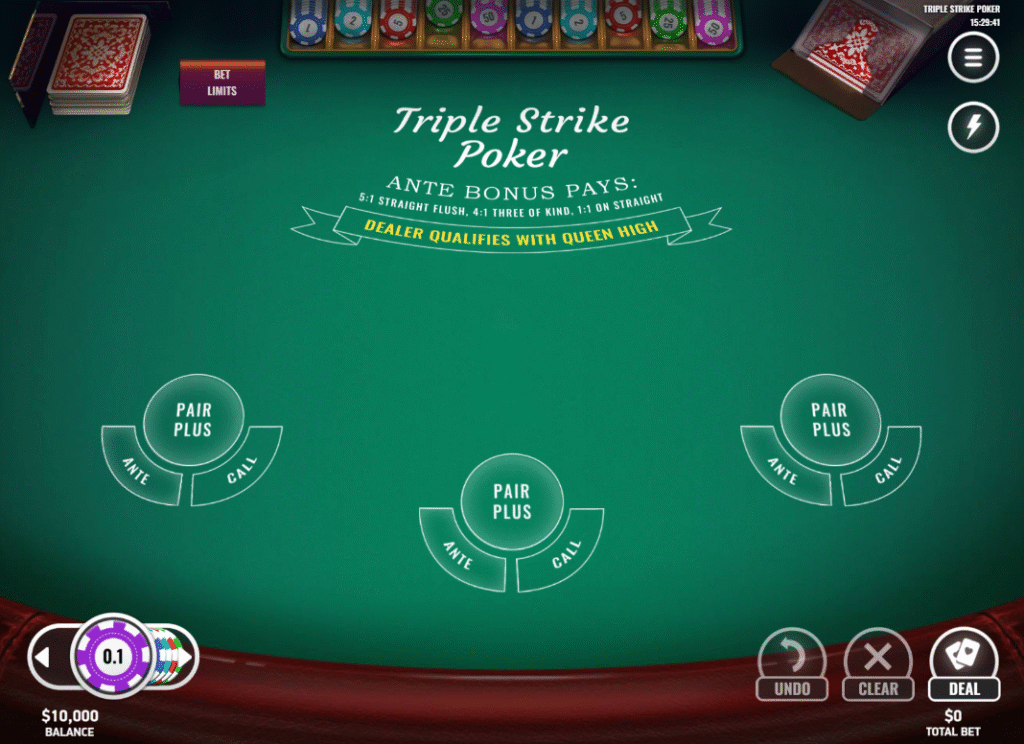
Triple Strike Poker follows a structured sequence that maintains steady pacing while requiring timely decisions. Each round begins with players placing an Ante bet on one or more positions. Simultaneously, players may opt for the Pair Plus side bet, which functions independently of the main game outcome. After bets are placed, three cards are dealt face-up to each active player position, while the dealer receives three face-down cards.
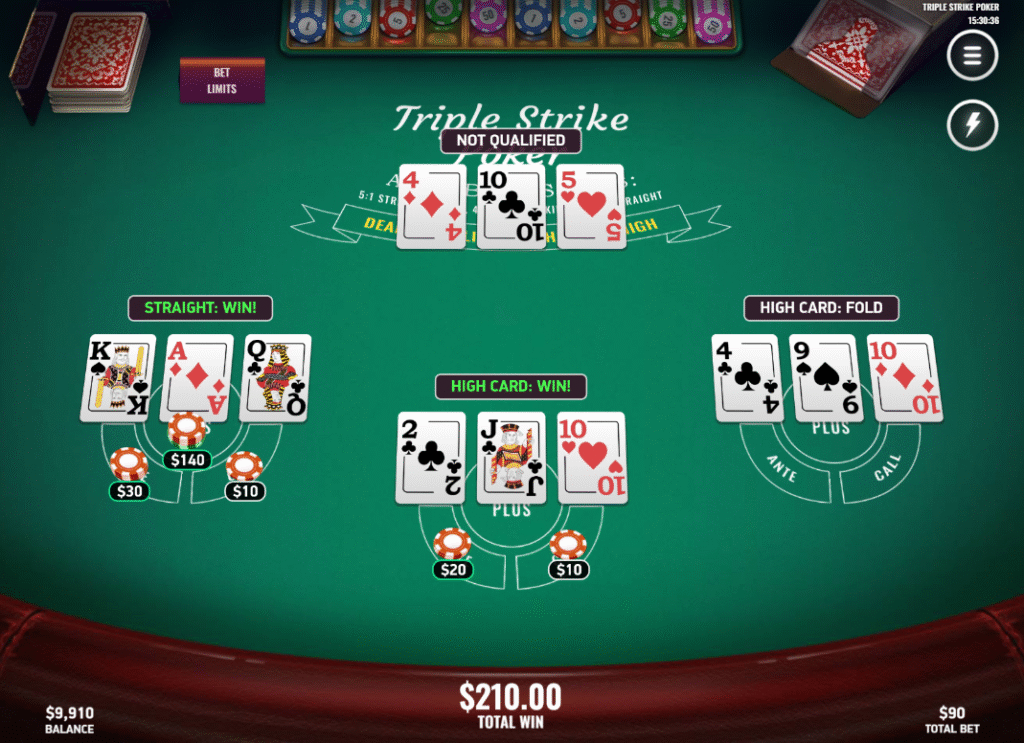
The decision point arrives after cards are revealed—players must either “Call” by matching their Ante bet or “Fold” and surrender their Ante. This pivotal choice hinges on hand evaluation and risk assessment. The Call option doubles the player’s investment but preserves the opportunity to win, while Folding minimizes losses when hands appear weak. Even when folding, any Pair Plus bets remain active and pay according to standard rules if qualifying combinations are present.
The dealer qualification rule adds another layer of strategy. The dealer must have Queen-high or better to qualify. When the dealer fails to qualify, the Ante automatically pays 1:1, and the Call bet is returned. This rule creates situations where marginal hands might be worth playing despite their apparent weakness—a fascinating strategic wrinkle rarely found in simpler card games.
Hand Rankings and Comparative Evaluation
Triple Strike Poker employs a modified ranking system tailored for three-card gameplay. The hierarchy, from strongest to weakest, consists of:
Straight Flush: Three sequential cards of the same suit (e.g., 10♠-J♠-Q♠) Three of a Kind: Three cards of identical rank (e.g., K♠-K♦-K♣) Straight: Three sequential cards of mixed suits (e.g., 9♦-10♥-J♠) Flush: Three non-sequential cards of identical suit (e.g., A♣-6♣-5♣) Pair: Two cards of identical rank plus one unmatched card (e.g., 10♥-10♦-A♠) High Card: Three unmatched cards with no sequence or suit pattern
This ranking system differs significantly from traditional five-card poker, where straights outrank flushes. The reordering acknowledges the probability shifts that occur when using only three cards. A straight flush becomes exceptionally rare and valuable in this format, while flushes become more common than straights.
When hands of identical rank occur, the comparison system becomes particularly nuanced. The highest card within the matching pattern determines superiority. If those are equal, the next highest card (the “kicker”) becomes decisive. For example, K-K-7 beats K-K-6 because the kicker (7) is higher than the opponent’s kicker (6). This tiebreaking mechanism rewards players who consider not just hand categories but also the specific card values within them.
Betting Structure and Payouts
Triple Strike Poker features a balanced payout structure that creates interesting risk-reward dynamics. The standard Ante payouts follow a graduated scale:
Straight Flush: 5:1 Three of a Kind: 4:1
Straight: 1:1 Flush: 1:1 Pair: 1:1 High Card: 1:1
The Pair Plus side bet offers significantly higher rewards for strong hands:
Straight Flush: 40:1 Three of a Kind: 30:1 Straight: 6:1 Flush: 4:1 Pair: 1:1
This dual payout structure creates an engaging tension. The standard game offers modest but reliable returns with a high RTP of 97.99%, while the Pair Plus bet presents opportunities for dramatic payouts but at a slightly lower RTP of 97.68%. This difference of 0.31% represents the statistical cost of pursuing larger wins—a common tradeoff in gambling mechanics that sophisticated players must evaluate based on their bankroll and risk preferences.
Strategic Approaches and Optimal Play
Successful Triple Strike Poker strategy hinges on understanding when to Call versus when to Fold. The optimal approach generally follows what poker theorists call the “Q-6-4 strategy”—Call when holding Q-6-4 or better, and Fold with weaker hands. This guideline derives from mathematical analyses of expected value across all possible three-card combinations.
However, several tactical nuances deserve consideration:
When holding marginal hands near the Q-6-4 threshold, the dealer qualification rule becomes crucial. If the dealer fails to qualify (happens approximately 33% of the time), the Ante pays automatically without the Call bet being evaluated. This creates positive expected value for borderline hands that might otherwise be folded.
The value of suited cards increases significantly in Triple Strike Poker. Not only do they contribute to potential flushes, but they also enable straight flushes—the highest-paying combination. When holding connected suited cards (like 8♥-9♥), the potential for completing powerful combinations may justify Calling despite falling below the general Q-6-4 threshold.
Pair Plus bets should be approached with careful bankroll management. While they offer substantial rewards, they operate independently of strategic decisions. Players seeking consistent results typically allocate a smaller portion of their total wagering to Pair Plus while maintaining standard Ante bets as their primary focus.
Technical Specifications
The Thunder feature merits special mention for players seeking maximum hands per hour. This accelerated mode reduces animation durations and transitional delays, allowing experienced players to increase their volume without sacrificing game integrity.
Return-to-player percentages are clearly documented, with the main game offering 97.99% RTP and the Pair Plus side bet providing 97.68%. These figures position Triple Strike Poker among the more player-favorable table games in the digital casino ecosystem.
Comparative Analysis Within the Three-Card Poker Genre
Triple Strike Poker belongs to the established three-card poker category that includes titles like Three Card Poker by Evolution Gaming and Tri Card Poker by various developers. Within this category, Platipus Gaming’s implementation distinguishes itself through several features.
The dealer qualification threshold (Queen high) in Triple Strike Poker represents a middle ground among similar games. Some variants require King high for dealer qualification, making it harder for dealers to qualify and increasing the frequency of automatic Ante wins. Others use Jack high, creating more qualified dealer hands. The Queen-high threshold strikes a balanced position that maintains game tension without excessive dealer advantages.
The Ante bonus structure in Triple Strike Poker differs from some competitors that offer “Ante Bonus” payouts regardless of dealer qualification or hand comparison outcomes. While Triple Strike lacks this feature, it compensates with higher payouts on premium hands in both the main game and Pair Plus structures.
The interface design emphasizes swift gameplay more prominently than some competitors. The Thunder feature, in particular, caters to volume-oriented players who value efficiency—an audience segment sometimes overlooked in more visually-oriented implementations.
Target Audience and Player Experience
Triple Strike Poker primarily appeals to analytically-minded casino players who appreciate mathematical edges and strategic decision points. The game’s dual betting tracks accommodate different approaches: the main game rewards hand-reading skill and proper fold/call decisions, while the Pair Plus option caters to those seeking higher variance and larger potential payouts.
The relatively simple ruleset with meaningful decisions makes Triple Strike Poker accessible to novices while retaining depth for experienced players. New players can follow basic strategies (like the Q-6-4 approach) to achieve reasonable results, then gradually incorporate more nuanced considerations as they gain experience.
The game’s pacing suits modern digital gambling preferences. With the Thunder feature activated, players can complete rounds in mere seconds—significantly faster than physical casino play. This efficiency appeals particularly to those who value volume and variance reduction through increased hand count.
The high RTPs (97.99% for main game, 97.68% for Pair Plus) position Triple Strike Poker as appropriate for serious players concerned with mathematical expectation. Few digital table games offer better theoretical returns, making this title noteworthy for advantage-focused players.
Triple Strike Poker effectively balances accessibility, strategic depth, and winning potential within the three-card poker format. The game distills poker’s essence into a streamlined experience without sacrificing the core mathematical and psychological elements that make poker compelling. Its dual-track betting structure accommodates different player preferences while maintaining reasonable house edges across both options. The dealer qualification rule creates interesting strategic situations where hand strength evaluation becomes contextual rather than absolute. For players seeking a mathematically sound table game with genuine decision points, Triple Strike Poker stands as one of the stronger offerings in the digital casino space. Its combination of strategic elements, favorable return percentages, and efficient gameplay creates a compelling package for both recreational players and serious advantage seekers. With its April 2025 release, Triple Strike Poker represents Platipus Gaming’s contemporary take on a proven casino format, enhanced with digital conveniences and balanced mathematics that should ensure its longevity in the competitive online gambling marketplace.