
A classic card game adapted into a slot format. Experience classic casino action in Three Card Poker by Boldplay. This fast-paced table game pits you against the dealer. Place your Ante bet and optional Pair Plus side bet for a shot at 40:1 payouts. With an optimal strategy RTP of 97.44%, the core challenge is simple: get a better three-card hand than the dealer. The game’s sleek design and straightforward rules make it perfect for both new players and seasoned card game strategists.
How to Play a Round of 3 Card Poker
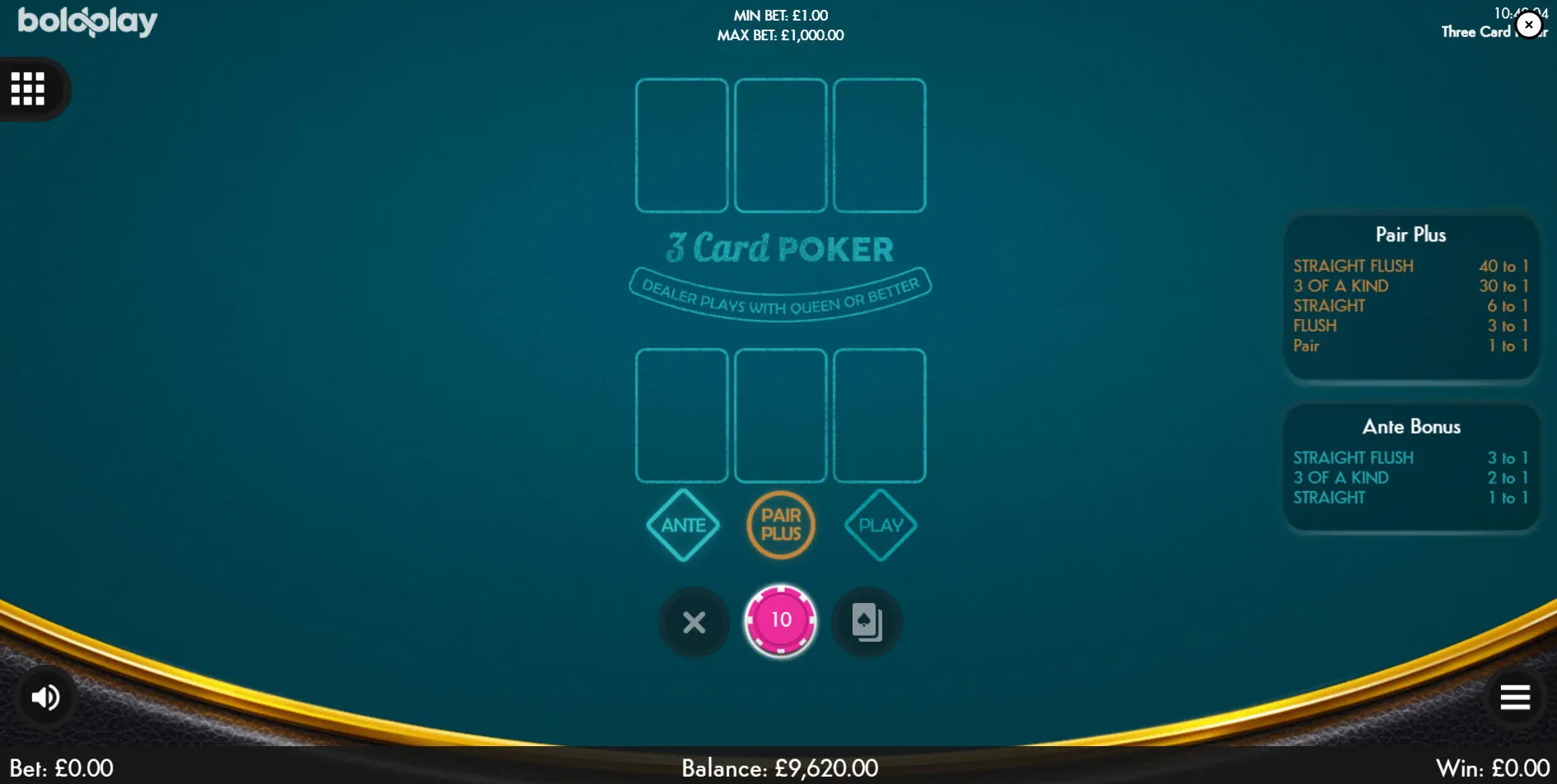
Playing a round involves placing a mandatory Ante bet to compete against the dealer. You then have the option to place a ‘Pair Plus’ side bet, which wins based only on the strength of your own hand. After the bets are placed and you receive your three cards, the game hinges on one choice: ‘Play’ by raising, or ‘Fold’ and forfeit your initial stake.
This simple game loop is the foundation of 3 Card Poker’s appeal. It’s a rapid cycle of betting, decision, and resolution. The game uses a standard 52-card deck that is shuffled before each round, ensuring every hand is a statistically independent event. The primary objective is to form a better three-card poker hand than the dealer, following standard poker rankings from a High Card up to a Straight Flush.
What is the Ante Bet?
The Ante is the initial, required wager you must place to receive cards and challenge the dealer’s hand. Winning this bet requires you to have a better hand than the dealer, who must have at least a Queen-high to qualify. This Dealer Qualification rule is fundamental; if the dealer fails to get a Queen-high or better, your Ante bet is paid 1:1, and your ‘Play’ bet is returned as a push, regardless of how strong your hand is.
If the dealer does qualify and you have the superior hand, both your Ante and Play bets are paid out at 1:1. If the dealer qualifies and has a better hand, you lose both bets. This qualification rule adds a crucial strategic element, as it provides a scenario where you can win even with a weak hand simply because the dealer failed to “open.”
How Does the Pair Plus Side Bet Work?
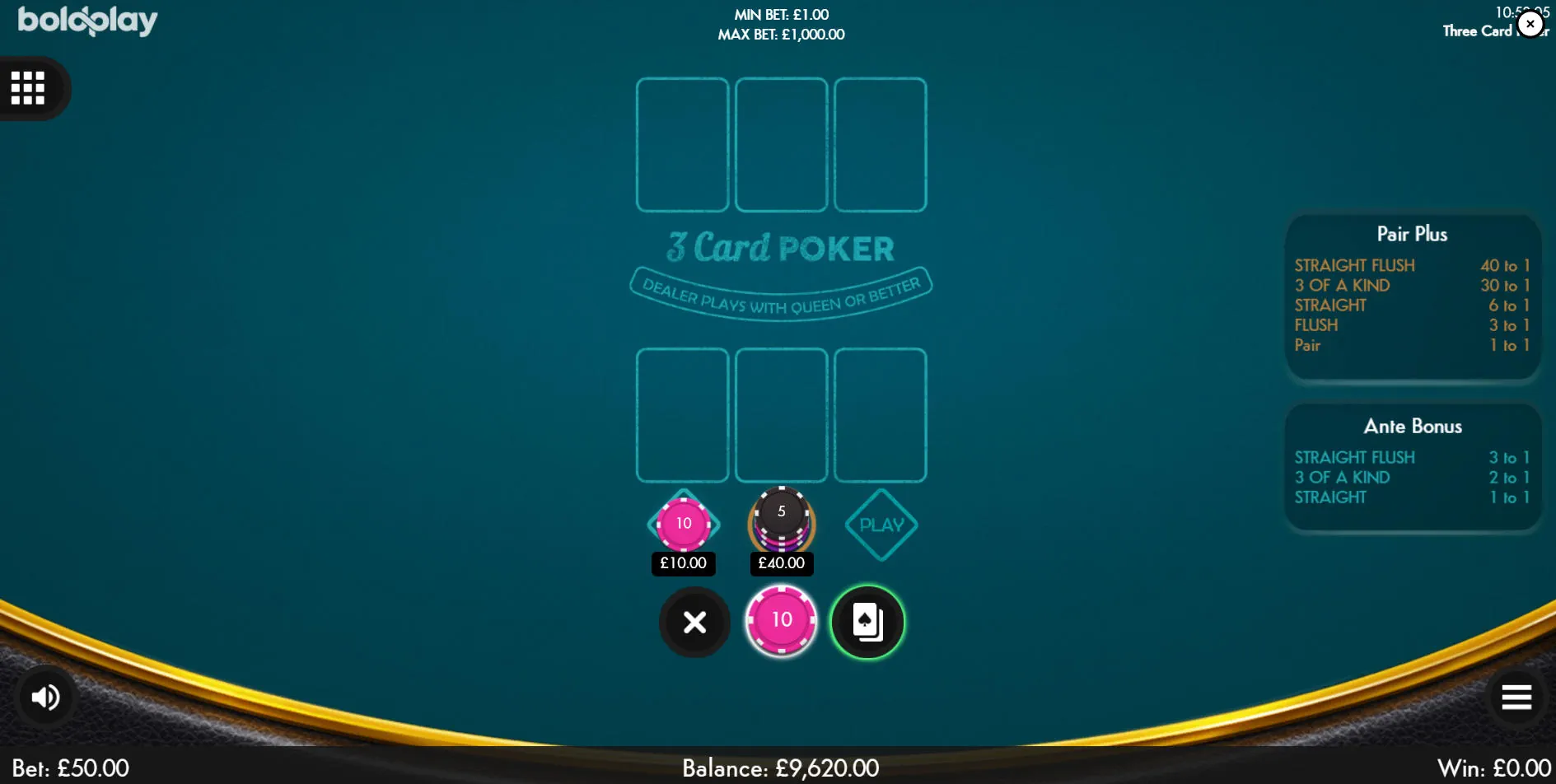
The Pair Plus is an optional side bet that pays out if your three-card hand contains a Pair or better. Its outcome is completely independent of the dealer’s hand, offering payouts up to 40:1 for a Straight Flush. This means you can lose your main Ante and Play bets but still secure a significant win from the Pair Plus wager if you’re dealt a strong hand.
This bet transforms the game’s dynamic. It functions as a separate, high-volatility game within the main one. The paytable for Pair Plus is clearly displayed, rewarding you for hands like a Pair (1:1), Flush (3:1), Straight (6:1), Three of a Kind (30:1), and the top-tier Straight Flush (40:1). It’s a bet on pure luck, turning any deal into a potentially high-payout event.
The Core Decision: Play or Fold?
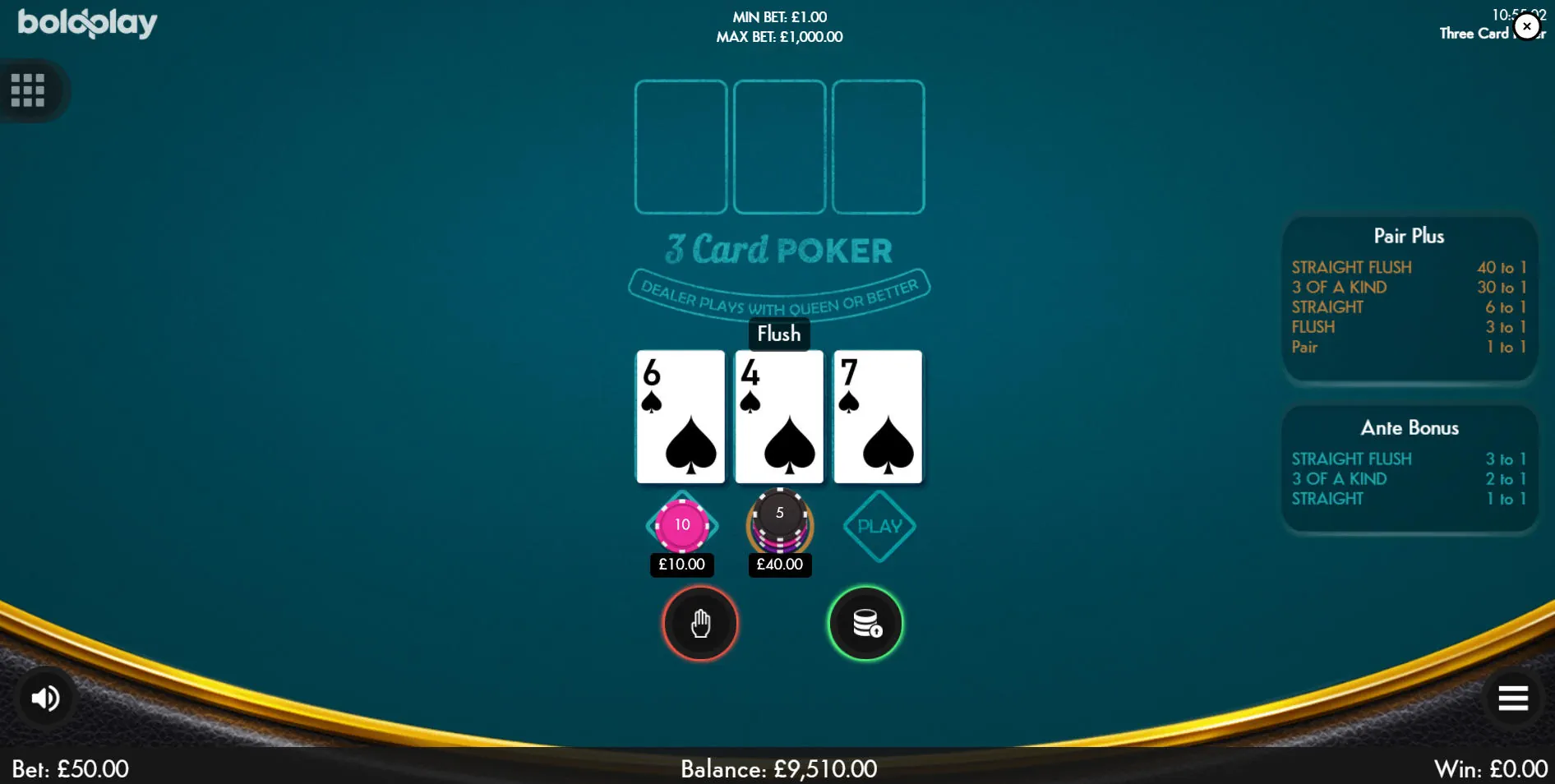
After seeing your cards, you must decide whether to ‘Play’ by matching your Ante bet, or ‘Fold’ to surrender your Ante. The mathematically optimal strategy advises playing any hand of Queen-6-4 or better. This is the single most important piece of strategy in the entire game.
Following this rule removes all guesswork. If your hand is, for example, Queen-5-3, it is technically weaker than the Q-6-4 threshold, and the correct mathematical play is to fold. Conversely, a hand like Queen-7-2 should be played. Committing this simple rule to memory is the most effective way to minimize the house edge and maximize your potential returns over time. It ensures you only commit your ‘Play’ bet in situations where you have a statistical advantage.
My 100-Hand Session: A Real Gameplay Experience
To test the flow and feel of Boldplay’s 3 Card Poker, I ran a 100-hand session focusing on optimal strategy. I stuck rigidly to the Q-6-4 rule for all my Ante bets and placed a small, consistent Pair Plus bet on every hand to experience both sides of the game. My starting balance in the demo was £10,000, and I set my Ante and Pair Plus bets at £10 each, for a total risk of £20 per hand when I chose to ‘Play’.
The pace is incredibly fast. Within minutes, I had cycled through dozens of hands. The Q-6-4 rule came into play constantly. I folded about 25% of my hands, which initially felt conservative but quickly proved its worth by saving me from committing a second bet on hopeless hands like Jack-8-3. The most frequent outcome was a loss on the Pair Plus bet, which is expected given its lower RTP. However, it paid off handsomely on three occasions: twice with a Flush (a £30 win each time) and once with a gratifying Straight (£60 win).
A key observation was the impact of the dealer’s qualification. On at least 10 occasions, my weak ‘Play’ hand (something like a King-high) won because the dealer showed a Jack-high and didn’t qualify. This is where the game’s edge is truly felt. After 100 hands, my balance stood at £9,850. The session resulted in a net loss of £150, largely driven by the Pair Plus bets that didn’t hit. The core Ante/Play game felt much more stable and predictable, confirming that the main game is a low-volatility grind while the side bet is the high-risk lottery ticket.
What Are the Payouts and House Edge?
The game’s payouts are split between the main Ante bet, which pays 1:1, and two bonus tables. Understanding the Return to Player (RTP) for each bet type is key to managing your expectations and bankroll effectively. The game’s design is transparent, with all potential payouts displayed directly on the main screen, ensuring you always know the potential rewards.
The two distinct RTP values published for the game are a direct reflection of its dual-bet structure. One number represents the optimal return on the base game, while the other reflects the higher-risk proposition of the Pair Plus side bet. This mathematical separation is crucial for any serious player to understand.
Decoding the Ante Bonus
The Ante Bonus is an extra payout on the Ante bet, awarded for strong hands like a Straight, Three of a Kind, or Straight Flush. This bonus pays out regardless of whether your hand beats the dealer’s. This is a powerful feature because it rewards you for premium hands even on the occasions when the dealer gets an even better one.
For example, if you are dealt a Straight, you automatically receive a 1:1 payout on your Ante bet from the Ante Bonus table. If the dealer has a lower hand, you also win the main Ante and Play bets. If the dealer has a better hand (like a Flush), you still lose the main bets, but you get to keep the Ante Bonus payout. The payouts are fixed: Straight pays 1:1, Three of a Kind pays 2:1, and a Straight Flush pays 3:1.
Vlad Hvalov: “The biggest trap in 3 Card Poker isn’t a bad hand; it’s mismanaging the Pair Plus bet. Treat it as a ‘lotto ticket’ side bet, not a core part of your strategy. Allocate maybe 10-15% of your session bankroll to it, and don’t chase losses on it. The main game’s high RTP is where your strategic edge lies.”
Is the 97.44% RTP for the Whole Game?
No, the higher 97.44% RTP applies specifically to the Ante/Play bet when using the optimal Q-6-4 strategy. The optional Pair Plus bet has a separate, lower RTP of 92.72%, reflecting its higher volatility and jackpot-style payouts. This nearly 5% difference in theoretical return is significant and highlights why the two bets should be considered as separate games.
The 97.44% RTP on the main game translates to a very competitive house edge of just 2.56%. However, this is only achievable by strictly adhering to the Q-6-4 strategy. Any deviation from this strategy, such as playing hands that should be folded, will increase the house edge and lower your personal RTP. The 92.72% RTP on the Pair Plus bet gives the house an edge of 7.28%, making it a far more costly proposition in the long run, balanced only by its potential for infrequent, large payouts.
Mastering the Q-6-4 Strategy
The single most important strategy in Three Card Poker is the ‘Queen-6-4’ rule. This simple guideline dictates the optimal mathematical decision for every hand you are dealt, minimizing the house edge. It is the dividing line between casual play and informed, strategic play, and mastering it is non-negotiable for anyone looking to play the game optimally.
The beauty of this strategy lies in its simplicity. Unlike the complex decision trees of Texas Hold’em, 3 Card Poker boils down to a single, binary choice that can be guided by this one rule. It was developed through computer simulations that analyzed millions of possible hand matchups to find the precise point of profitability.
What It Is: The Q-6-4 Rule
The rule is straightforward: you should ‘Play’ (raise your bet) if your hand is Queen-high, 6-high, and 4-high or better. If your hand is worse than this specific combination, you should ‘Fold’. Any pair, flush, straight, or three of a kind should always be played, as they are all stronger than Q-6-4. The rule is specifically for deciding on hands where your highest card is your only value.
For example:
- Q, 7, 2: Play. (The 7 is higher than the 6).
- Q, 6, 5: Play. (The 5 is higher than the 4).
- Q, 6, 3: Fold. (The 3 is lower than the 4).
- K, 2, 3: Play. (Any King-high or Ace-high is an automatic play).
- J, 10, 9: Fold. (Jack-high is always a fold, regardless of the other cards).
Why It Works: The Math Behind the Move
This specific hand, Q-6-4, represents the mathematical tipping point where the probability of winning against the dealer’s random range of qualifying hands becomes favorable enough to justify the additional ‘Play’ bet. When you place the ‘Play’ bet, you are risking another unit to win both the Ante and the Play bet.
Calculations show that with a hand worse than Q-6-4, the long-term expected value of folding (and losing only the Ante bet) is better than the expected value of playing. Even though you might sometimes win with a Q-5-2, over thousands of hands, you would lose more money by playing it than you would save by folding. The strategy is not about winning every hand; it is about making the decision with the highest long-term profitability.
What It Means for You: Practical Advantage
Consistently applying the Q-6-4 rule is the single most effective way for a player to reduce the game’s inherent house edge. It removes guesswork and emotion, ensuring you make the most profitable decision over the long term. By taking the guesswork out of your primary decision, you can focus more on bankroll management and your approach to the optional Pair Plus bet.
This disciplined approach is what separates strategic players from those who rely on gut feelings. In a game of fine margins like 3 Card Poker, sticking to the optimal strategy is what allows for longer play sessions and maximizes your chances of coming out ahead. It turns a simple game of chance into a game of applied skill. This game can be found in collections of Casino and Cards themed games, which can be seen on the page with an overview of all available themes on Respinix.
The Strategist’s Notebook: Key Facts
Beyond the basic rules lies a deeper layer of information about Three Card Poker. These facts cover its unique history, mathematical quirks, and its place within the broader world of casino games.
- Modern Invention: Unlike poker’s 19th-century origins, 3 Card Poker was invented in 1994 by Derek Webb in the UK.
- Initial Rejection: Webb’s game was initially rejected by UK casinos. He had to launch it in the United States, where it became a massive success.
- Dual Game Design: The game was specifically designed to have two parts (Ante/Play and Pair Plus) to appeal to both strategic players and those seeking jackpot-style payouts.
- Hand Frequency: The odds of being dealt a specific hand are fixed. A Pair is the most common valuable hand (16.94%), while a Straight Flush is the rarest (0.22%).
- The Push is Powerful: The dealer fails to qualify (get Queen-high or better) approximately 30.6% of the time, making the push on the Play bet a very common and important outcome.
- Not Truly Poker: While it uses poker hand rankings, it’s technically a casino table game, not a true “poker” game, because you play against the house, not other players.
- Strategic Simplicity: The entire optimal strategy is contained in the Q-6-4 rule, making it one of the easiest strategic table games to learn and master.
- Boldplay’s Take: Boldplay’s version focuses on a clean, digital-first presentation, with no superfluous animations, to maximize the number of hands played per minute.
- RTP vs. Reality: The stated RTP is a theoretical, long-term average. Short-term results can and will vary wildly, especially when using the Pair Plus bet.
- Global Standard: The rules and general paytables for 3 Card Poker are remarkably consistent across different providers and casinos worldwide.
- Player vs. Player Version: A less common variant called “Player’s Choice” 3 Card Poker allows players to bet against each other.
- Certified Fairness: Like all reputable online casino games, Boldplay’s 3 Card Poker is audited by independent labs like GLI or eCOGRA to ensure the card shuffling is truly random and the game operates fairly.
Boldplay has created a superb digital version of a casino classic. It’s fast, intuitive, and mathematically sound. The minimalist design is a strength, keeping the focus entirely on the strategic decision at the heart of every hand. While the Pair Plus bet should be approached with caution due to its lower RTP, it provides the thrill of a big payout that many players seek. For those who enjoy strategy-based table games, applying the Q-6-4 rule in the free demo version available on sites like Respinix.com is a perfect way to master the game. It is a faithful and expertly executed adaptation, typical of Boldplay’s focus on refined, player-centric table game experiences. I highly recommend it for both beginners and veterans of casino card games.
FAQ
What is the best strategy for Three Card Poker?
The best and simplest strategy is the ‘Q-6-4’ rule: always ‘Play’ if your hand is Queen-6-4 or better, and ‘Fold’ if it is worse. This minimizes the house edge.
What does ‘Dealer Plays with Queen or Better’ mean?
It means the dealer’s hand only ‘qualifies’ to play if it contains at least a Queen-high card. If not, the Ante bet wins 1:1 and the Play bet is returned as a push.
Is the Pair Plus side bet worth playing?
The Pair Plus bet offers high payouts (up to 40:1) for strong hands but has a significantly lower RTP (92.72%) than the main game, making it a higher-risk, higher-reward option.
What is the RTP in Boldplay’s Three Card Poker?
The game has a dual RTP: 97.44% for the main Ante bet when using optimal strategy, and 92.72% for the optional Pair Plus side bet.
Where can I play a free demo of Three Card Poker by Boldplay?
A free-to-play demo version of Boldplay’s Three Card Poker is available on the Respinix.com website.