
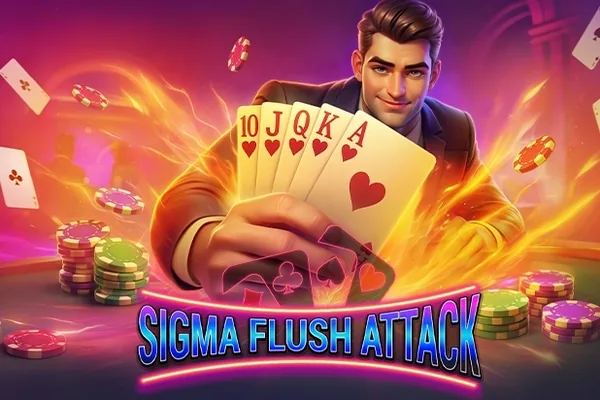
Sigma Flush Attack is a video poker-style table game from Arrows Edge built around five-card draw, a Flush Attack meter, and a progressive jackpot. It suits players who prefer steady pacing over violent variance, because the listed RTP is 96.05%, volatility is low, and the main tension comes from charging a boosted Flush instead of waiting for a wild bonus round. If old-school banking machines, Jacks-or-Better paytables, and blunt Double Up gambles sound appealing, this one makes more sense in demo play than in hype-driven expectations.
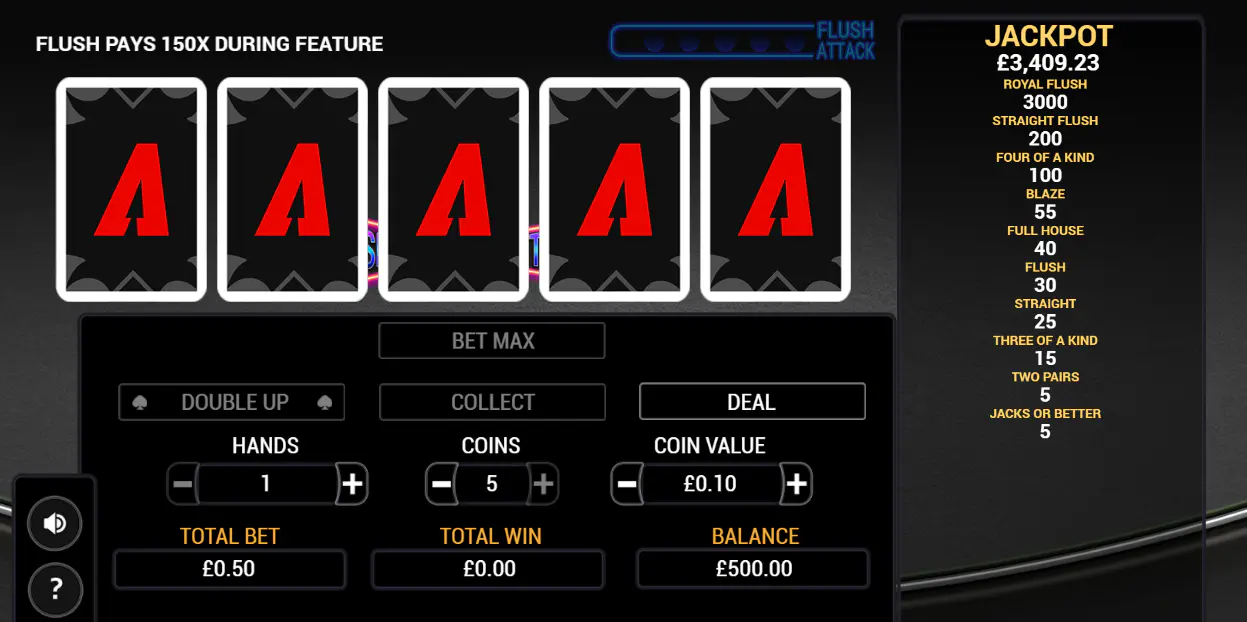
Flush Attack is the whole pitch. The game tracks Flush results and then turns the next qualifying Flush into a boosted score. One section points to a trigger after 3, 4, or 5 Flushes with the next Flush paying 100x or 125x. A screen inside the file pushes a harder claim: 5 Flushes on separate deals, then the next Flush pays 150x. That conflict matters. This machine sells one main idea, and the paper trail leaves that idea with two different faces.
I still like the feature. A jump from 30 to 150 means the boosted Flush hits at 5x the base Flush value. Put that next to a 600x top line and the feature reward alone reaches 25% of the posted maximum. That is a serious chunk of the ceiling. It also tells you what this game is not. It is not a slow-burn card title that suddenly blows the roof off with a huge endgame. It is a measured grind with one sharp bump built into the center.
The paytable keeps the machine honest. At 5 coins, Jacks or Better pays 5, Two Pairs pays 5, Three of a Kind pays 15, Straight pays 25, Flush pays 30, Full House pays 40, Blaze pays 55, Four of a Kind pays 100, Straight Flush pays 200, and Royal Flush pays 3000. The 3000 line against a 5-coin stake matches the stated 600x top win. No mystery there. The ugly part sits elsewhere. Blaze appears as a paying hand at 11, 22, 33, 44, and 55 across the bet ladder, yet the file never explains what Blaze means.
That missing definition is not a tiny paperwork flaw. This title runs on card logic and hard numbers. When one of the mid-tier hand names has no clean explanation, trust takes a hit. A player should not need to guess what a 55-payout hand means in a machine this stripped down. The rest of the paytable reads like clear math. Blaze reads like a loose screw.
The progressive jackpot adds another crackle to the setup. The file states that it may pay at any point while playing, even after a losing hand. One captured screen shows a jackpot ticker at 3,409.23 with a 0.50 total bet and a 500.00 balance sample. That is a strange fit with the listed 600x cap. The document never settles whether the progressive sits outside that ceiling or inside it. So the game posts a fixed top line, then leaves one door open.
I do not mind that tension. I mind the silence around it. A low-volatility machine with a random progressive after losing hands gets a nice little jolt of danger, but the rules should lock that down in one voice. Here they do not. You get a better sense of the game’s mood than of its exact contract. For a table-style release built on arithmetic trust, that is sloppy work.
The Double Up feature is much cleaner. After any winning round, you either collect or take a higher-card shot against one face-up dealer card and four facedown choices. Pick a higher card and the win doubles. Miss and the amount in play dies on the spot. The feature repeats more than once, and the document caps it at x100 max bet. That cap matters. It stops the side gamble from turning into a bottomless hole with no visible wall.
This is where the game gets mean in a good way. The base model runs on low volatility, the RTP sits at 96.05%, and the hand awards scale in tidy steps. Then Double Up drops a hard yes-no risk gate right after a win. You either bank it or push into pure greed. No fake strategy cloud hangs over that choice. It is blunt, quick, and more honest than many modern add-ons.
The interface does its job without theater. Hold markers sit over selected cards, the View More Hands button shows extra hands in groups of 5 by 5, the Back button returns to the single-hand view, and the screen space goes to hand count, coin value, total bet, total win, balance, and paytable. There is no visual fog here. That suits the game. When a title leans on delayed Flush value, hand volume, and one post-win gamble, clutter would only get in the way.
This design also narrows the audience fast. Players who want packed reels, animated symbols, and feature chains will bounce off in minutes. Players who like old banking-style poker machines, exact payout ladders, and a meter that fattens one target hand will settle in. The low-volatility tag backs that up. So does the 96.05% RTP. So does the 600x ceiling. Every major number points to repeat play with controlled heat rather than a huge one-shot smash.
There is also a limit to that comfort. Multi-hand settings go all the way to 100 hands. A calm variance tag does not save a careless bankroll when hand count jumps from 1 to 100 and the stake still carries up to 5 coins per round. The game gives the player enough rope right on the front panel. That is not a flaw. It is a reminder that low volatility and low damage are not the same thing.
No hit frequency is listed. No exact bonus frequency is listed either. The file hides both. I would have preferred those numbers in a game where the full sales pitch leans on how often Flushes build toward a boosted payout. Without them, the machine still reads well, but part of the timing remains under glass. You know the shape. You do not get the full map.
My view is simple. Sigma Flush Attack has a spine. The five-card draw base, the Jacks or Better floor, the 5-coin bet ladder, the 3000 top paytable line, the 600x posted max, the low-volatility tag, the random progressive angle, and the x100 Double Up cap all give it a clear identity. But the game also carries three ugly little dents: conflicting Flush Attack details, an undefined Blaze hand, and no published hit-rate data in the attached file. I would sit down with it for the meter chase and the clean card rhythm. I would not sit down with it expecting a giant ceiling or perfect rulebook discipline.
Cards Under the Lamp
This game leaves a better impression once the noise gets stripped away. The numbers show a focused machine, and the rough edges show where the documentation lost discipline. Both sides matter here. Ignore either one and the read gets soft.
There is also a nice old-school streak under the shell. The game stores anticipation in a tracked hand type instead of in a long bonus script, and that decision gives Sigma Flush Attack a different pulse from standard reel-based releases. It feels closer to a meter-fed poker cabinet than to a feature-stuffed slot with card art pasted on top.
- The game uses a single 52-card deck and standard five-card draw rules.
- Winning hands start at Jacks or Better.
- Hand volume runs through 1, 5, 10, 25, 50, and 100 hands.
- The bet ladder rises to 5 coins.
- Royal Flush pays 600, 1200, 1800, 2400, and 3000 across Bet 1 to Bet 5.
- Straight Flush tops out at 200, Four of a Kind at 100, Full House at 40, and Flush at 30.
- Flush Attack details conflict inside the same file: one path says 3, 4, or 5 Flushes for a 100x or 125x boost, another says 5 separate Flushes and then a 150x hit.
- The progressive jackpot may fire after a losing hand.
- Double Up starts only after a winning round and carries a x100 max-bet limit.