
Ricochet’s Saddle Up offers a strategic grid-based game experience with a clean, minimalist visual style. Gameplay unfolds on a 6×6 grid where players ascend by selecting tiles, moving upwards row by row. Each selection reveals either a safe passage, allowing continuation, or an eliminator tile, ending the round and forfeiting the stake plus accrued winnings. A core feature is the player-controlled volatility setting, chosen before each round, which dictates the range of potential final multipliers. Players constantly face the strategic choice to cash out accumulated gains after any safe reveal or risk proceeding for higher rewards. The objective culminates in reaching Row 6, where selecting a “Cup” applies its multiplier (up to 10x based on chosen volatility) to the winnings gathered during the climb. Saddle Up features a highly variable RTP between 96.31% and 99.19%, directly tied to player decisions on volatility and cashing out. This design provides a calculated, mechanics-focused challenge distinct from standard online slots.


The player-selected Volatility Level is perhaps the most influential factor shaping the gameplay dynamics in Saddle Up. There are five distinct levels, adjustable before initiating a round. This choice directly impacts the potential rewards available, specifically the multipliers associated with the Cups in the final row, and implicitly adjusts the underlying risk, likely by altering the distribution or frequency of Eliminator tiles across the grid.
The primary function of the volatility setting is to scale the randomised Cup Multiplier values located in Row 6. Higher volatility levels unlock access to significantly larger potential multipliers, but this comes at the presumed cost of a more challenging path (i.e., a higher chance of encountering Eliminators). The game rules specify the range of possible Cup multipliers for each volatility level, which are randomised for each new round:
Ricochet introduces Saddle Up, a game that deviates significantly from conventional reel-spinning slots. Instead, it presents a grid-based challenge focused on path selection, risk assessment, and strategic decision-making. Central to its design is a player-adjustable volatility system, allowing participants to tailor the risk-reward profile of each round before it commences. This structure positions Saddle Up more within the realm of “crash” or “mine” style games, offering a different kind of engagement for players accustomed to standard slot formats. The visual approach is functional and direct, prioritizing clarity of gameplay over elaborate thematic immersion. For seasoned players looking for alternatives to traditional slots, or those wishing to engage with mechanics-driven free slots online, Saddle Up provides a distinct framework.
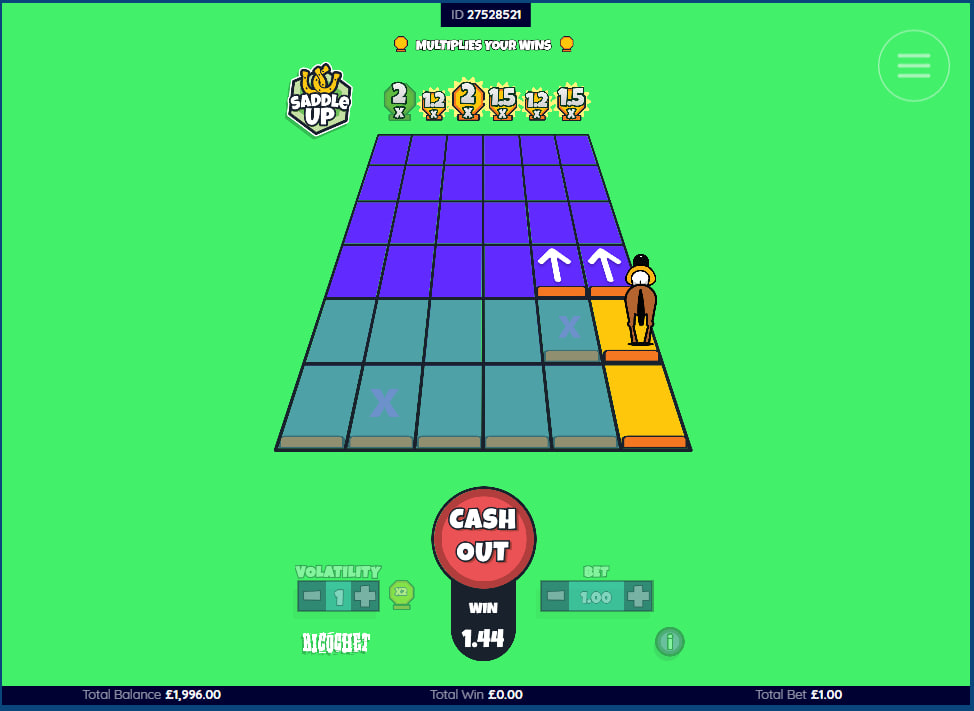
Navigating the Grid: Core Mechanics Explained
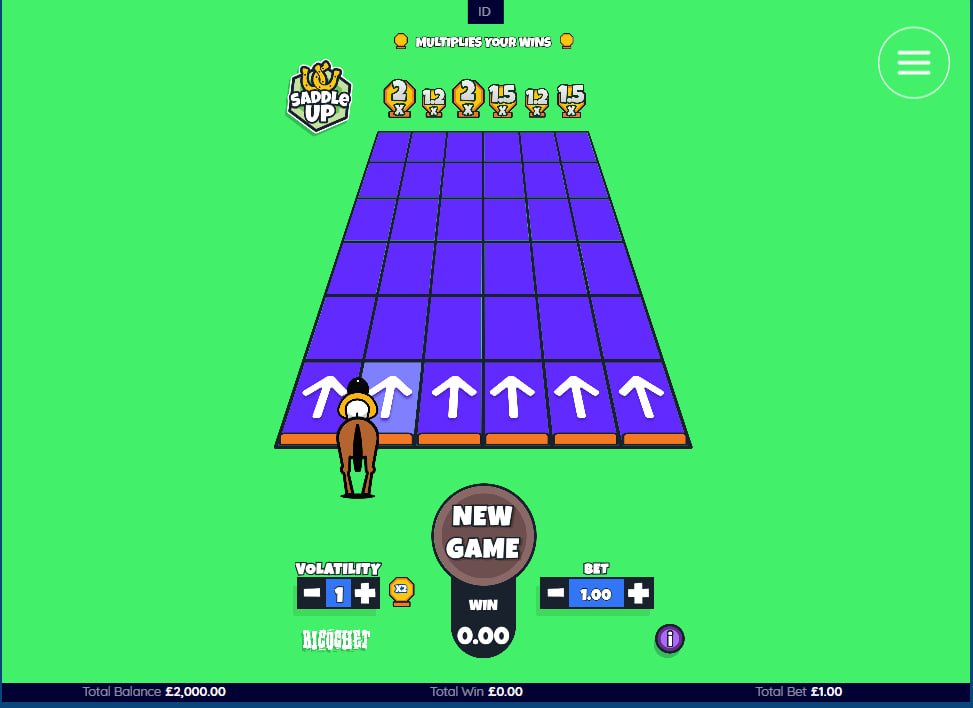
The fundamental structure of Saddle Up is built upon a 6×6 grid, arranged visually as a widening trapezoid leading upwards. The objective is straightforward: navigate a path from the bottom row (Row 1) to one of the designated “Cup” positions in the top row (Row 6). Gameplay proceeds in discrete steps, row by row. Each round begins with the player selecting one of the six tiles in the starting bottom row. This initial choice also effectively places the bet for the round.
Once a tile is selected and revealed, there are two possible outcomes:
Safe Tile: Depicted as a plain gold or yellow square. Revealing a Safe Tile allows the player to advance. Winnings accumulate with each successful step, calculated based on the initial bet and potentially influenced by the chosen volatility level (though the exact per-step accumulation formula needs close observation in practice). Crucially, a Safe Tile permits the selection of a tile in the next row up.
Eliminator Tile: Represented by a red ‘X’. Uncovering an Eliminator Tile immediately ends the game round. When this occurs, both the initial bet placed for that round and any winnings accumulated up to that point are forfeited.
Movement across the grid follows specific rules. After revealing a Safe Tile in a given row, the player must choose a connecting.2x, 1.5x, 1.5x, 2x, 2x.
Volatility Level 2: Cup multipliers can be 1.5x, 1.5x, 1.5x, 2x, 2x, 3x.
Volatility Level 3: Cup multipliers can be 2x, 2x, 2x, 3x, 3x, 5x.
Volatility Level 4: Cup multipliers can be 2x, 2x, 3x, 3x, 5x, 8x.
Volatility Level 5: Cup multipliers can be 3x, 4x, 5x, 6x, 8x, 10x.
It’s important to note that these multiplier values are randomised at the start of each round tile in the row directly above it. The game allows selections directly above the current position or diagonally adjacent in the next row. However, the rules note that “some [diagonal movements] may be restricted,” although the precise conditions for these restrictions are not detailed in the provided help text. This implies players need to observe the available highlighted options presented by the interface at each step. The maximum number of successful picks in a single round is six, corresponding to reaching the final row.
The Crucial Role of Volatility
and might not appear in sequential order across the cups in Row 6. This variability adds another layer of unpredictability. The selection of a higher volatility level fundamentally changes the strategic consideration: the potential payout ceiling increases substantially, but the likelihood of successfully reaching thatA defining characteristic of Saddle Up is its player-controlled volatility, adjustable via interface buttons before initiating a round. There are five distinct volatility levels. This selection is paramount as it directly influences the potential reward structure, specifically the multiplier values associated with the ” ceiling diminishes. Understanding this trade-off is key to engaging with Saddle Up effectively. The exact manner in which volatility affectsCups” located in the final (sixth) row.
Volatility Level 1: Potential Cup Multipliers include 1.2x, 1: The Final Multiplier Application
Successfully navigating through five rows of tile selections (requiring five successful Safe tile reveals) brings the player to the pinnacle.2x, 1.5x, 1.5x, 2x, 2x.
Volatility Level 2: Potential Cup Multipliers include 1.5x, 1.5x, 1.5x, 2x, 2x, 3x.
Volatility Level 3: Potential Cup Multipliers include 2x, 2x, 2x, 3x, 3x, of the grid: Row 6. This row doesn’t contain standard tiles but instead features the Cups. Each Cup displays 5x.
Upon reaching Row 6,x, 2x, 3x, 5x, 8x.
**Volatility Level the player selects one of the Cups. The multiplier shown on the chosen Cup is then applied to the total accumulated winnings 5: Potential Cup Multipliers include 3x, 4x, 5x, 6x, 8x, 10x.
These multiplier values are randomized for each new round and might not appear in a specific order. Successfully reaching Row** gathered during the ascent from Row 1 to Row 5. The precise mechanism for how winnings accumulate per step isn’t explicitly defined 6 and selecting a Cup applies its displayed multiplier to the total accumulated winnings from the previous five successful picks.
The rules as a visible multiplier per safe tile in the provided rules, but the core concept is that successful progression builds a base value also mention another set of fixed multiplier values associated with each volatility level (Level 1: 1.2x, Level 2: 1.4x, Level 3: 1.6x, Level 4: 1.8x, Level 5: 2.2x), stating they “remain the same from the 1st row to the 5th row.”, which is then subject to the final Cup multiplier. This final selection determines the total payout for the round. A round involves a maximum of six picks (one per row, culminating in the Cup selection), but as noted, it can end prematurely by The precise mechanical application of these fixed values in relation to the step-by-step accumulation or the final cup multiplier is not explicitly revealing an Eliminator or by the player opting to Cash Out. The maximum win achievable is capped at 515.5x the total bet elaborated upon in the base rules. It could relate to how the winnings accumulate per step, but the primary payoff clearly hinges, or a monetary ceiling of 250,000 GBP (or currency equivalent).
Strategic Decisions: Cashing Out
Integral to the gameplay loop, with RTP generally decreasing slightly the further one progresses before cashing out, reflecting the increasing cumulative risk).
The game is the Cash Out function. After any successful pick (revealing a Safe Tile), the player is presented with the documentation states an overall minimum RTP of 96.31% and a maximum RTP of 9 option to cash out their current accumulated winnings. This action immediately ends the current round, and the collected amount is secured. This9.19%. The exceptionally high RTP values associated with cashing out early (especially after Level 1) suggest a feature introduces the core strategic tension of Saddle Up.
At each step after uncovering a Safe Tile, the player faces a critical decision:
Continue: Risk the currently accumulated winnings and the initial bet for the chance to progress further up design that statistically rewards cautious play, while the allure of the large multipliers at the top tempts players into taking greater risks, which corresponds the grid, potentially reaching higher accumulated values and ultimately one of the Row 6 Cup multipliers.
Cash to scenarios closer to the minimum overall RTP. This variable RTP is a significant point of interest for experienced players who appreciate statistical Out: Secure the current winnings, ending the round and forfeiting the chance for larger multipliers but eliminating the risk of hitting nuances and strategic depth in their online slot or game choices. It underscores that player decisions directly influence the expected return over time, an Eliminator on subsequent picks.
This decision point makes Saddle Up a game heavily reliant on risk management and personal risk a characteristic not found in most standard slot machines.
Visual Presentation and Atmospheric Tone
Saddle Up adopts a starkly minimalist graphical tolerance. The optimal strategy is not fixed; it depends entirely on the player’s assessment of the situation, the chosen style. The game grid, tiles, and interface elements are rendered using simple geometric shapes and solid colors. There’s a distinct lack of intricate detail or volatility level, the potential multipliers visible at the top, and their individual approach to balancing risk versus reward. This aspect aligns it elaborate background scenery. A small animated horse figure progresses up the side of the grid, visually representing the player’s advancement closely with the psychological dynamics found in many crash-style games, where the temptation to push for higher returns battles against the prudence, which ties loosely into the “Saddle Up” name, suggesting a race track or steeplechase concept.
However of securing existing gains. Understanding this mechanic is fundamental when playing, whether engaging with free slots for practice or evaluating the game’, the overall aesthetic leans heavily towards function over form. The clarity of the grid, the distinct visual difference between Safe and Eliminator tiles (s structure.
Presentation and Interface
Saddle Up employs a minimalist and functional visual design. The screen is dominatedonce revealed), and the prominent display of volatility, bet, and potential winnings are paramount. This visual approach effectively strips away distractions, focusing the player’s attention squarely on the mechanical choices and risk assessment at hand. It won’t appeal to those by the geometric grid against a plain green background. Tiles are simple shapes with clear indicators: gold/yellow for Safe, seeking rich visual narratives or cutting-edge animation, but it serves the game’s tactical nature exceptionally well. The sound design includes red ‘X’ for Eliminator, and a Cup icon for the final row objectives. The path taken by the player is options to mute all audio or toggle background music separately from game sound effects, offering basic customization for the player’s auditory environment highlighted, and a small horse icon indicates the current position on the grid. Animations are direct and serve to communicate gameplay events.
Developer Insights and Game Suitability
Developed by Ricochet, Saddle Up stands out as an example of desviación – tile reveals, movement, and round termination – without unnecessary graphical flourishes. This approach focuses player attention squarely on the grid from standard slot templates. It blends elements reminiscent of classic “Mines” type games with adjustable volatility and multiplier mechanics often and the decision-making process.
The user interface is straightforward and positioned below the grid. It features clear buttons for adjusting the ** found in modern crash games or specialized slots. This hybrid approach results in a game that prioritizes player agency and strategic thinkingBet (+/-)** and Volatility (+/-). A large, prominent Cash Out button is centrally located, reflecting within a chance-based framework. The direct control over volatility and the constant availability of the Cash Out option empower players to tailor its importance in the gameplay loop. Standard displays for Total Balance, Total Bet, and Total Win are also present. An each round to their risk tolerance.
Sound design complements the minimalist aesthetic. Expect functional audio cues corresponding to tile selections, reveals RTP adds a layer of complexity that rewards thoughtful engagement. While the simple graphics might not capture everyone’s attention, the underlying (distinct sounds for Safe and Eliminator tiles), cash-outs, and possibly subtle background ambiance. Options to mute sound mechanics offer a compelling alternative for experienced players seeking a departure from traditional reel-spinning formats. The blend of pathfinding, risk management, and scalable rewards provides a mentally engaging experience where each click carries weight. It’s a design that respects player intelligence and offers genuine or just background music are typically included, catering to player preference. The presentation prioritizes function and clarity, ensuring the mechanics strategic choices within its defined rule set.