
Ricochet’s Cup Up presents a calculated grid-based gaming challenge distinct from typical online slots. Its minimalist, strategy-oriented atmosphere centers entirely on risk assessment across a 6×6 grid layout. Players select tiles aiming to ascend safely to the top row, avoiding hidden Eliminators. The core game involves making crucial decisions after each successful pick: cash out accumulated winnings or continue climbing for higher potential rewards. Gameplay intensity is shaped pre-round by selecting one of five volatility levels, impacting multipliers. This strategic title boasts a variable RTP, potentially reaching up to 99.19% based on optimal play, with a minimum of 96.31%. Successfully reaching the final row triggers the Cup Multiplier feature, applying a significant randomized multiplier to gathered winnings. Achievement can result in payouts reaching 515.5x the initial wager, subject to a maximum win cap.


Ricochet presents “Cup Up,” a title that diverges significantly from the conventional reel-spinning slot format. Instead of paylines and symbol combinations, players engage with a grid-based progression system reminiscent of classic mine-clearing challenges, but with a distinct gambling framework. This game centers around navigating a 6×6 grid, making sequential choices with the objective of reaching the top row to secure a potentially substantial multiplier on accumulated winnings. Key elements defining the experience include a mandatory pre-round volatility selection, the constant option to cash out after a successful step, and a clear, function-driven design. It’s tailored for the experienced player who appreciates strategic decision-making within a chance-based structure, those seeking engaging free slots for entertainment, or individuals aiming to understand nuanced game mechanics before considering real money play online.
Unpacking the Core Gameplay Loop
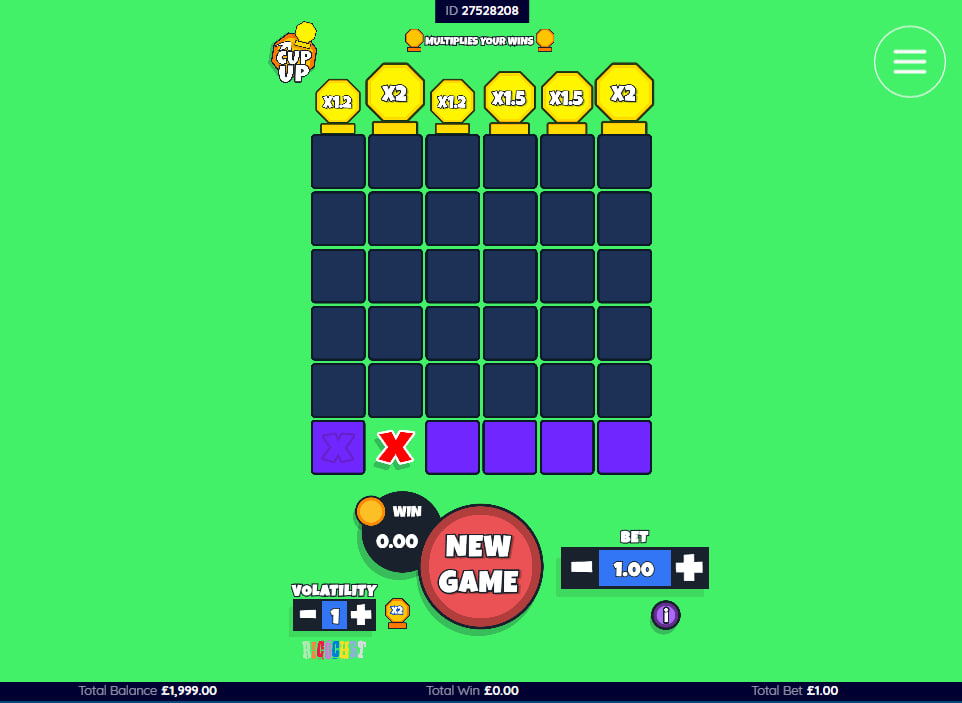
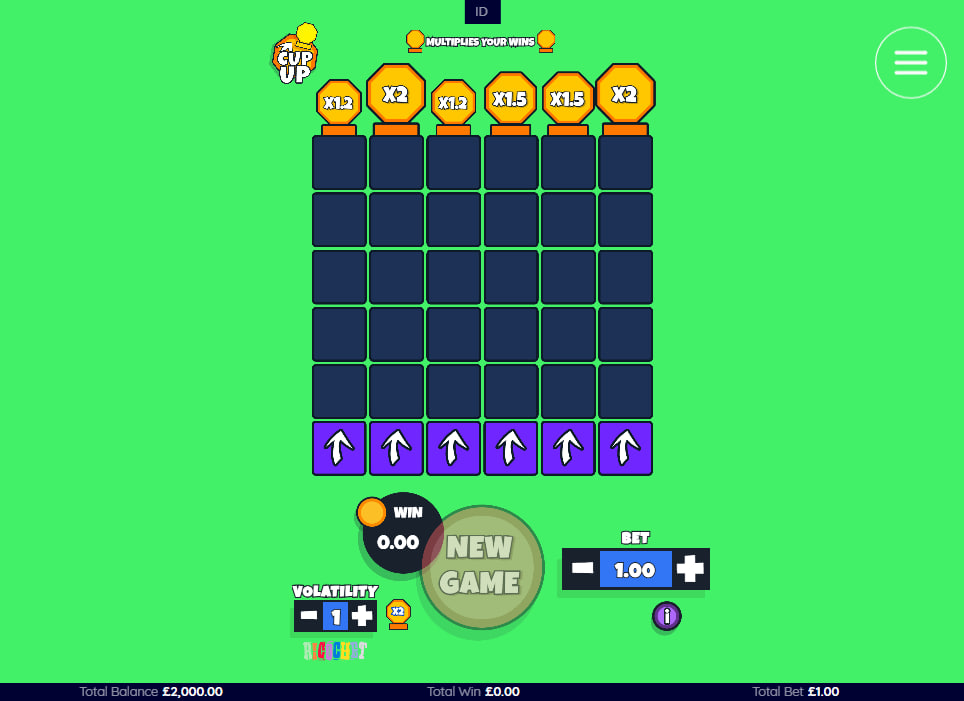
The fundamental process in Cup Up involves navigating a path upward through a 6×6 grid. Each round commences only after the player sets two parameters: the bet amount and the volatility level (ranging from 1 to 5). These choices are fixed for the duration of the round and cannot be altered once play begins. The game initiates when the player selects one of the six tiles in the bottom-most row (Row 1). This action also confirms the placement of the bet for that round.
Upon selection, a tile reveals one of two outcomes: a Safe Tile or an Eliminator. Discovering a Safe Tile allows the player to advance. They must then choose a tile in the subsequent row directly above or diagonally adjacent to the revealed Safe Tile. This step-by-step progression continues as long as Safe Tiles are uncovered. Each successful pick increases the potential accumulated winnings for the round. Conversely, revealing an Eliminator immediately ends the round. In this scenario, both the initial bet and any winnings accrued during that round are forfeited.
A defining characteristic of Cup Up is the Cash Out option. After any successful reveal of a Safe Tile, the player faces a critical decision: secure the current accumulated winnings by pressing the “Cash Out” button, thereby ending the round voluntarily, or risk those winnings by picking another tile in the next row to potentially increase the payout further. This mechanic introduces a continuous element of risk management, placing control in the player’s hands at each stage of progression. An interesting feedback mechanism occurs when moving forward: the unchosen tiles in the row just vacated are revealed, displaying the positions of the Eliminators that were avoided. This doesn’t influence future picks but provides transparency about the risks that were bypassed.
Volatility Selection and Its Consequences
Before any tile is picked, the player must select one of five distinct Volatility Levels. This decision is paramount as it dictates the potential reward scaling and implicitly influences the risk distribution across the grid for the upcoming round. The chosen volatility level directly impacts two types of multipliers within the game: fixed row multipliers and randomized cup multipliers. Once selected, this level remains constant until the round concludes either by cashing out, hitting an Eliminator, or reaching the top row.
It’s important to note that the specific multipliers assigned to the six cups at the top are randomized for every round and might not appear in any specific order. Choosing a higher volatility level increases both the fixed row multipliers and the potential ceiling of the cup multipliers, indicating a higher-risk, higher-reward strategy. Lower volatility levels offer more modest multipliers, suggesting a potentially steadier, lower-risk approach. This pre-round strategic choice is a significant departure from standard slots where volatility is typically a fixed characteristic of the game itself.
The Multiplier System Explained
Understanding how multipliers function and winnings accumulate is key to appreciating Cup Up’s structure. The game involves two distinct phases of potential reward multiplication. First, as the player successfully reveals Safe Tiles and ascends the grid from Row 1 towards Row 5, the fixed multiplier associated with their chosen Volatility Level comes into play. The game rules state “accumulating winnings” as progression occurs.
The second, more impactful multiplication phase occurs only if the player successfully navigates all five lower rows and chooses a tile in Row 6 – the Cup row. Reaching this final stage allows the player to select one of the six Cups displayed at the top. Each Cup holds one of the randomized multiplier values determined by the pre-selected Volatility Level for that specific round. The multiplier revealed behind the chosen Cup is then applied to the total accumulated winnings gathered during the ascent through Rows 1 to 5. This final multiplication can significantly increase the round’s total payout, representing the ultimate goal of the progression.
For instance, imagine a player chose Volatility Level 3 (1.6x fixed multiplier, Cup multipliers range 2x-5x) and successfully navigated to Row 6, having accumulated a hypothetical value of $10 during the climb. If they then select a Cup revealing a 5x multiplier, the final payout for the round would be $10 * 5 = $50. This highlights the importance of reaching the top row for the largest potential rewards, balanced against the ever-present risk of hitting an Eliminator on any pick, which would forfeit the accumulated $10 and the initial bet. The fixed row multipliers (1.2x to 2.2x) seem to serve more as benchmarks for the increasing potential value as one climbs, rather than applying cumulatively in a complex way before the final cup phase. The primary accumulation appears linear with the bet, potentially with minor row-based increments, leading up to the major multiplication event at the Cup stage.
Atmosphere, Design, and User Interface
Cup Up adopts a highly functional and minimalist design approach. The visual focus is entirely on the 6×6 grid, the state of the tiles (unrevealed, Safe, or Eliminator), and the multiplier values displayed on the Cups at the top. There’s no elaborate background narrative, character animation, or thematic dressing typically found in video slots. The color scheme appears simple, likely using contrasting colors for clear differentiation between safe zones, danger zones (Eliminators, often marked with a red ‘X’), and potential rewards (Cups). This spartan aesthetic ensures that player attention remains fixed on the core gameplay mechanics and the critical decisions required.
The user interface elements are straightforward and clearly labeled. Buttons for adjusting the Bet (+/-) and Volatility (+/-) are present, allowing players to set their parameters before starting a round. A prominent “New Game” button likely resets the grid for a new round after one concludes. The “Cash Out” button is strategically important, enabling players to collect winnings at any point after a successful pick. Standard displays for Total Balance and Total Bet provide essential financial information. Sound and Music controls are available, allowing players to mute effects or background music independently, catering to individual preferences.
The overall atmosphere is one of calculated risk rather than immersive fantasy or adventure. The animations are expected to be functional, likely involving simple tile reveals and perhaps a more pronounced effect when an Eliminator is hit or when a Cup multiplier is applied. The design prioritizes clarity and usability, ensuring that players can easily understand the game state and make informed decisions without visual clutter. This practical approach aligns well with the game’s nature as a strategic exercise in risk versus reward.
Understanding the Game’s Structure and Risk Mechanics
The structure of Cup Up is built around the 6×6 grid and the binary outcome of each tile selection: Safe or Eliminator. Movement is constrained to forward-vertical or forward-diagonal steps, preventing lateral or backward movement. This directed path reinforces the sense of progression towards the goal at the top row. The limited movement options, particularly near the grid’s edges, can sometimes funnel choices, adding a subtle layer to the navigation strategy.
The core risk mechanic is unambiguous: revealing an Eliminator results in the loss of the stake and all accumulated winnings for that round. This creates inherent tension with every pick, especially as the accumulated potential winnings grow with each successful step. The player’s primary tool for managing this risk is the Cash Out feature. Deciding when to cash out versus pushing forward for potentially higher rewards is the central strategic dilemma of the game. This decision depends heavily on the player’s risk tolerance and their assessment of the current situation, influenced by the chosen volatility level and the number of steps already successfully taken.
A particularly noteworthy aspect of Cup Up, detailed in its rules, is its variable Return to Player (RTP). Unlike most traditional slots with a single, fixed RTP value, Cup Up’s RTP changes based on the player’s actions, specifically when they choose to cash out and the selected Volatility Level. The game information provides specific RTP examples:
At Volatility 1, cashing out after reaching Level 2 yields an RTP of 98.5%.
At Volatility 1, cashing out after reaching Level 3 yields an RTP of 98.0%.
Similar variations exist for other volatility levels and cash-out points (e.g., Volatility 5 showing 98.5% for Level 2 cash-out).
The game states a maximum possible RTP of 99.19% and a minimum RTP of 96.31%. This wide range, conditional on player strategy, is highly unusual for online slot games and positions Cup Up closer to theoretical models seen in some strategy-based gambling games or optimized video poker play. It implies that certain patterns of play (likely involving specific volatility choices and cash-out timings) can theoretically yield a very high return percentage, while less optimal strategies result in a lower, though still respectable, minimum RTP.
Finally, the game specifies a maximum win multiplier of 515.5x the total bet. Additionally, there’s an absolute maximum winning cap per single game round set at 250,000 GBP (or currency equivalent). This cap acts as an upper limit regardless of the bet size and achieved multiplier if the calculated win exceeds this threshold. Standard clauses regarding game malfunctions voiding pays and plays, the fairness of the Random Number Generator (RNG), and procedures for interrupted games are also included, ensuring operational transparency. Ricochet has engineered a game where player interaction significantly shapes the risk and potential reward profile within defined mathematical boundaries.