
Pinoy Bet Games’ Pixie Magic: Color Game offers a substantial deviation from conventional online slot formats. The game presents a serene atmosphere, evoking the feeling of a magical fair at twilight, with a focus on functional design over narrative. It discards the standard reel and payline structure in favor of a straightforward three-dice mechanic. The core gameplay centers on predicting which colors will land on the dice after each community roll. Its most defining element is the social betting interface, which provides real-time statistics on player wagers and color frequencies. Wins are determined by the quantity of matching dice, activating a tiered payout system. This structure awards multipliers of 2x, 3x, or up to 4x the bet amount for one, two, or three matches respectively. This design fosters a fast-paced, data-centric experience for players who value statistical analysis and community interaction.


Pinoy Bet Games presents an interesting proposition with Pixie Magic: Color Game. At first glance, the title might suggest another entry into the crowded fantasy-themed slot market. However, this assumption is quickly dispelled. The game forgoes reels, paylines, and traditional symbol matching entirely, opting instead for a multiplayer, dice-based color prediction format. This design choice places it in a category closer to live casino table games or classic carnival attractions, but with a streamlined digital interface and a compelling social component. It’s a deliberate move away from the isolated experience of typical online slots, focusing instead on shared outcomes and community-driven data. This review will analyze the game’s social mechanics, core gameplay loop, visual presentation, and the strategic considerations that arise from its distinct structure.
A Community-Driven Experience: Analyzing the Social Features
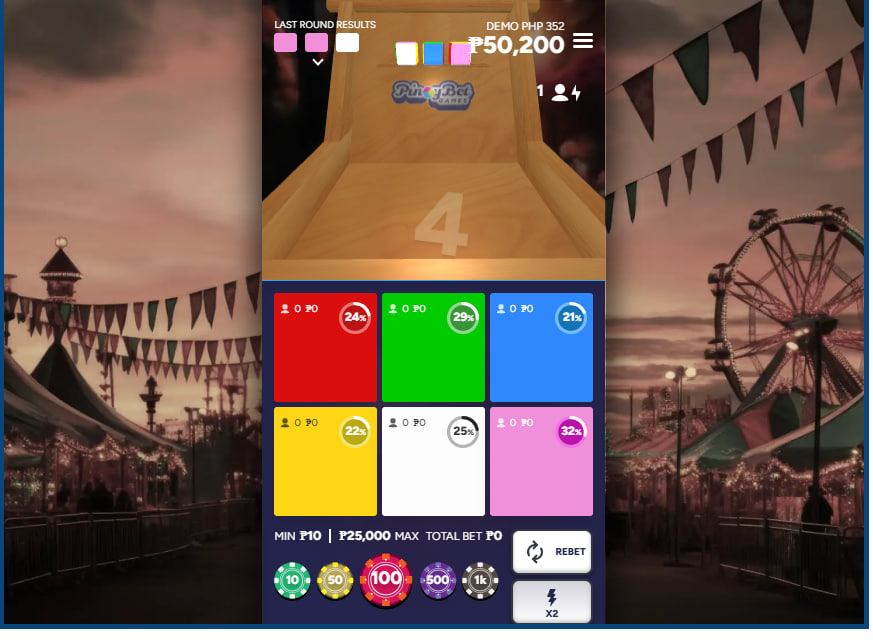
The most defining characteristic of Pixie Magic: Color Game is its foundation in a shared, live environment. Unlike the vast majority of online casino games that provide a solitary session against a random number generator, this title creates a communal space. The interface prominently displays an icon indicating the number of concurrent players, immediately establishing that each round’s outcome is a collective event. This simple piece of information transforms the activity from a private wager into a public spectacle, where one’s success or failure is shared with a group of anonymous peers. This fosters a sense of participation in something larger than oneself, a feeling more commonly associated with live dealer baccarat or roulette tables.
The social integration goes far beyond a simple player count. The game provides two critical data points for each of the primary colors available for betting. First, it shows the number of players who have placed a wager on a specific color. Second, it displays the total bet amount accumulated on that color from all participants in the current round. This transparency is the game’s strategic core. It presents players with a constant dilemma: follow the majority’s sentiment, a concept often called “the wisdom of the crowd,” or adopt a contrarian approach by betting against the prevailing trend. Seeing a large amount of money and a high number of players on a single color might suggest a shared intuition, or it could present an opportunity for a higher relative return if the less popular colors appear. This layer of social psychology adds a dimension of thought that is absent in standard slot gameplay.
Further enhancing this data-driven approach is the statistical percentage display. This feature shows the frequency with which each color has appeared over a recent series of rounds. For the analytically minded player, this functions as a history tracker, similar to the hot/cold number boards in roulette. While fundamentally, each dice roll is an independent event, this tool caters to players who employ pattern-seeking strategies. They can choose to bet on “hot” colors that are appearing frequently or gamble on “cold” colors that they believe are statistically “due” for an appearance. The combination of live betting data and historical frequency statistics creates a rich information environment that invites analysis and tactical decision-making before each round begins.
Deconstructing the Core Gameplay and Payouts
The mechanics of Pixie Magic: Color Game are direct and easy to comprehend, standing in stark contrast to the often convoluted bonus features and payline structures of modern video slots. The game revolves around the outcome of a three-dice roll. Instead of symbols, each face of the dice is a solid color. The player’s objective is to predict which color or colors will appear on the dice after they are rolled. Before each round, players can place wagers on up to three different colors, distributing their total stake as they see fit. This allows for a degree of risk management; a player might place a larger bet on a color they feel is likely and smaller bets on two others to hedge their main wager.
The payout system is tiered and directly correlated to the number of dice that match the player’s chosen color. The structure is clear and unambiguous, which is a commendable aspect of the game’s design.
Three Matching Dice: If all three dice land on a single color that a player has wagered on, the payout is 4x the bet amount placed on that specific color.
Two Matching Dice: If two of the three dice show the same color, any wager on that color receives a 3x payout.
One Matching Die: If only one die corresponds to a color the player has bet on, the payout is 2x the bet amount.
No Match: If a player wagers on a color that does not appear on any of the three dice, that specific wager is lost.
To illustrate, consider a player who places a wager on Red and a separate wager on Green. If the dice roll results in two Red dice and one Blue die, the player’s bet on Red is multiplied by three. The wager placed on Green is lost, as Green did not appear. This simple, multiplicative system makes it easy to calculate potential outcomes and understand the value proposition of each bet. The game is not about triggering complex cascades or free spin rounds; it is a straightforward game of chance and probability, amplified by the social data available.
Visual Presentation and Thematic Elements
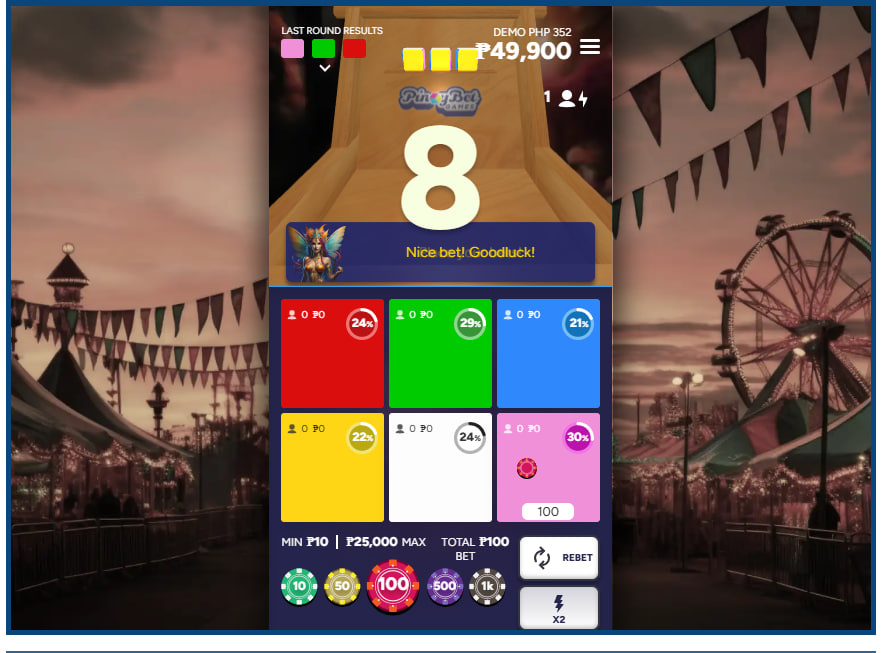
The “Pixie Magic” theme is applied with a light touch, serving more as a backdrop than a central narrative element. The visual environment suggests a festive, outdoor setting at dusk, perhaps a magical fair or night market, with strings of pennant flags visible in the background. The color palette is dominated by deep purples and blues, creating a calm and focused atmosphere that allows the vibrant colors of the betting options and the dice to stand out. This design choice prevents the theme from becoming distracting, ensuring that the player’s attention remains on the crucial game information and betting interface. The visual focus is clearly on utility and clarity rather than on immersive storytelling.
The user interface itself is modern and clean. Information is presented logically, with the social statistics, betting options, and history tracker all clearly demarcated. Animations are likely to be centered on the dice roll, which is the climactic moment of each round. A well-executed dice animation—one that feels weighty and random without being overly slow—is critical to the game’s pacing and satisfaction. Pinoy Bet Games appears to have prioritized a design where data is king. The numbers, percentages, and betting amounts are given visual prominence over any thematic character or elaborate graphical effect.
This approach is a departure from many contemporary games that rely on high-fidelity animations and cinematic sequences to retain player interest. Here, the engagement comes from the rapid succession of rounds and the constant stream of new data from the community. The aesthetic is functional and efficient, catering to a player who values quick access to information and a fast-paced betting cycle. It is a pragmatic design that respects the player’s desire to analyze and act without unnecessary visual clutter.
The user interface includes several features designed for convenience and to streamline the betting process, which is important in a game with quick rounds. The Rebet button allows players to instantly place the same bets on the same colors as the previous round. This is particularly useful for players employing a consistent strategy or who simply wish to continue with their previous choices without manually re-entering them. Alongside this is the x2 button, which doubles the current bet amounts on the selected colors. This feature facilitates simple progressive betting strategies, allowing players to easily increase their stake after a loss or a win without needing to adjust bet levels manually.
While the game’s foundation is chance, the available information allows for several strategic approaches. A player can be a “populist,” always betting with the largest group of players and the most money. Conversely, a “contrarian” strategy involves betting on the least popular colors, operating on the theory that a win on those colors provides a greater sense of outsmarting the crowd. A third approach is purely analytical, relying on the historical color percentages to identify trends or bet on statistical deviations. The interplay between the social statistics and the simple probability can be nuanced. If the function of the community betting display is not immediately clear, launching the demo Pixie Magic: Color Game version and accessing the in-game help file (often marked with an ‘i’ icon) will provide the developer’s official, detailed explanation.
Ultimately, the strategy in Pixie Magic: Color Game is one of bankroll management and interpreting external data rather than reacting to symbols on a reel. Players must decide which information source—the crowd’s bets, historical data, or pure gut feeling—they trust the most. This decision-making process, repeated every round, is the central pillar of the game’s long-term appeal for a thinking player.
The Developer’s Approach: A Departure from Conventional Slots
With this title, Pinoy Bet Games demonstrates a clear intent to innovate outside the confines of the traditional slot machine format. Pixie Magic: Color Game is a successful blend of classic dice game probability with modern, online social features. It taps into a different player psychology than most slots, one that thrives on community, shared experience, and data analysis. The design acknowledges that for some players, the thrill comes not from intricate bonus mechanics but from predicting the outcome of a simple, transparent event within a live, competitive environment.
By stripping away common features like wilds, scatters, and free spins, the developer places all the emphasis on the core prediction mechanic. This creates a game that is accessible to novices but contains enough statistical and social depth to engage seasoned players, particularly those with a background in table games like Sic Bo or Roulette. The choice to make betting data and player counts transparent is a bold one, as it directly influences player behavior and forms the basis of the game’s interactive loop.
This focus on communal play and transparent statistics makes Pixie Magic: Color Game a noteworthy entry in the online gaming space. It successfully carves out a niche for players who value direct mechanics and social interaction over complex bonus rounds and narrative-heavy slot experiences. It serves as a strong alternative for anyone looking to play online games that offer a different kind of engagement, one based on collective participation and simple, elegant rules.