
Cluster Pays Explained for Beginners
If you are new to online slots, Cluster Pays games can feel unusual at first because they do not rely on traditional paylines. Instead of matching symbols across fixed lines, these slots usually pay when matching symbols land in touching groups, or clusters.
That simple change makes the format feel very different from classic slots. In a traditional game, you often look left to right across the reels, while in a Cluster Pays slot you look for connected groups of the same symbol instead.
For beginners, that is the easiest way to understand the format. Cluster Pays is not about following lines. It is about spotting symbol connections.
What Cluster Pays means
A Cluster Pays slot forms wins through groups of matching symbols that touch each other on the grid. That means the layout of the screen matters more than the idea of fixed lines. The game is usually designed to make you read the board as one connected space instead of as separate reels with preset win paths. This is why Cluster Pays slots often feel more visual once you understand the rule. You stop asking, “Did that land on a payline?” and start asking, “How big is that cluster?”
How Cluster Pays slots work
Most Cluster Pays games use a grid-style layout instead of a standard payline structure. When enough matching symbols connect to form a valid cluster, the game awards a win.
The minimum cluster size depends on the slot, which is why the paytable matters so much in this format. For example, Respinix pages for Cluster Gems and Fiesta Clusters describe wins from 5 or more adjacent matching symbols, showing how the threshold is built into the game rules.
After a winning cluster lands, many Cluster Pays slots use cascades or tumbles. Respinix examples such as Cluster Gems and Fruit Party 2 describe winning symbols disappearing and new ones falling in, which can create additional wins from the same paid spin.
For beginners, that means one spin may contain more than one result. A win can trigger another symbol drop, then another cluster, and sometimes another modifier on top.
Why Cluster Pays feels different
The biggest difference is where you focus your eyes. In a payline slot, you look across lines. In a Cluster Pays slot, you look for shape and connection.
This changes the whole rhythm of the game. Traditional slots often feel more structured because the winning paths are fixed, while cluster games feel looser and more dynamic because each screen creates a fresh pattern across the grid.
That is also why Cluster Pays often appears alongside cascades, multipliers, or expanding grids. Respinix examples in this category include tumbling wins, multiplier ladders, dynamic grids, and expanding board features.
For a beginner, the key point is simple: Cluster Pays slots are usually more about pattern recognition than line tracking.
Cluster Pays vs paylines and Megaways
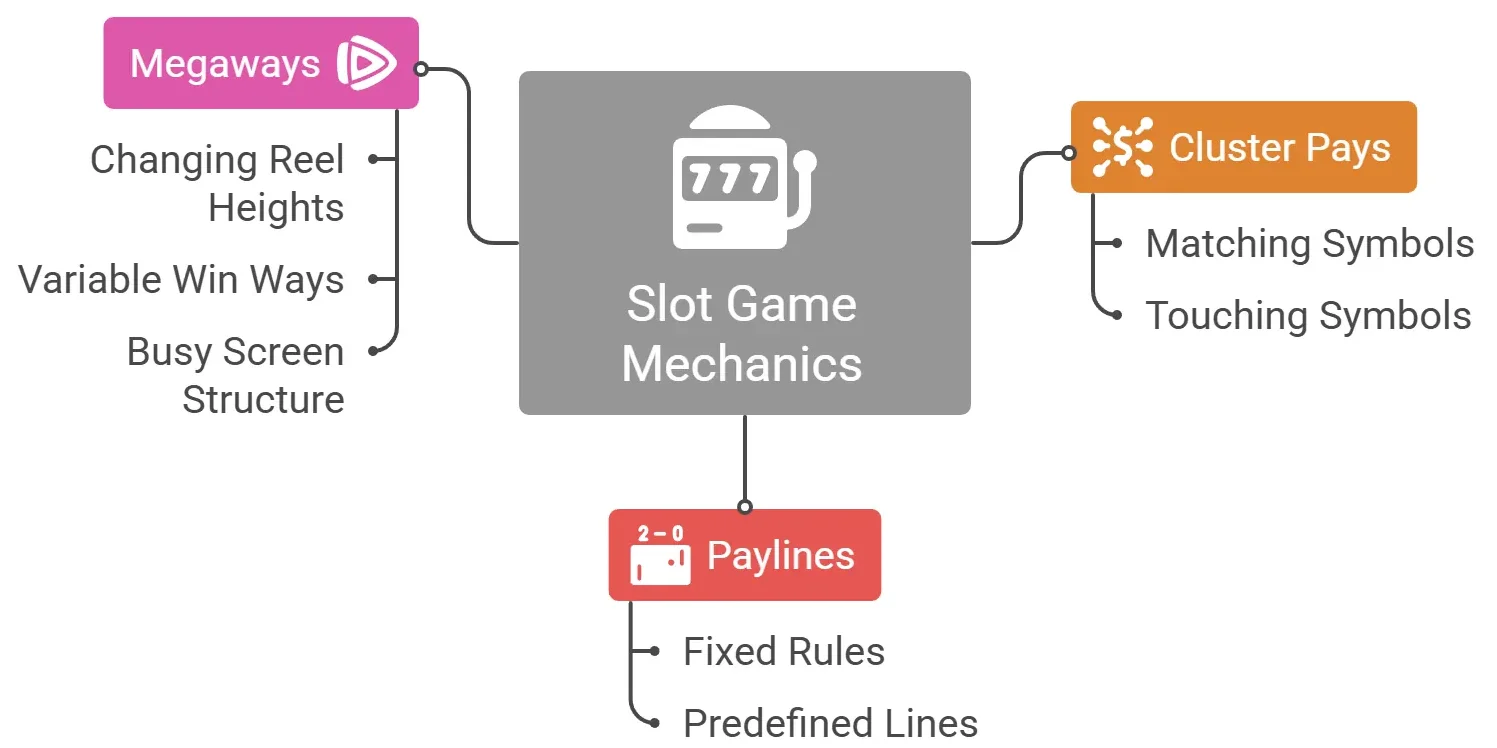
A payline slot usually has fixed rules about where a win can form. A Cluster Pays slot does not care about predefined lines in the same way. It cares about whether matching symbols are touching in a valid group.
Megaways works differently again. Respinix’s Megaways guide explains that Megaways changes the number of visible symbols on the reels and creates a variable number of ways to win, while cluster games focus on connected symbol groups on a grid.
In simple terms, Megaways is about changing reel structure. Cluster Pays is about connected symbol groups.
For some beginners, Cluster Pays can actually feel easier than Megaways because the basic question is more visual: “Are these symbols touching?” Megaways often asks you to process changing reel heights, variable ways to win, and a busier screen structure at the same time.
What beginners should check first
12 Cluster Pays examples on Respinix
If you want to understand Cluster Pays faster, the easiest approach is to try a few real demo slots that use the mechanic in different ways.



Respinix already has a strong mix of cluster-based demos, from simpler grid games to more feature-heavy titles with tumbling wins, multipliers, and changing board sizes. Respinix also has a dedicated Cluster Pay Slots category page that highlights the mechanic itself and points readers toward additional titles in the same format.
|
Slot |
Why it is useful for beginners |
|---|---|
|
A 7×7 grid slot with Cluster Pays, tumbling wins, and random multipliers up to 256x, which makes it a strong modern example of the mechanic. |
|
|
One of the clearest teaching examples because it explains 5+ adjacent matching symbols, cascades, and a re-spin multiplier ladder up to x10. |
|
|
Jellos |
An 8×8 grid Cluster Pays slot that helps beginners see how a larger board changes the reading of connected wins. |
|
A 5×6 grid example that is useful for readers who want a less standard board shape than the usual square layouts. |
|
|
A more advanced cluster title where the grid can grow from 4×4 to 16×16 through its Shrink Shift Clusters mechanic. |
|
|
A cluster-based game built around cascades and chain-reaction potential, which helps explain how several wins can happen from one spin. |
|
|
A 7×7 Cluster Pays slot with a multiplier element, making it a good next-step game after simpler cluster demos. |
|
|
A beginner-friendly 7×7 example where wins come from 5+ vertically or horizontally adjacent symbols, with straightforward multiplier logic layered on top. |
|
|
Starts on a 6×6 grid and can expand to 9×9 during features, showing how the mechanic can evolve inside one game. |
|
|
A compact 5×5 cluster slot that is useful for beginners who want a smaller, easier-to-read board. |
|
|
A recognizable UK-friendly example using cluster logic on a dynamic 4×4 to 8×8 grid. |
|
|
A hybrid-style cluster game with 7 reels and varying rows from 4 to 8, showing that cluster slots do not all use the same board structure. |
Are Cluster Pays slots good for beginners?
Yes, they can be. Some beginners actually find Cluster Pays easier than paylines after the first few minutes because the rule becomes more visual and less dependent on remembering line patterns.
The best beginner-friendly cluster games are the ones with a clear board, a simple minimum cluster rule, and a bonus structure that does not overload the screen. Titles such as Cluster Gems, Fiesta Clusters, Jellos, and Gridlock Gem Blast are good examples of readable formats for early practice.
The main beginner risk is not the cluster mechanic itself. The real risk is choosing a title that adds too many extra systems at once, such as highly dynamic grids or multiple feature layers, as seen in more advanced examples like Cluster*uck or Egg Hustler.
Common beginner mistakes
FAQ
A Cluster Pays slot is a game where wins are formed by groups of matching symbols that touch each other, usually on a grid, instead of along fixed paylines.
That depends on the slot. Respinix examples such as Cluster Gems and Fiesta Clusters describe wins from 5 or more adjacent matching symbols, but the threshold can vary by game.
They can be, especially for visual learners. Once you stop looking for lines and start looking for connected groups, the format often becomes easier to follow.
Many of them do. Fruit Party 2, Cluster Gems, and Golden Gumballs are examples where winning symbols can disappear and new ones can fall into place.
Yes, especially in demo mode. They work well for beginners as long as the game has a readable grid and not too many overlapping features.
A good starting set is Cluster Gems, Fiesta Clusters, Jellos, and Gridlock Gem Blast because they give readers clear examples of adjacent-symbol wins without forcing them into the busiest feature sets first.