Wild Card Gang is a high-volatility crime slot from BGaming built on a 6×6 cluster pays grid. Set in a foggy, rain-slicked town ruled by a dangerous mafia, the game features a unique Merge Up mechanic where matching symbols combine to advance through 9 levels of payouts. Landing 4 or more scatters triggers up to 20 free spins, where winning positions receive doubling cell multipliers capped at x128. Players can leverage a Chance x2 feature or directly purchase the bonus round.

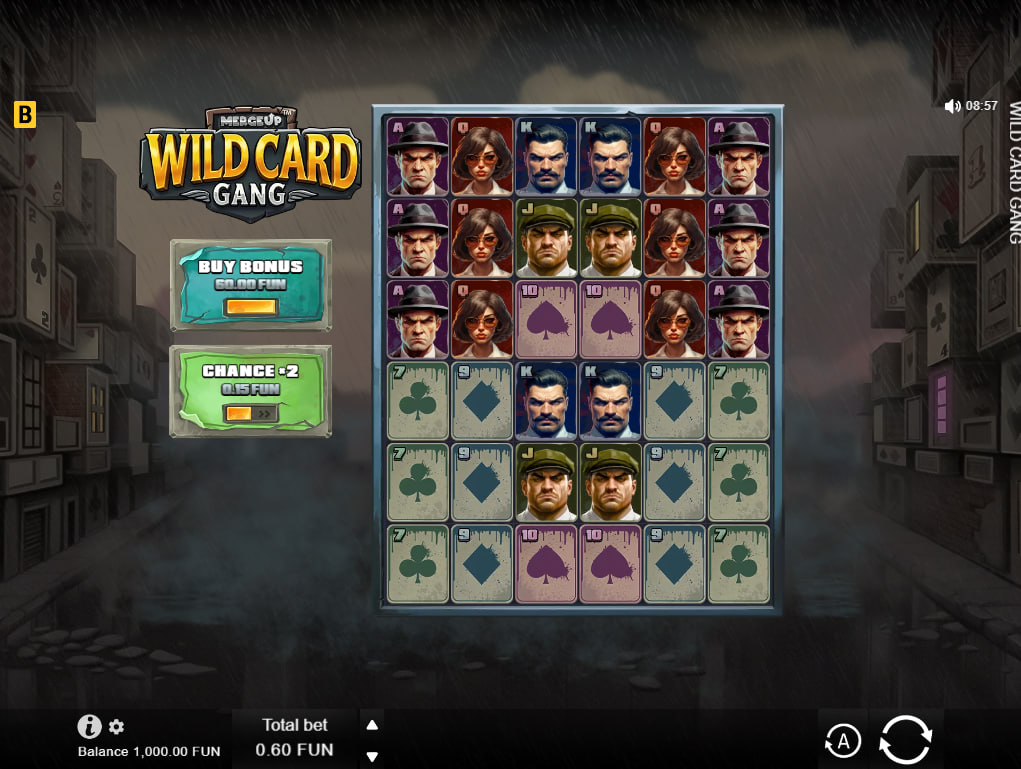
Winning requires matching groups of four or more identical icons connected vertically or horizontally across a dense six by six grid. Instead of standard cascading drops that simply replace symbols, this engine forces winning clusters to merge into higher-tier characters. This progressive leveling system means your low-value suit symbols act as raw material for the high-paying gangster avatars. Watching the balance bleed during dry spells is brutal, as small four-symbol clusters rarely cover the cost of the spin. The system requires long, sustained chains to climb the nine-level payout hierarchy.
Casual players seeking steady, incremental returns will hate this high-variance setup. The math model punishes short sessions because the true payout weight resides in creating eighth-level clusters that transform directly into scatters. Visually, the contrast between the bleak gray base game street and the neon-soaked night mode during bonus rounds perfectly mirrors the shift in volatility. The animations are fast and functional, showing immediate transformations rather than wasting time on theatrical delays. This mechanical speed benefits grinders who want to burn through spins quickly, though the lack of an explicit base game wild symbol makes the main grind feel sterile.
The Underbelly of the Gang’s Math Model
Analyzing the grid layout and feature behavior reveals specific operational hazards that players must navigate during extended sessions. The game hides its most brutal mechanics beneath the flashy visual transitions of its leveling system.
Why does the eighth-level merge contain a hidden trap?
The eighth-level merge requires an immense amount of luck because it is the only manual path to generating scatters outside of random drops. When you successfully cluster top-tier gangster symbols, they do not just award a flat payout; they condense into a single ninth-level scatter icon. This mechanic drains your current board state of high-value symbols, forcing you to start the cascading chain completely from scratch on the next drop.
This transformation creates a massive deficit in high-tier symbols across the remaining grid spaces. Grinders often find themselves with one scatter symbol but a completely ruined board layout that halts any ongoing cascade momentum. It forces a complete reliance on the next spin rather than rewarding the momentum of the current one.
Is the Chance x2 option a deceptive bankroll drain?
Activating the Chance x2 feature increases your base stake to boost free spin trigger rates, but it fundamentally worsens your short-term return efficiency. The extra cost of the spin does not increase the underlying symbol payout values listed in the paytable. You pay a premium for a theoretical frequency shift while watching your flat wins yield lower relative returns against your total bet.
This setup rapidly depletes balances during extended dead streaks. If the bonus round fails to trigger within a calculated window, the inflated spin cost eats away your recovery buffer far faster than standard play. It represents a strict trade-off where players trade session longevity for a volatile shot at the night mode.
How do license restrictions cripple the autospin ergonomics?
The inclusion of advanced autospin configurations suggests deep customization, but local jurisdictional licenses frequently disable the vital quick spin toggle. Without quick spin enabled, the manual or automatic execution of long chains becomes an agonizingly slow process. The engine forces you to watch every single sequential cluster animation play out in its entirety.
This lack of speed ruins the pacing for serious high-volume players who rely on rapid session turnover. When combined with the rule that automatically resets your customized autospin thresholds back to default bet parameters upon stopping, the user interface feels clunky. You are forced to reconfigure your loss limits and bet sizes every single time you pause the action.
The Capo’s Ledger of Cold Hard Metrics
Analyzing the underlying structures reveals several strict rules governing how this crime-themed grid operates over extended sessions. These technical details show exactly how the developer tuned the volatile progression mechanics.
Activating the bonus buy feature instantly overrides and disables the active status of the Chance x2 betting mechanism.
The game grid operates on a fixed six by six layout utilizing a pure cluster pay mechanism requiring four or more connected symbols.
There are exactly nine distinct tiers of symbols in the game economy, with the ninth tier functioning exclusively as the scatter.
Free spin triggers scale dynamically, awarding fifteen, eighteen, or twenty spins for landing four, five, or six or more scatters respectively.
Retrigger values are compressed compared to initial triggers, providing five, eight, or ten extra spins for identical scatter counts.
Cell multipliers during the bonus round scale by doubling up to a hard mathematical cap of x128 per individual position.
Multipliers do not apply to the win that generates them, instead activating only for subsequent winning combinations utilizing that specific cell.
Winning requires matching groups of four or more identical icons connected vertically or horizontally across a dense six by six grid. Instead of standard cascading drops that simply replace symbols, this engine forces winning clusters to merge into higher-tier characters. This progressive leveling system means your low-value suit symbols act as raw material for the high-paying gangster avatars. Watching the balance bleed during dry spells is brutal, as small four-symbol clusters rarely cover the cost of the spin. The system requires long, sustained chains to climb the nine-level payout hierarchy.
Casual players seeking steady, incremental returns will hate this high-variance setup. The math model punishes short sessions because the true payout weight resides in creating eighth-level clusters that transform directly into scatters. Visually, the contrast between the bleak gray base game street and the neon-soaked night mode during bonus rounds perfectly mirrors the shift in volatility. The animations are fast and functional, showing immediate transformations rather than wasting time on theatrical delays. This mechanical speed benefits grinders who want to burn through spins quickly, though the lack of an explicit base game wild symbol makes the main grind feel sterile.
The Underbelly of the Gang’s Math Model
Analyzing the grid layout and feature behavior reveals specific operational hazards that players must navigate during extended sessions. The game hides its most brutal mechanics beneath the flashy visual transitions of its leveling system.
Why does the eighth-level merge contain a hidden trap?
The eighth-level merge requires an immense amount of luck because it is the only manual path to generating scatters outside of random drops. When you successfully cluster top-tier gangster symbols, they do not just award a flat payout; they condense into a single ninth-level scatter icon. This mechanic drains your current board state of high-value symbols, forcing you to start the cascading chain completely from scratch on the next drop.
This transformation creates a massive deficit in high-tier symbols across the remaining grid spaces. Grinders often find themselves with one scatter symbol but a completely ruined board layout that halts any ongoing cascade momentum. It forces a complete reliance on the next spin rather than rewarding the momentum of the current one.
Is the Chance x2 option a deceptive bankroll drain?
Activating the Chance x2 feature increases your base stake to boost free spin trigger rates, but it fundamentally worsens your short-term return efficiency. The extra cost of the spin does not increase the underlying symbol payout values listed in the paytable. You pay a premium for a theoretical frequency shift while watching your flat wins yield lower relative returns against your total bet.
This setup rapidly depletes balances during extended dead streaks. If the bonus round fails to trigger within a calculated window, the inflated spin cost eats away your recovery buffer far faster than standard play. It represents a strict trade-off where players trade session longevity for a volatile shot at the night mode.
How do license restrictions cripple the autospin ergonomics?
The inclusion of advanced autospin configurations suggests deep customization, but local jurisdictional licenses frequently disable the vital quick spin toggle. Without quick spin enabled, the manual or automatic execution of long chains becomes an agonizingly slow process. The engine forces you to watch every single sequential cluster animation play out in its entirety.
This lack of speed ruins the pacing for serious high-volume players who rely on rapid session turnover. When combined with the rule that automatically resets your customized autospin thresholds back to default bet parameters upon stopping, the user interface feels clunky. You are forced to reconfigure your loss limits and bet sizes every single time you pause the action.
The Capo’s Ledger of Cold Hard Metrics
Analyzing the underlying structures reveals several strict rules governing how this crime-themed grid operates over extended sessions. These technical details show exactly how the developer tuned the volatile progression mechanics.
- The game grid operates on a fixed six by six layout utilizing a pure cluster pay mechanism requiring four or more connected symbols.
- There are exactly nine distinct tiers of symbols in the game economy, with the ninth tier functioning exclusively as the scatter.
- Free spin triggers scale dynamically, awarding fifteen, eighteen, or twenty spins for landing four, five, or six or more scatters respectively.
- Retrigger values are compressed compared to initial triggers, providing five, eight, or ten extra spins for identical scatter counts.
- Cell multipliers during the bonus round scale by doubling up to a hard mathematical cap of x128 per individual position.
- Multipliers do not apply to the win that generates them, instead activating only for subsequent winning combinations utilizing that specific cell.
- Activating the bonus buy feature instantly overrides and disables the active status of the Chance x2 betting mechanism.
FAQ
How does the Merge Up mechanic function in Wild Card Gang?
When a winning cluster of four or more identical symbols lands, a portion of those icons disappears while the remaining ones transform into symbols of the next highest level.
What is the maximum cell multiplier available during the Free Spins round?
Marked cells that continuously participate in winning combinations double their multiplier value with each win up to a limit of x128.
Can you manually generate scatter symbols on the reels?
Yes, forming a winning combination using the highest 8th-level gangster symbols causes them to merge into a single 9th-level scatter icon.
Where can I play the Wild Card Gang demo version safely?
The slot is available on Respinix.com for players looking to test the mechanics without risking real money.
How many initial free spins do you get for hitting five scatter symbols?
Landing exactly five scatter symbols across the grid triggers an initial round of eighteen free spins.