Tropic Dancer is a 5-reel fixed slot from CT Interactive built around a vibrant carnival setting. The game features twenty-five fixed lines with bets ranging from 0.25 to 2.00 per spin. The math engine uses restricted wilds on reels two through five alongside a high-density scatter system. Landing six or more scatters triggers up to thirty-three free games where all payouts receive a flat two-times multiplier. A double-up gamble option with a half-risk toggle rounds out this volatile experience.

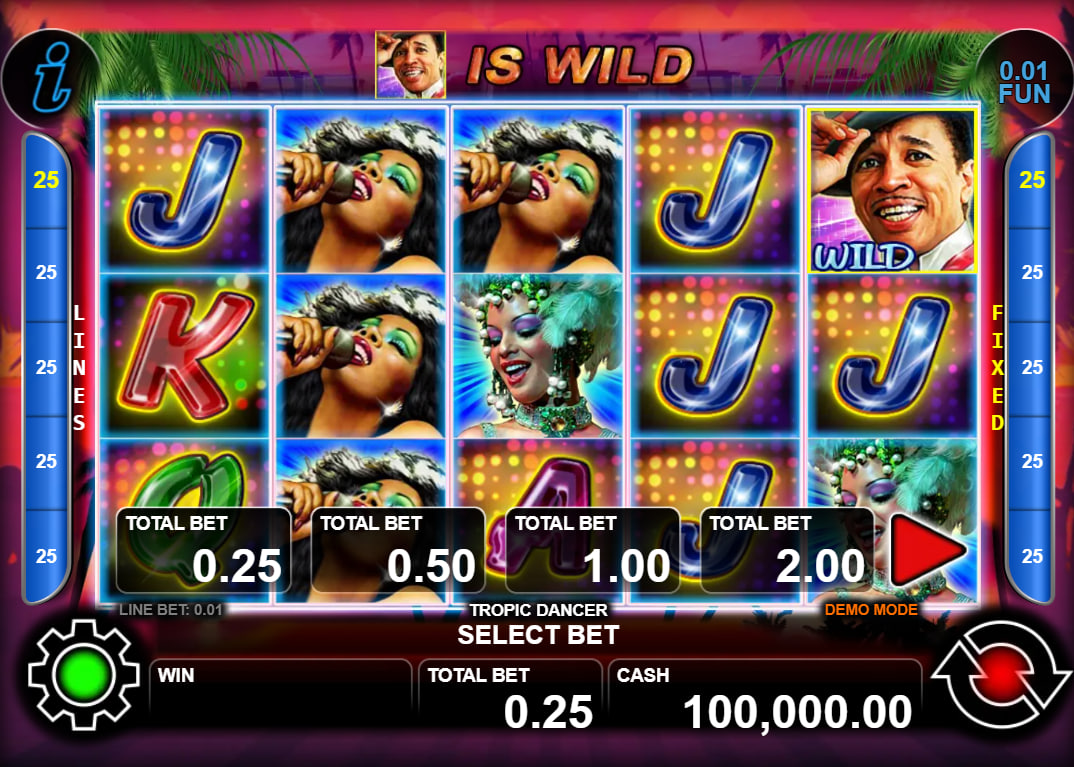
The mathematical model sets up a steady grind where small line hits keep the session moving, while the real variance hides behind the scatter distribution. Running on twenty-five fixed betting lines, the math engine requires all wins to start from the leftmost reel and pay left to right on adjacent positions only. The single exception belongs to the scatter symbols, which disregard payline paths entirely and pay out from any position on the screen. Betting stretches from a minimum total bet of 0.25 up to a maximum option of 2.00 per spin, setting a fixed line bet of 0.01 for the base unit. This tight bet range dictates a controlled environment where rapid balance depletion is mitigated, but massive single-click windfalls remain structurally limited. High-value line combinations feature thematic dancers and classic card ranks, with the highest single-line win paying out 10.00 for five matching premium symbols.
The wild mechanic operates with strict structural boundaries designed to complicate easy line completions. Emblazoned with a smiling performer, the wild symbol substitutes for all missing items except for the scatter. However, the game engine restricts its appearance exclusively to the second, third, fourth, and fifth reels. This means you can never land a wild on the first reel, completely preventing it from generating its own independent payouts. Instead, it serves purely as a bridge to link matching adjacent panels from the left. During standard operations, this restriction creates frequent blocking zones where a clean layout on the first two reels goes completely unrewarded due to the total absence of wild support on the initial column.
Are the Retrigger Mechanics Designed for Sustained Volatility?
The free games engine relies on a massive escalatory scale that ties the volume of bonus spins directly to the density of the initial trigger. Landing six or more scatter symbols across the five reels activates the feature, unlocking a sliding scale of fifteen, seventeen, nineteen, twenty-one, twenty-three, twenty-five, twenty-seven, twenty-nine, thirty-one, or thirty-three free rounds. This variable scaling injects sharp variance into the bonus entry phase, where hitting the absolute minimum of six scatters offers a standard session, while maxing out the trigger completely alters the duration of the bonus.
During the free games phase, the math model applies a flat two-times multiplier to all incoming combinations, instantly doubling the paytable values. Furthermore, the engine permits additional free games to be won during the active round, keeping the potential for an extended session alive. This multiplier layer offsets the tough base game mechanics, converting standard line hits into meaningful balance recovery periods. The presence of retriggers means an active bonus round can stretch significantly, though the underlying hit frequency for six or more scatters requires a patient approach to variance.
Unmasking the Blind Spots of the Carnival Grid
Beneath the flashing lights lies a mechanical environment that punishes careless button pressing and demands sharp bankroll awareness. Navigating the interface reveals distinct structural choices that favor high-speed efficiency over casual entertainment.
Why is the Double-Up Mode a High-Risk Mathematical Trap?
The built-in gamble feature activates after any individual spin that yields a return lower than fifty times your total bet. Pressing the double button takes you to a secondary screen where a single playing card sits face down. You must guess either the correct color for a two-times multiplier or the exact suit to secure a four-times payout. Getting the choice wrong instantly strips away the entire gambled amount. The system allows you to protect a portion of your win by clicking the half gamble button, which risks only fifty percent of the current payout. However, the game enforces a strict ceiling where doubling is completely cut off once your win reaches fifty times the total bet. This cap prevents players from riding a lucky streak into massive territory, making the gamble feature a grinding tool with limited upside and a fifty-percent flat failure rate.
How Do Keyboard Shortcuts Optimize Grinding Performance?
For players focused on maximizing round throughput, the development team integrated hardcoded keyboard commands to bypass slow UI animations. Pressing either the spacebar or the enter key instantly fires off a spin, and hitting the same keys during a round immediately stops the reels and collects the winnings. Forcing an automated session is achieved by holding down the play button for a full two seconds, triggering the autoplay sequence. This ergonomic setup eliminates mouse fatigue and speeds up the transition between rounds, creating a highly streamlined environment for grinders tracking long-term hit frequencies.
Internal Notebook of the Carnival Analyst
The technical layout and distribution of payouts inside this carnival engine show specific architectural choices made by the development team. Reviewing the core structure highlights several unique details.
- The fixed line configuration locks the layout into exactly twenty-five lines across all phases of play, completely preventing any manual adjustment to the active pay patterns.
- The scatter paytable scales heavily based on mass accumulation, starting from a payout of 1.25 for six symbols and climbing to 25.00 when fifteen panels hit simultaneously.
- Card suits like the K and J symbols fill out the lower tiers of the economic matrix, requiring a minimum of three matching units to return a baseline value of 0.05.
- The game operates with specialized development version markers, logged under serial notation ver 1 53/07 04 2026, confirming its certified software state.
- The interface employs a distinct five-second idle counter after a winning spin; if you do not manually choose to gamble or spin, the start interface transitions into a cancel option.
- Certification protocols ensure that any software malfunction voids all pays and plays, wiping out active round history to protect the integrity of the math model.