
7777 Gaming offers a focused interpretation of Texas Hold’em, built on a minimalist digital felt background that prioritizes strategy over spectacle. This heads-up card game pits the player against the dealer in a multi-stage betting format, beginning with a mandatory Ante. The central strategic element is the dealer’s qualification rule, which requires a hand of a pair of fours or better to proceed with a standard showdown. This pivotal mechanic often results in pushes on the player’s larger bets, significantly influencing the game’s tactical approach. With a high theoretical RTP of 98.75%, the game demonstrates its low volatility through a consistent, flat 1:1 payout for all winning hands. This design rewards methodical play and a deep understanding of hand probabilities. The gameplay demands a calculated approach to every betting decision from the flop to the river.

7777 Gaming presents a digital version of Texas Hold’em that strips the classic poker game down to its strategic core. This is not a video slot masquerading as a card game with superfluous animations or distracting side bets. Instead, it offers a focused, heads-up confrontation against a dealer, governed by a very specific set of rules. The two defining characteristics of this particular iteration are its dealer qualification requirement and a rigid, flat payout structure. These elements combine to create a gameplay experience that rewards methodical decision-making and a solid understanding of poker fundamentals over the pursuit of high-variance, lottery-style payouts. It’s a calculated and distilled form of casino poker designed for players who appreciate the mechanics of the game itself.
Core Gameplay and Betting Structure
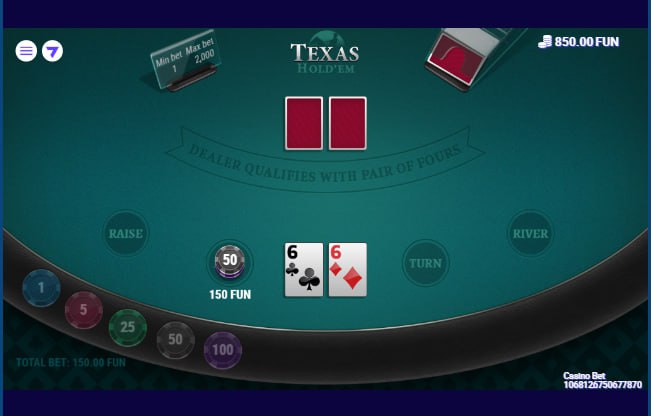
The game flow is structured around a series of clear, sequential decisions. Each hand commences with the player placing a mandatory Ante bet. Following this, both the player and the dealer are dealt two hole cards, with the dealer’s cards remaining face down. This is the first critical decision point. The player must evaluate their two-card hand and choose to either Fold, forfeiting the Ante bet and ending the hand, or to Raise. Selecting Raise commits the player to the hand and requires an additional wager, designated as the Flop bet, which is always double the amount of the initial Ante. This initial 2x raise is a significant commitment and forms the foundation of the hand’s potential value.
Should the player proceed, three community cards—The Flop—are dealt face up on the table. This is where the strategic depth of the game begins to unfold, as the player can now assess their five-card hand potential. The game then presents the second betting decision. The player may Check, passing the action without placing an additional bet, or place a Bet equal to the original Ante amount. This action is followed by the fourth community card, The Turn. The betting process is repeated, offering another opportunity to Check or place a Bet equal to the Ante. Finally, the fifth community card, The River, is dealt, and the final five-card hands are set. This multi-stage betting format allows players to control their investment as the hand develops, rewarding those who can accurately assess the changing strength of their hand against the potential of the dealer’s hidden cards.
The Dealer Qualification Mechanic: A Central Strategic Element
The most pivotal rule governing the outcome of every hand is the dealer’s qualifying hand requirement. For a showdown to proceed in a standard manner, the dealer must hold a hand of a Pair of Fours or better. This single constraint fundamentally alters the strategic landscape of the game and introduces a layer of player protection not found in many other casino poker variants. It acts as a gatekeeper for the dealer’s hand, directly impacting the resolution of every bet on the table. A player’s strategy must constantly account for the probability of the dealer failing to meet this threshold.
When the dealer’s hand does not contain at least a pair of fours, the dealer fails to qualify. In this scenario, the player’s initial Ante bet is paid out at 1:1. Critically, all subsequent bets—the 2x Flop bet, the Turn bet, and the River bet—are returned to the player as a Push. This means that even if the player has a weak hand that would have lost to the dealer’s non-qualifying hand (e.g., player has Ace-high, dealer has King-high), the player still wins the Ante and gets their larger bets back. This creates a fascinating dynamic where a player can be rewarded for aggression even with a marginal hand, provided the dealer fails to form a qualifying hand. The interplay between the player’s betting decisions and the dealer’s qualification requirement is fundamental to the game’s strategy. If the exact conditions for a Push versus a full payout seem unclear, it can be beneficial to run a few hands in the demo Texas Hold’em version and consult the in-game help file (accessible via the ‘i’ icon) for a turn-by-turn breakdown of these outcomes.
Conversely, if the dealer’s hand is a pair of fours or stronger, the hand qualifies for a full showdown. At this point, the player’s and dealer’s five-card hands are compared directly using standard poker hand rankings. If the player’s hand is stronger, all wagers—Ante, Flop, Turn, and River—are paid out at 1:1. If the dealer’s hand is stronger, the player loses all active bets. In the event of an exact tie, all bets on the table result in a Push, and the player’s full stake for the hand is returned. This binary outcome after qualification places immense importance on hand evaluation before each betting round.
Analysis of the Paytable and Probabilities
The pay structure of this game is perhaps its most straightforward and telling feature. Unlike many poker-based games that offer escalating payouts for stronger hands, this version maintains a flat payout system. Whether a player wins with a simple higher card (when the dealer qualifies) or a Royal Flush, the compensation is the same.
This table illustrates a design philosophy centered on consistency. The thrill is not derived from hitting a rare, high-paying hand, but from correctly navigating the betting rounds to secure a win of any kind. This removes the jackpot-hunting element entirely and places the focus squarely on short-term tactical success. The game’s stated theoretical return to player (RTP) is 98.75%. This high figure is a direct result of the game’s mechanics, particularly the dealer qualification rule. The frequent pushes on larger bets when the dealer fails to qualify significantly mitigate player losses over time, contributing to a lower house edge. However, this is balanced by a low maximum payout, stated as “up to 2 times the bet amount” on a single game. This confirms that the game is engineered for sustained play with minimal volatility, rather than for generating large, singular wins.
Visual Presentation and User Interface
The aesthetic of 7777 Gaming’s Texas Hold’em is one of stark functionalism. The presentation is built on a deep blue, almost black, digital felt background. There are no elaborate table dressings, animated dealers, or themed environments. The entire focus is on the cards, the chips, and the action buttons. This minimalist design choice speaks directly to an audience that prioritizes gameplay over spectacle. The cards themselves are clean and legible, with standard suits and ranks that are instantly recognizable. The animations are brief and serve only to advance the game state—cards are dealt, chips move to the pot, and losing bets are collected without any unnecessary fanfare.
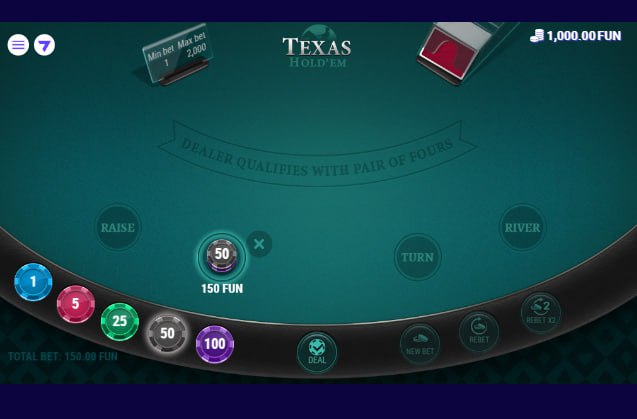
The user interface reinforces this philosophy of efficiency. Betting is managed through clearly marked chip denominations, and the primary action buttons—Deal, Raise, Check, Bet—are large, unambiguous, and logically positioned. The game provides quality-of-life features such as “RESET” to clear a bet and “RESET X2” to quickly place the same wager as the previous hand, facilitating a smooth and rapid pace of play. The absence of distracting visual or auditory elements allows for concentration on the strategic decisions at hand. This approach makes the game feel less like a cinematic production and more like a clean, digital tool for playing poker against the house.
Strategic Considerations for the Player
Success in this game hinges on a nuanced understanding of its specific rule set, not just general Texas Hold’em principles. The initial pre-flop decision is paramount. Deciding whether to Fold or make the substantial 2x Ante Raise should be based on more than just high cards. Suited connectors, pocket pairs, and two high, unsuited cards all have increased value due to their potential to develop into strong hands that can confidently face a qualifying dealer. Folding weaker, disconnected hands is a crucial discipline to preserve one’s balance for more promising opportunities.
Post-flop strategy is a delicate balance between aggression and caution, dictated by the dealer qualification rule. When holding a very strong hand (e.g., two pair or better on the flop), the correct play is almost always to bet on the Turn and River. This maximizes value in the likely event the dealer qualifies and the player wins. The more complex decisions arise with drawing hands (e.g., four cards to a flush or straight) or medium-strength hands like a top pair with a weak kicker. In these cases, checking can be the prudent play. It allows the player to see the next card for free, potentially improving their hand without further investment. If the hand does not improve, the player has minimized their potential loss.
Ultimately, the player’s objective is to correctly identify two key situations: when their hand is strong enough to merit betting through to the river, and when it is marginal enough that the best outcome is a win on the Ante combined with a push on the bigger bets. The game rewards players who can discern the difference. It is a compelling exercise for those who enjoy the mathematical and psychological aspects of poker, offering a consistent and intellectually stimulating challenge. The design favors a player who is analytical and patient, making it a well-constructed option for anyone looking to engage with pure casino poker mechanics.