
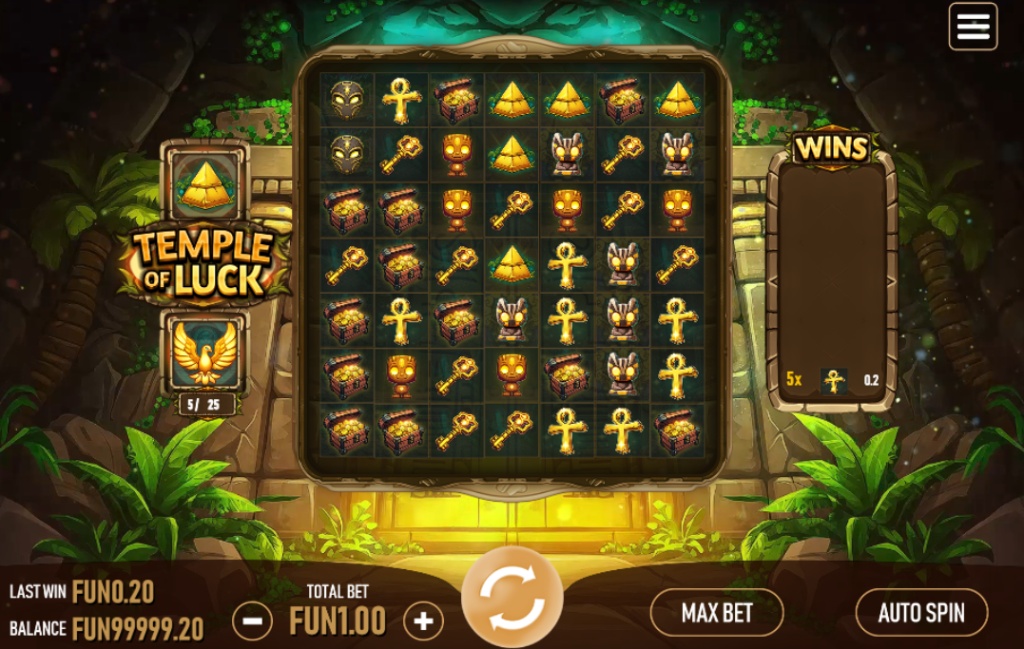
Temple of Luck by Urgent Games invites you into a mysterious jungle sanctuary where Egyptian artifacts are charged with quantum power. This slot operates on a 7×7 grid, utilizing a Cluster Pays system combined with cascading wins for dynamic, chain-reaction gameplay. The central focus is the Quantum Leap meter, which charges with each winning symbol to unleash one of five powerful grid modifiers. Look for the Tiki Titan feature, where a 2×2 symbol block merges to create a giant icon with a 2x win multiplier. While official RTP and volatility figures are unlisted, its mechanics suggest a medium-high volatility experience. The game forgoes traditional free spins for a feature-rich loop that rewards momentum, making it an engaging title for fans of modern grid slots. Discover its secrets in the Temple of Luck free play mode.

Core Bonus Mechanics in Temple of Luck
| Feature Name | Description | Trigger / How it Works |
|---|---|---|
| Cluster Pays & Cascades | Wins are formed by landing clusters of 5+ matching symbols connected horizontally or vertically. Winning symbols are removed, and new ones fall into place. | Land 5 or more identical, adjacent symbols. |
| Tiki Titan | A 2×2 block of four identical symbols transforms into a single giant symbol. Any wins involving this symbol are doubled (2x multiplier). | Form a 2×2 square of any regular paying symbol. |
| Quantum Leap Meter | A meter that charges with each symbol in a winning cluster. Collecting 25 symbols in one spin sequence adds a random Quantum Feature to a queue. | Collect 25 winning symbols during a single spin and its subsequent cascades. |
| Quantum Features | Four different grid modifiers (Alteration, Demolition, Implosion, Incision) that trigger when no more wins are possible. | Triggered from the Quantum Leap queue after a winning cascade sequence ends. |
| Blaze Behemoth | A powerful super-feature that is added to the queue after the Quantum Leap meter is charged five times within a single game round. | Fully charge the Quantum Leap meter a fifth time in one spin sequence. |
| Instability | A randomly triggered feature on any non-winning spin that adds 4 to 8 Wild symbols to the grid. | Occurs randomly after a spin that results in no win. |
What is the Core Gameplay Loop in the Temple of Luck Game?
The core gameplay in Temple of Luck revolves around forming symbol clusters to trigger cascades, which in turn charge the Quantum Leap meter to unleash powerful grid-altering features. Unlike traditional slots, the objective is to create a self-sustaining chain reaction where each win fuels the next, leading to a feature-packed finale. Success in this game is less about single lucky spins and more about building momentum.
This title clearly belongs to the Adventure and Jungle genres, immersing you in a quest for discovery within a lost temple setting.
Understanding the 7×7 Grid and Cluster Pays Mechanic
The game operates on a large 7×7 grid, foregoing standard paylines entirely. To secure a win, you must land a cluster of at least five matching symbols that are connected either horizontally or vertically. The size of the cluster directly determines the payout, with larger clusters of 15 or more symbols yielding the highest rewards for that symbol type. This Cluster Pays system encourages a different way of looking at the board, where the goal is to group symbols together rather than align them on a line.
How Do Cascading Wins Fuel the Action?
Every time a winning cluster is formed, the Cascading Reels mechanic is activated. The winning symbols are removed from the grid, and the empty spaces are filled by new symbols falling from above. This creates opportunities for new winning clusters to form within the same spin. This process continues as long as new wins are created. More importantly, every symbol removed in a win contributes to charging the Quantum Leap meter, making cascades the primary engine for triggering the game’s main bonus features.
How Do You Activate the Quantum Features?
You activate a random Quantum Feature by collecting 25 winning symbols in a single game round through cascading wins, which fully charges the Quantum Leap meter. Once charged, a pending feature is added to a queue, ready to be deployed as soon as your current sequence of winning cascades comes to an end. You can stack up to four features in the queue.
This intricate system of modifiers and rewards firmly places the game in the Magic and Mystery categories, where each spin can unfold in unpredictable ways.
A Deep Dive into the 5 Quantum Modifiers
The Quantum Features are the main attraction, each offering a distinct way to manipulate the grid and extend your winning streak. When no more wins are present, the next feature in the queue activates. The four standard modifiers are Alteration, which transforms one low-pay symbol type into another; Demolition, which destroys all low-pay symbols on the grid; Implosion, which turns 3 to 6 symbols into Wilds and destroys adjacent symbols; and Incision, which creates a Wild in the center of two intersecting diagonal lines of a chosen symbol.
Expert’s Advice (Vlad Hvalov): “Pay close attention to the features in your queue. An Implosion or Demolition feature is often your best bet for clearing the grid and collecting enough symbols to recharge the meter for another feature. Alteration can be situational, but a well-timed Demolition can single-handedly trigger a massive chain reaction.”
What is the Blaze Behemoth Feature?
The Blaze Behemoth is the pinnacle of the Quantum Leap system. It is added to the feature queue if you manage to charge the meter a fifth time within a single continuous game round. Once triggered, this super-feature unleashes a colossal Wild symbol onto the grid, which moves and creates wins, offering a high potential for a screen-clearing payout. Triggering it is rare and requires a significant chain reaction, making it the ultimate prize in the hunt for Treasure.
The Instability Feature: A Lifeline on a Non-Winning Spin
The Instability feature acts as a safety net. On any spin that results in no initial win, the game may randomly trigger this modifier, adding between 4 and 8 Wild symbols to various positions on the grid. This can turn a dead spin into a lucrative cascade, potentially collecting enough symbols to kickstart the Quantum Leap feature sequence. It’s a welcome addition that mitigates some of the frustration from unlucky spins.
The Role and Value of Symbols in Temple of Luck
The symbols in this game are a curious blend of two popular slot themes. The high-value symbols are distinctly tied to an Ancient theme, featuring ritualistic masks and golden pyramids. The low-value symbols, conversely, consist of familiar Egyptian artifacts, grounding the game in the classic Egypt theme that many players recognize.
Analyzing the Paytable: High and Low-Value Symbols
The paytable is straightforward, with payouts scaling based on the number of symbols in a cluster. The highest-paying symbols are the four masks and the golden pyramid. The lowest-paying symbols are the treasure pot, the key, and the ankh. Payouts begin for clusters of 5 and max out at 15 or more. While individual cluster payouts may seem modest, the game’s win potential is realized through successive cascades and feature activations, not single large hits. This is a game that rewards volume and chain reactions.
What Is the Tiki Titan and How Does Its 2x Multiplier Work?
The Tiki Titan is a special mechanic that enhances the base game. Whenever four matching regular symbols land adjacent to each other to form a 2×2 square, they merge into a single large Tiki Titan symbol. This symbol acts as a single entity for forming clusters, and importantly, it carries a 2x multiplier. Any winning cluster that includes the Tiki Titan will have its payout doubled, providing a significant boost to your winnings before the Quantum Features even come into play.
Expert’s Advice (Vlad Hvalov): “The Tiki Titan’s 2x multiplier is your best friend for maintaining your balance while hunting for the Quantum features. It’s the most consistent source of meaningful wins in the base game. Actively look for opportunities to form those 2×2 squares, as they can significantly extend your playtime.”
What Are the Temple of Luck RTP and Volatility?
The specific Temple of Luck RTP and Volatility metrics have not been officially published by Urgent Games. However, based on its mechanics—including cluster pays, cascading wins, and feature meters that require significant collections—the game plays like a medium-to-high volatility slot. This means wins may not occur on every spin, but there is potential for substantial payouts when feature-driven chain reactions are triggered.
How Volatility Shapes Your Gameplay Experience
The implied high volatility dictates the flow of the game. Players should expect periods of smaller wins or no wins, punctuated by bursts of intense activity when the Quantum Leap meter is charged. Bankroll management is key. The game is designed for players who enjoy the thrill of the chase, building up to a powerful feature rather than seeking small, consistent payouts. This style of play is characteristic of many modern grid slots.
Is There a Recommended Betting Strategy?
Given the game’s structure, a flat betting strategy is advisable. The goal is to give yourself enough spins to weather the dry spells and trigger the Quantum feature queue. Avoid increasing your bet after a loss, as this can deplete your balance quickly in a high-volatility environment. The Temple of Luck free play mode on Respinix is an excellent tool for testing betting strategies and understanding the game’s rhythm without any financial risk.
Secrets of the Temple: A Deeper Look
- A Nod to a Classic: The Quantum Leap meter is a clear homage to the feature system popularized by Play’n GO in their iconic Reactoonz slot. This indicates Urgent Games is directly engaging with a player base that appreciates this style of feature-rich grid gameplay.
- Thematic Fusion: The combination of an Egyptian temple setting with a “Tiki Titan” is a deliberate creative choice. It blends two of the most popular themes in the slot world—Gold-filled Egyptian tombs and Polynesian mystique—to broaden its appeal, even at the expense of historical accuracy.
- Designed for the Chase: The gameplay loop is psychologically tuned to create a “near miss” sensation. Seeing the meter almost fill up before a cascade ends is a powerful motivator for players to try “just one more spin” to finally trigger the features, making the Temple of Luck demo essential for understanding its pull.
How Does Temple of Luck Compare to Similar Grid Slots?
Temple of Luck shares its core feature-meter mechanic with famous grid slots, placing it in direct conversation with the giants of the genre. Its gameplay will feel instantly familiar to anyone who has spent time with high-action cluster pays titles.
Temple of Luck vs. Reactoonz: A Head-to-Head Comparison
The most obvious comparison is with Play’n GO’s Reactoonz. Both games use a 7×7 grid, cluster pays, and a meter that charges to release one of four random modifiers, culminating in a super-feature involving a giant Wild. Temple of Luck differentiates itself with the Tiki Titan 2x multiplier symbol, which adds an extra layer to the base game, and its unique thematic blend. Reactoonz is known for its higher volatility and iconic character design, while Temple of Luck serves as a solid alternative for those seeking a similar mechanical thrill with a different aesthetic.
Exploring Other Titles from Urgent Games
Urgent Games is a developer that is building its portfolio with a variety of themes and mechanics. While Temple of Luck represents their foray into the popular grid slot niche, exploring their other titles can give insight into their design philosophy. Their games often feature clean graphics and straightforward mechanics, making them accessible to a broad range of players.
Visuals and Atmosphere: A Journey into the Jungle Temple
The game combines detailed symbols of ancient Egypt with a lush, mysterious jungle temple backdrop, creating a distinct visual identity. The setting is atmospheric, with glowing runes on a stone gateway and animated foliage swaying in the periphery. The symbol art is clean and easily distinguishable, which is crucial for a busy 7×7 grid. The animations for winning cascades and feature activations are smooth and satisfying, enhancing the feeling of a powerful chain reaction. The overall presentation is polished and effectively supports the theme of uncovering ancient, powerful secrets.
Is the Temple of Luck Slot Worth Playing? My Final Verdict
Temple of Luck is a well-executed and engaging grid slot that successfully implements a popular and proven set of mechanics. While it doesn’t invent anything new, it offers a compelling alternative for fans of the Reactoonz formula. The addition of the Tiki Titan multiplier provides a nice touch to the base game, and the Quantum Features deliver the exciting, grid-clearing action that players of this genre crave. The blended theme works surprisingly well, creating a memorable aesthetic.
I recommend trying the Temple of Luck game if you enjoy strategic, high-volatility gameplay where building momentum is the key to unlocking big wins. It’s a solid and entertaining slot that stands as a strong entry in the competitive world of grid-based games. Its core loop is satisfying, and the potential for explosive chain reactions makes it a title worth exploring.
FAQ
The main feature is the Quantum Leap meter. It charges by collecting symbols from winning clusters and, once full, unleashes one of several powerful modifiers onto the grid, such as adding wilds, transforming symbols, or destroying low-paying ones.
No, Temple of Luck does not have a traditional free spins round triggered by scatters. The bonus action is centered entirely around charging the Quantum Leap meter to trigger a sequence of grid-modifying features.
When four matching symbols form a 2×2 square on the grid, they merge into a giant Tiki Titan symbol. This symbol then applies a 2x multiplier to any winning cluster it becomes a part of.
While the developer, Urgent Games, has not officially stated the volatility, the game’s mechanics (cluster pays, cascading reels, and feature meters) strongly suggest a medium-to-high volatility level.
Yes, it is mechanically similar. Both slots use a 7×7 grid, cluster pays, and a feature meter that charges up to release random modifiers. Temple of Luck offers a different theme and the unique Tiki Titan multiplier feature as its main points of distinction.
Instability is a random feature that can activate on any non-winning spin. When it triggers, it adds between 4 and 8 Wild symbols to the grid, creating a new chance to start a winning cascade.
You can play the Temple of Luck slot demo for free right here on Respinix.com. The free play version allows you to experience all the game’s features, including the Quantum Leap and Tiki Titan, without any risk.
Temple of Luck was created by Urgent Games, a developer known for producing slots with clean designs and engaging, modern mechanics.