
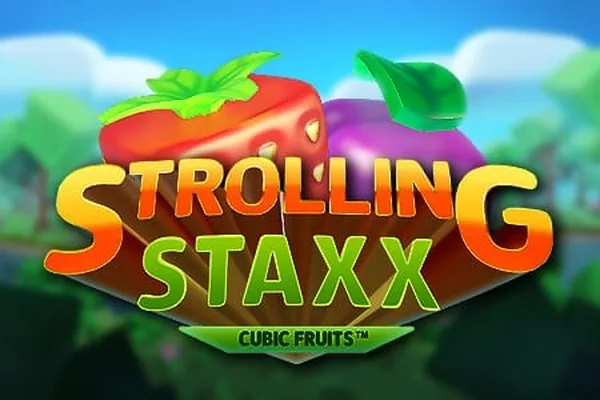
NetEnt’s Strolling Staxx: Cubic Fruits is a retro fruit slot with a toy-box look, a 5×3 layout, 10 fixed paylines, and official RTP of 95.98% or 95.95% with Bonus Bet. The file tags volatility as low in one section and medium in another. Re-Spins, Colossal Symbols, Bonus Bet, and Extra Chance carry the whole game because there are no scatters or free spins.
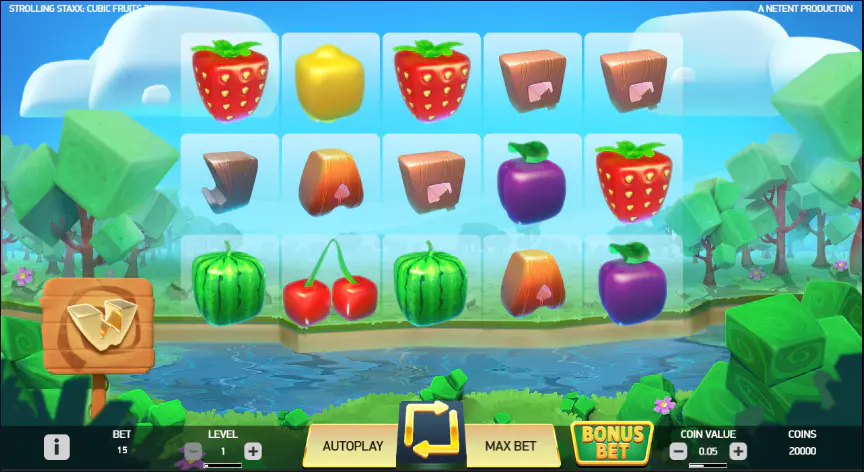
The shape of the board changes the whole session. Earlier Staxx games in this line run on a 5×4 layout with 40 paylines, while this one drops to 10 fixed paylines on a 5×3 grid. That reduction makes the screen easier to read and harder to milk. There is less room, fewer line paths, and fewer cheap ways for medium symbols to stitch together.
That trade-off hits the base game hard. A 5×3 setup with 10 lines can look neat and still pay light for long stretches. The slot does not hide behind noise. When the board misses, it misses in plain sight.
The whole machine revolves around Strolling Staxx Re-Spins. When one or more reels are fully covered by the same symbol, the feature starts. Every stack and every connected matching symbol moves one reel left on each re-spin until the stack disappears from reel 1. If new stacks land during that chain, the feature starts breathing again.
That left-shift motion is the one part that feels sharp from the first minute. It has a domino effect without turning into chaos. You can track it. You can read it. You can also sit through a lot of dead air while waiting for it because the slot has no scatter trail and no free-spin shortcut.
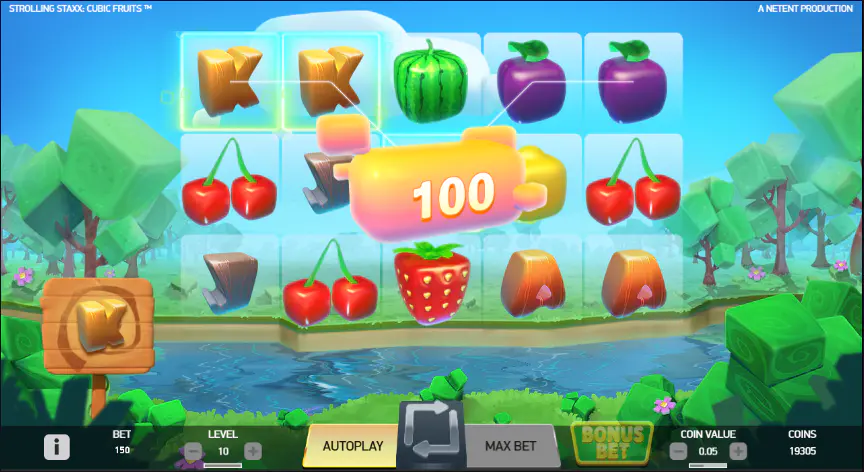
The little Staxx Sign in the lower-left corner matters more than the art around it. It shows which symbol may land as a full stack on that spin. That tiny detail gives the game a visible target and stops the feature from feeling random. You watch the sign, then watch the reels either line up or waste your time.
The rules under the hood are tighter than the bright fruit theme suggests. Wild substitutes for all symbols in line wins, but Wild does not substitute to create the triggering stack. That matters. A near-miss with Wild in the wrong place still dies as a near-miss.
Connected symbols follow a second strict rule. They must match the stack symbol and sit adjacent to the stack or to a reel with another connected symbol. That keeps the feature honest. It also prevents fake momentum from mixed symbols that only look useful.
Colossal Symbols do most of the visual lifting. Any symbol may land as a single symbol, a 2×3 block, or a 3×3 block. After landing, the giant symbol splits into 2 to 9 single symbols, and any part of that shape that sits on a paying line counts by the regular paytable. The screen can fill fast. The pay model still keeps both feet on the brake.
That is the tension in this slot. Big blocks create excitement on arrival, then the 10-line system cuts them back down to size. A Colossal fruit can cover a lot of space and still fail to do enough because the slot does not pay by ways, does not pay by clusters, and does not pay by scatter.
The paytable tells the story with no sugar on top. Wild and Watermelon pay 500 for 5, 100 for 4, and 25 for 3. Strawberry pays 150 for 5. Lemon pays 120. Cherries and Plum pay 100. A and K pay 50, while Q and J cap at 30 for 5. That spread is easy to read and easy to judge. Most of the board lives in the cheap seats.
That symbol economy shapes the balance drain. Low royals and middling fruit fill the 5×3 space without building much pressure. When a session cools off, the reels keep showing activity while the bankroll moves the wrong way. The screen stays busy. The win meter does not.
Bonus Bet is the slot’s sales pitch and its best trap. Switch it on and the game runs at 15 coins per bet level while opening the door to Extra Chance. The official RTP drops from 95.98% to 95.95% in that mode. The cut is small. The direction is still ugly.
Extra Chance only appears when Re-Spins are triggered not by a 3×3 Colossal Symbol. First, ordinary line wins are evaluated. Then an extra step can place overlay 3×3 Colossal Symbols fully or partially on the reels. After that spin, no wins are evaluated, and the Re-Spins begin. That means the flashy part is setup, not payout.
The ugly part is how the game sells excitement with a lower return. The button looks like extra power. The math says you pay more coins per level and accept a thinner RTP for the privilege. That is not a disaster. It is still a trap for anyone who hits the switch and assumes better value.
The top-end numbers need a cold reading too. A full-screen top symbol pays 500x the stake without Bonus Bet and 333x with Bonus Bet. The advertised max win for the whole game reaches 5000x the stake through the re-spin chain. That number is decent for a light-styled NetEnt slot. It still does not turn this into a monster.
The interface keeps things tidy. You get LEVEL, COIN VALUE, AUTOPLAY, SPIN, MAX BET, BONUS BET, and REPLAY. Bet levels run from 1 to 10. The official rules put the minimum bet at $0.15 and the maximum bet at $300.00. A different part of the package throws out 0.20/200 and even a euro range, so the rule screen is the only number set I would trust in real play.
There is one awkward ergonomic touch. MAX BET plays at the highest bet level and the current coin value, but when you sit below the top level the button must be clicked twice to play that round at the selected lower level. That is clumsy. Fast grinders will notice it right away.
The art direction earns credit. The cubic fruit, wooden royals, and old-console color palette give the slot a playful face that fits the Staxx mechanic better than the older games’ busier setups. It feels like a toy chest version of a fruit machine. That helps the re-spin chain look clearer because every important shape is bold and easy to spot.
Still, the cheerful look can fool people. This slot is much drier than it appears. No scatter. No free spins. No gamble feature in the game package. No bonus buy in the game package. If your sessions live on feature hunts and violent momentum shifts, this game can feel flat long before the art wears out.
The Board Is Small, and That Changes the Damage
This slot eats money in a very specific way. It does not smash the balance with chaos. It leaks it through a tight board, a thin line count, and a symbol set that spends more time filling space than building value.
Why does the screen look stronger than the payout?
Because the board shows bulk while the pay system stays narrow.
A 3×3 Colossal symbol looks huge on a 5×3 layout. The player sees coverage and expects force. The slot still pays on 10 fixed lines and only left to right. If the shape misses those paths, the board can look loaded and still return next to nothing.
That mismatch creates one of the slot’s nastiest habits. The game keeps presenting visual weight without financial weight. It is a polished illusion. The art says push. The line model says maybe not.
Do low symbols turn into dead weight?
Yes, and the paytable proves it.
Q and J pay 30 for 5. A and K pay 50 for 5. Those symbols are cheap, blocky, and common enough to choke space during bad stretches. They are useful as filler for the feature system, but they do not carry a session on their back. When they dominate the board, they turn the slot into a slow bleed.
Plum and Cherries sit higher at 100 for 5, yet even they do not feel premium when the best fruit and Wild sit at 500 for 5. The gap inside the symbol ladder is wide enough to feel every cold patch in real time.
Is Bonus Bet a bad deal?
Yes, if you judge it by return first and spectacle second.
Standard mode sits at 95.98% RTP. Bonus Bet mode sits at 95.95%. The difference is 0.03 percentage points, and that is enough to expose the whole trick. You pay 15 coins per bet level to access Extra Chance, but the slot does not reward that loyalty with a better return.
The button still has entertainment value. Extra Chance can add bigger overlay blocks before the chain starts. But if the question is simple – better math or worse math – the answer is worse.
What hidden rule hits the feature hardest?
Wild refusing to help with the trigger is the one that bites.
Wild substitutes in wins, but Wild does not substitute when the game checks for a full-reel stack. That means some near-features die even when the screen looks close. The player sees support. The slot sees a fail.
The other hidden cut is the feature ending rule. When the last stack leaves the leftmost reel, the game gives one more re-spin. If no new stack lands there, the chain ends. That extra beat is fair. It also stretches suspense in a game that already withholds its biggest moments.
Who should play it? The answer is narrow. Pick it if you want a readable 5×3 slot with a clean feature loop, a light arcade face, and no patience for clutter. Skip it if you want free spins, scatter pressure, a gamble button, or a math model that feels generous in the base game.
I would play this in short sessions and keep the expectations tight. The slot has style, a solid central mechanic, and better visual discipline than many brighter releases. It also has thin line coverage, hidden friction in Bonus Bet, and a ceiling that sounds louder than it hits.
NetEnt gave this one a pleasant mask and a strict little rulebook. That mix will suit players who enjoy structure. Everyone else will notice the same thing after a cold run – the cubes keep bouncing, the fruit keeps landing, and the meter stays stubborn.
FAQ
What is the RTP in Strolling Staxx?
The official rules list 95.98% RTP, or 95.95% with Bonus Bet.
Does Strolling Staxx have free spins?
No, this slot has no scatter symbol and no free-spin feature.
How do Strolling Staxx Re-Spins start?
They start when one or more reels are fully covered by the same symbol.
What is the maximum win in Strolling Staxx?
The attached materials state a maximum win of 5000x the stake.
What does Bonus Bet do in this slot?
It raises the game to 15 coins per bet level and enables Extra Chance during qualifying re-spin setups.
Where can I play the demo version of Strolling Staxx?
The slot is available on Respinix.com.