Sparta Dice by Amusnet is a 5-reel, 20-line fixed slot blending ancient warrior aesthetics with abstract dice mechanics. The game operates on a 5×3 grid featuring a 1000x max win potential and a four-level progressive jackpot. Key highlights include 12 Free Spins triggered by scatters on reels 1, 3, and 5, where Wilds become stacked to boost payout frequency. With a Buy Bonus feature and turbo mode, this high-volatility title caters to players seeking a fast-paced, disciplined grind.
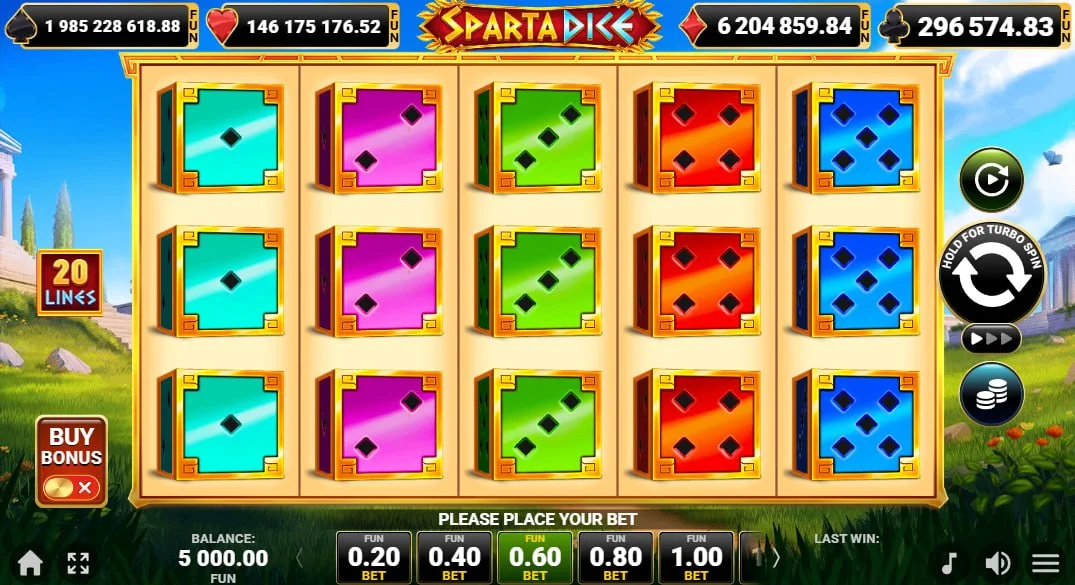
This slot operates on a rigid 5×3 layout where the 20 lines are fixed, meaning you cannot adjust your exposure to the variance. The paytable shows a steep drop-off between the premium Gold Dice and the bottom-tier fillers. For instance, at a $0.60 stake, the top-tier Gold Dice pays out $12.00 for a five-of-a-kind, while the lowest symbols—the Green, Purple, and Light Blue dice—scrape the bottom with a pathetic $0.15 for three symbols. That is a 0.25x return, which does not even cover a quarter of the spin cost. This creates a war of attrition where the base game slowly bleeds your balance while you wait for the Bonus symbols to land on reels 1, 3, and 5. The design is utilitarian, housing the dice inside stone-carved blocks that look heavy but offer nothing in terms of interactive depth.
If you are looking for a game that respects your time with fast animations, the hold-for-turbo feature is the only thing keeping the session alive. Without it, the reel stops feel sluggish. The integration of the “Buy Bonus” button is a direct admission that the natural hit frequency for the 12 Free Spins can be brutal. Amusnet’s decision to move the Wild substitution mechanics into a stacked format during the bonus round is where the only real profit potential hides. In the base game, the Wild is just a solitary substitute; in the free rounds, those stacked Wilds are the only way to bridge the gap between mediocre line hits and a decent session exit. Critics of this style will find the lack of multipliers in the base game offensive, as you are essentially playing a flat math model until the scatters align.
The Mechanics of the Spartan Grind
The 20 fixed lines dictate every move in Sparta Dice. You are forced to cover all paths, which at a $1.00 max bet (in this version) feels low-impact. The math model is predictable: 11 total symbols, with a heavy emphasis on the Wild and Bonus icons. Because the Bonus symbols only live on reels 1, 3, and 5, the “near-miss” effect is frequent and irritating. You will often see the first two scatters land, only for the fifth reel to mock you with a low-value Green Dice.
The payouts are strictly left-to-right. There are no “pay anywhere” or “adjacent” mechanics to save a bad reel setup. If your first two reels are duds, the spin is dead. This transparency is honest but brutal. The premium symbols like the Gold Dice require all five spots to reach that 20x payout, a feat that is statistically rare given the symbol density. Grinders will appreciate the Jackpot Cards mystery game, which can trigger after any spin, but relying on a random mystery feature for profitability is a high-risk strategy that usually ends in a depleted bankroll.
Is the Bonus Buy a Mathematical Trap?
The “Buy Bonus” option sits prominently on the left, offering a shortcut to the 12 Free Spins. While it bypasses the dead spin streaks of the base game, it puts a massive premium on the session cost. You are essentially gambling that the stacked Wilds will appear frequently enough within those 12 rounds to recoup the buy-in. Given that the Wilds only “stack” during this phase, the volatility spikes significantly.
Symbol Economy and Dead Zones
The lower half of the paytable is cluttered. The Purple, Green, and Light Blue dice appear with high frequency, often blocking the path for the Gold or Red premiums. These are “filler” symbols designed to give the illusion of activity while returning less than the cost of the spin. In a 20-line environment, these symbols often result in “wins” that are actually net losses, a common psychological trick in low-to-medium volatility math models.
Technical Reconnaissance
The UI is built for efficiency, specifically for players who value speed over spectacle. The “Information” panel is bare-bones, providing the paytable and basic rules without any fluff about narrative or world-building. This is a gambling tool, not an entertainment product. The inclusion of a dedicated “Turbo” mode via holding the spin button suggests the developer knows their audience wants to burn through the math as fast as possible.
- The Bonus feature is locked to 12 Free Spins with no mention of retriggers in the core “Introduction” text.
- Stacked Wilds are the primary engine for the Bonus round, replacing the standard single Wilds.
- The jackpot values (Clubs, Diamonds, Hearts, Spades) are updated in real-time at the top of the screen.
- Total symbol count is 11, creating a moderate level of symbol friction on the 5×3 grid.
- The “Buy Bonus” cost is not static and scales with your selected bet level.
- Keyboard shortcuts for Turbo and spacebar spinning are integrated for desktop users.
Sparta Dice is a reskin that serves a specific niche: players who like the Amusnet Sparta math but prefer the clean, abstract look of dice. It offers no new ground in terms of mechanics but remains a solid, if uninspired, choice for those who want a predictable, high-frequency jackpot chase. The math is transparent, the risks are clear, and the exit strategy should always revolve around hitting the stacked Wilds early in the free spins or walking away after a lucky jackpot trigger.
FAQ
Where can I find the Sparta Dice demo version?
The slot is available on the Respinix.com website.
How many free spins does the bonus round offer?
Landing three Bonus symbols on the odd-numbered reels triggers exactly 12 Free Spins.
What makes the Free Spins round different from the base game?
The Wild symbols become stacked during the bonus round to increase the chance of multi-line wins.
Can I buy my way into the bonus feature?
Yes, the game includes a Buy Bonus button that allows immediate access to the 12 Free Spins.
Does Sparta Dice have a progressive jackpot?
It features the Amusnet Jackpot Cards mystery bonus with four distinct progressive levels.