Slingo Day 2 Dab is a feature-rich Slingo title from Gaming Realms that elevates its predecessor with the new Dab Spread Chain mechanic. This game is best suited for strategic players who enjoy complex, multi-stage bonus rounds and have the patience for the paid extra spins chase. If you are a fan of other in-depth Slingo games or titles that require tactical decision-making, this vibrant sequel offers a significant challenge worth exploring in demo.
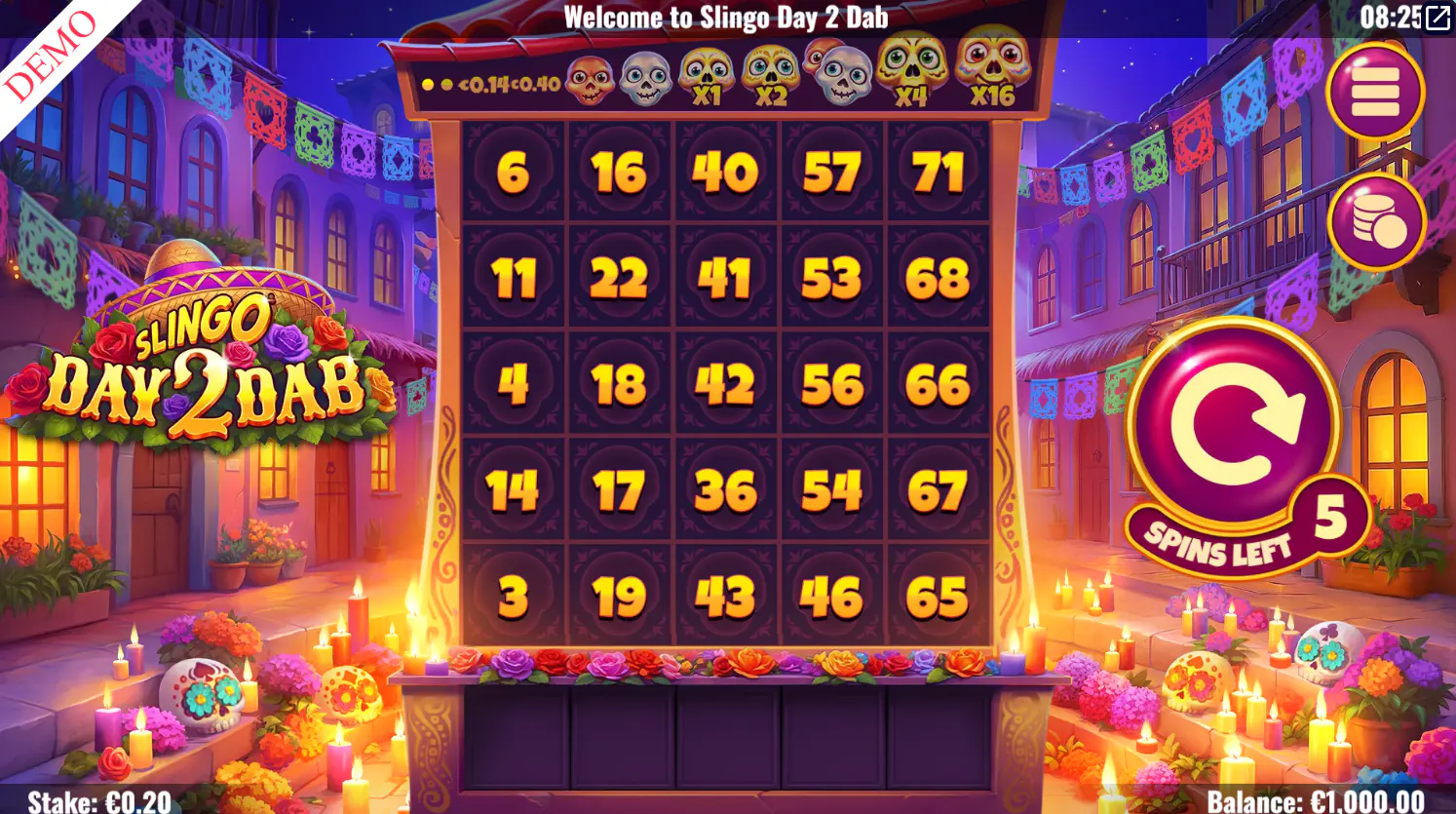
It’s a game of calculated risk, especially after your initial spins run out. The entire economic model pivots on the new Dab Spread Chain mechanic. When you dab a number, there’s a chance adjacent matching Skulls will also trigger, setting off a cascade. This adds a much-needed layer of volatility to the base game, turning a single dab into a potential multi-line completion. It’s the primary engine for moving up the payladder with any speed.
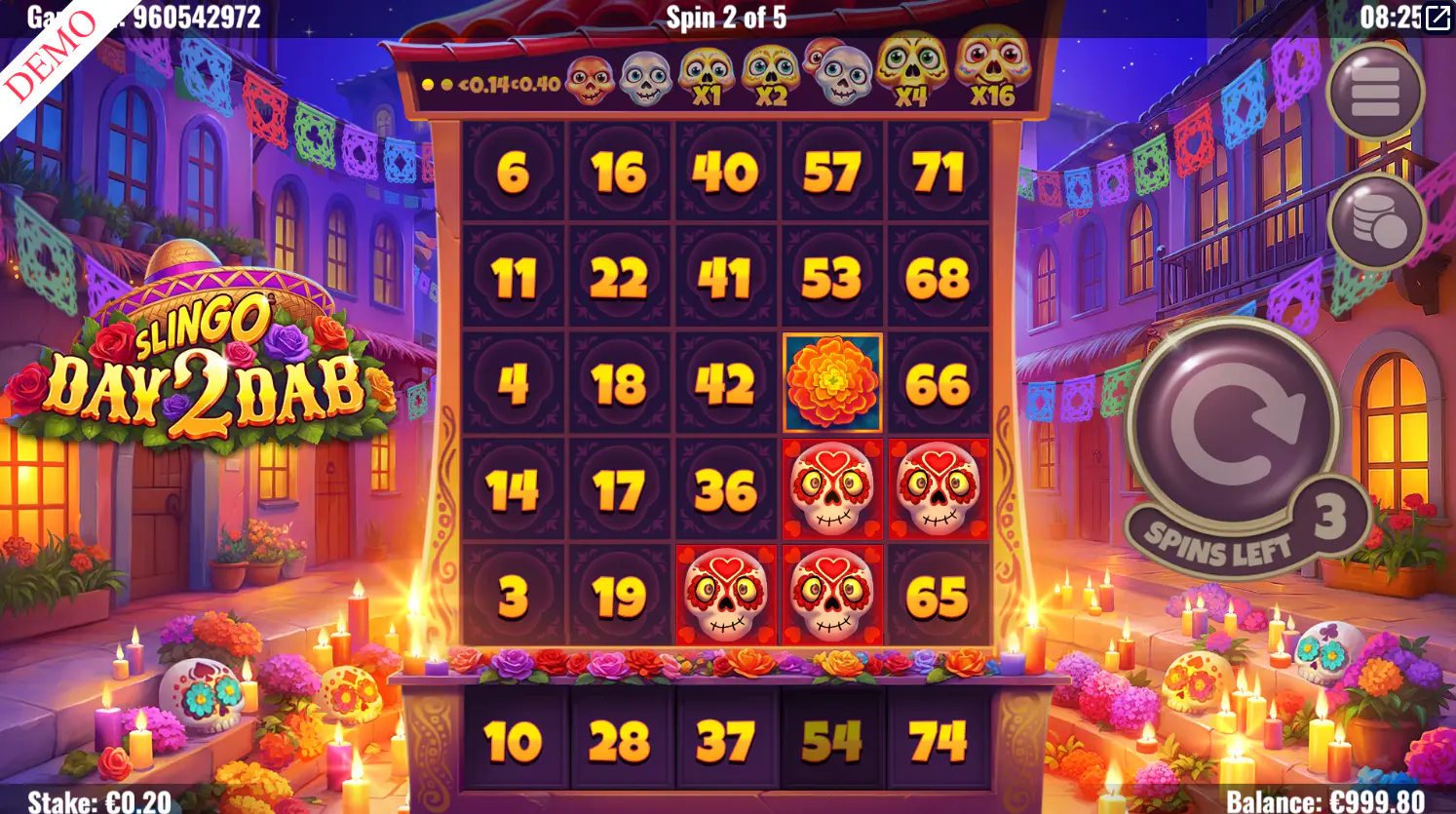
The special symbols are the usual suspects for Slingo veterans. Wilds let you pick a number in the column above, and Super Wilds let you pick anywhere on the grid. The optimal strategy, as any grinder knows, is to always prioritize the center square since it’s part of four potential Slingos. Then you have the Blocker symbols, which are just dead spots on the reel designed to kill momentum. Bonus Spin symbols grant an extra free spin, but they are a base-game-only luxury; they conveniently vanish once the game starts asking for your money during the paid Extra Spins.
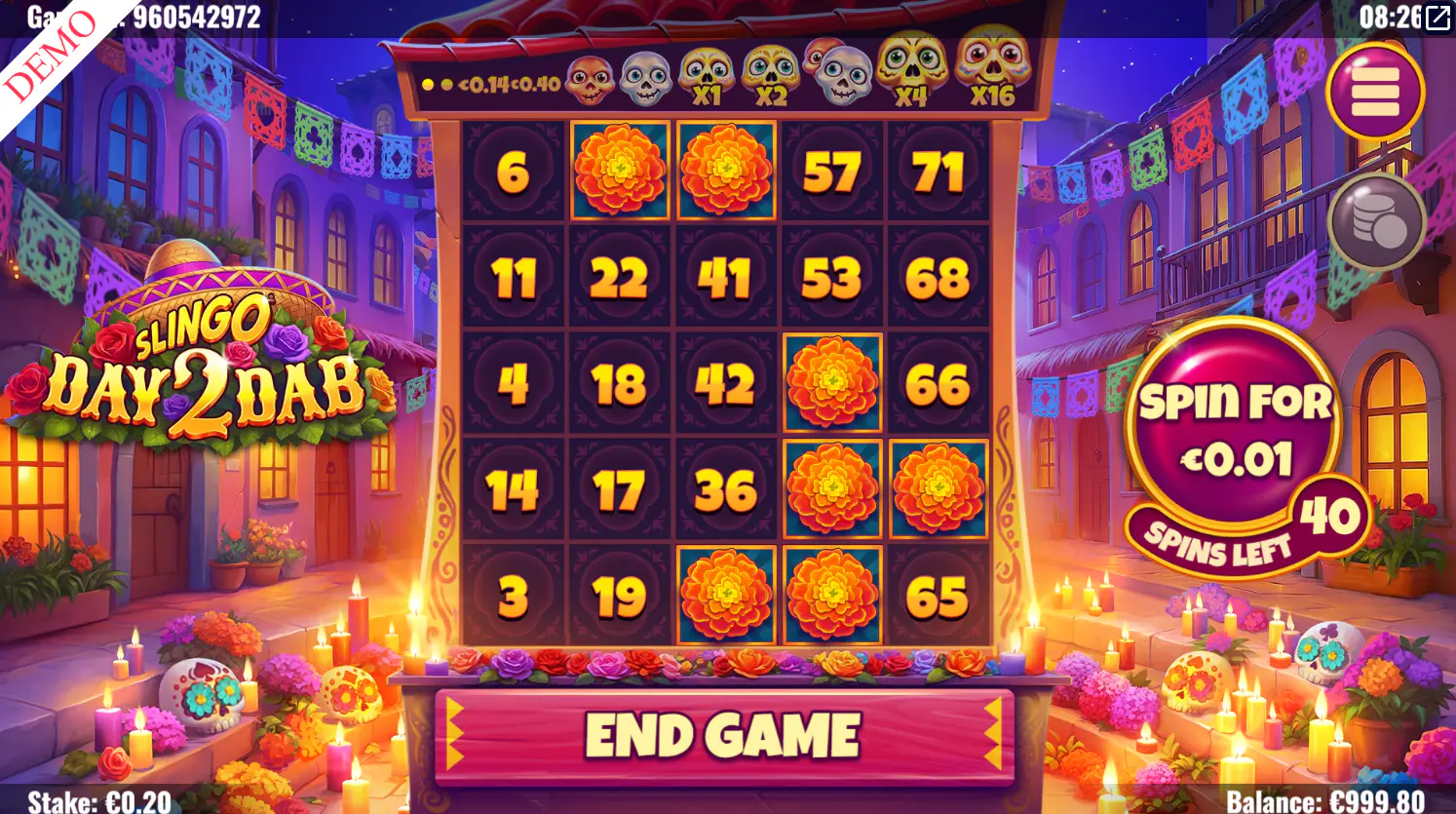
The visual presentation is a blast of color, with Calavera skulls and a festive Mexican street party vibe. It’s polished, but it’s just the wrapper on a cold, calculated math model. This game isn’t for casual players looking for quick hits. It’s for the Slingo strategist who understands the long game and has the bankroll to chase the ladder.
Payladder
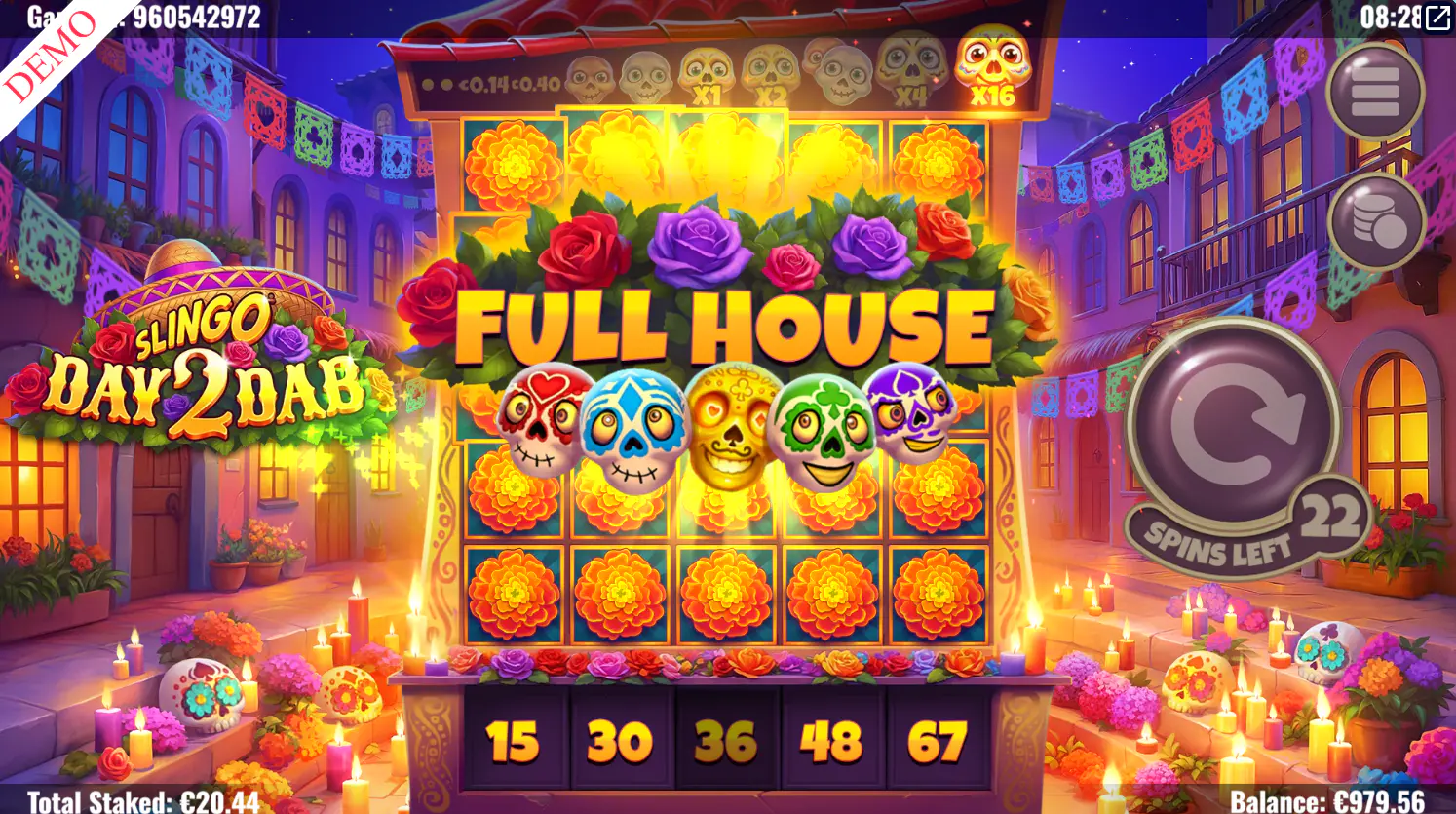
The payladder in Slingo Day 2 Dab is a lesson in patience and bankroll management. It’s heavily back-loaded, designed to tempt you into the costly extra spin phase. The first two rungs are basically worthless. Landing three Slingos gets you a paltry 0.7x your stake back, and four Slingos returns a meager 2x. These wins do nothing but slightly offset the cost of the next paid spin. The entire base game is engineered to get you to at least five Slingos, which is the gateway to the first bonus round.
From there, the journey up the ladder becomes a strategic nightmare. The game alternates between its two main bonus features. Five and six Slingos trigger the Calavera Match. Seven and eight Slingos get you into The Offering. Nine Slingos bizarrely sends you back to the Calavera Match, but with enhanced potential. Finally, ten and twelve Slingos (a Full House) grant access to the most potent versions of The Offering. This structure is critical. It forces you to assess the value of chasing a specific bonus. Sometimes, paying for extra spins to push from six to seven Slingos means jumping to a completely different, and potentially more lucrative, bonus game. It’s a system that preys on the “sunk cost” fallacy, making you feel you’re too invested to stop.
The Extra Spins Deathtrap: A Post-Game Autopsy
This is where Slingo Day 2 Dab shows its teeth. Once your initial five spins are done, the game shifts from a slot to a high-stakes negotiation. Every subsequent spin is sold to you, and the price is dynamic, based on the potential wins on the board. This is the core of the game’s high-friction design, and it contains several mathematical traps for the unwary player.
Why is the Extra Spin RTP Mathematically Worse?
The developer’s own documents reveal a subtle but critical detail. The standard game, based on best strategy, operates with a theoretical RTP of 94.84%. However, each extra spin you purchase has a minimum theoretical RTP of 94.82%. While a 0.02% drop seems insignificant, it’s a clear “house edge tax” on chasing. Over hundreds of extra spins, this fractional difference compounds. The game is telling you, mathematically, that the longer you extend the session with your own cash, the more the odds stack against you compared to the initial phase. It’s a calculated penalty for persistence.
How Dynamic Pricing Annihilates a Bankroll
The “dynamic” pricing of extra spins is brutal. If your grid is mostly dead with little potential, an extra spin might cost a fraction of your base stake. But get one or two numbers away from triggering The Offering bonus, and the game knows it. The price for that single spin can skyrocket to 20x, 50x, or even more than 100x your initial bet. Chasing that final number for a Full House can feel like you’re paying for a bonus buy, one agonizing spin at a time. This system is designed to exploit player psychology, turning a game of chance into a war of nerves against a pricing algorithm.
Are Bonus Spin Symbols a Strategic Illusion?
The Bonus Spin symbols, which grant a free extra spin, are a welcome sight during the initial five spins. They provide value and extend the base game without cost. But their removal from the reels during the paid Extra Spins phase is a deliberate design choice. Just when you are paying premium, often inflated prices for each spin, the one symbol that could offer a reprieve is taken out of play. It makes the paid chase harder and more expensive, ensuring that once you start paying, you’re unlikely to get any more free help.
Inside the Bonus Rounds: A Tale of Two Minigames
If you survive the climb and the cost of extra spins, you’ll land in one of two bonus features. They are vastly different in mechanics and potential, and knowing what you’re fighting for is key.
Is Calavera Match a High-Variance Coin Flip?
Triggered at 5, 6, and 9 Slingos, Calavera Match is a fast-paced, high-variance feature. You’re presented with a board of 16 small Calaveras. A large “target” Calavera is revealed (two targets at 9 Slingos). All the small skulls then reveal their suits. Any that match the target award an instant cash prize. The non-matching skulls explode, and a second round begins with the remaining skulls, but with all prize values doubled. A final third round quadruples the initial values. The potential here can swing wildly. At 9 Slingos, if you match the “same Calaveras” type, the payout starts at 6x and can scale up to 24x by the third round. It’s a quick feature that can either pay decently or completely brick.
The Offering: A Calculated Grind for a Massive Payday?
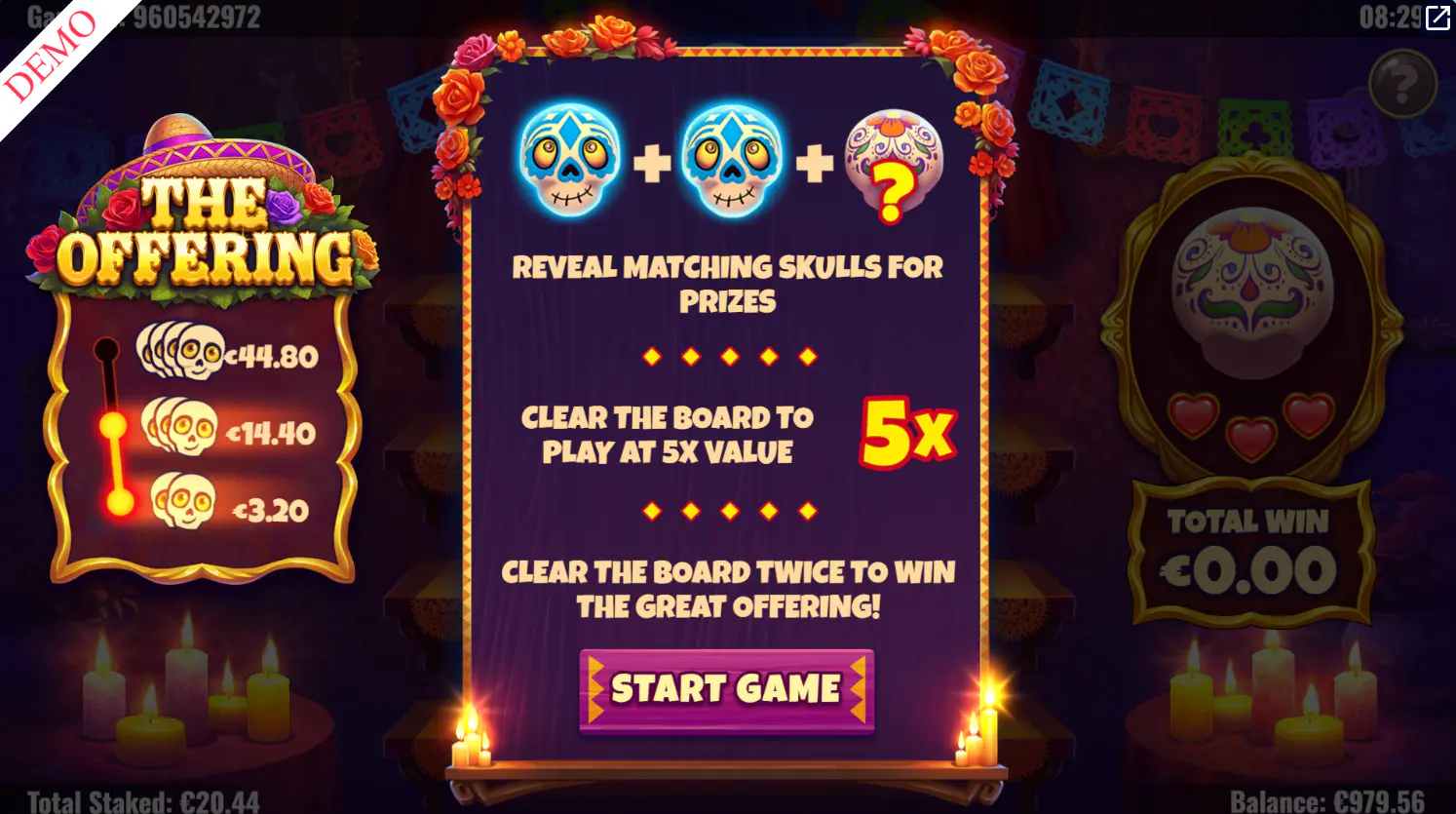
This is the main event, triggered at 7, 8, 10, and 12 Slingos. The Offering is a multi-layered pick’em bonus. You start with 19 skulls and 3 lives. Your first pick determines the “target” suit for the round. You then continue picking skulls. A match awards a prize based on a paytable and removes the matched skulls. A non-match costs you a life. The goal is to clear the entire board. If you do, you advance to Round 2, where the prizes are massively increased. Clearing the board a second time awards The Great Offering, a huge bonus prize. The numbers here are where the game’s max win potential is hiding. At 12 Slingos, matching four Calaveras in Round 1 pays 224x. In Round 2, that same feat pays a staggering 1,120x. On top of that, The Great Offering for 12 Slingos can award an additional prize of 360x, 720x, or even 1,080x. This is a deep, strategic bonus that requires some luck to navigate without losing all your lives.
The Strategist’s Ledger
Peeling back the festive paint job on Slingo Day 2 Dab reveals a machine built with specific rules and strategies in mind. It’s more of a complex puzzle than a simple game of chance, and the developer has left clues for anyone willing to look closer. This isn’t just about spinning; it’s about making calculated decisions under pressure.
Here are some of the core mechanical truths that define the experience:
- The game is hard-coded to give you a boost on the final number. If only one number remains on the grid, completing it will always award at least two winning Slingo lines. This is a small but crucial detail that can impact extra spin decisions.
- This is a true sequel, not a clone. Gaming Realms explicitly elevated the stakes from the first game, focusing on deeper bonus gameplay and a much higher win potential, shifting it from a casual Slingo title to a more serious grinder’s game.
- The developer provides a “best strategy” guide, confirming that Wilds and Super Wilds should be used to complete lines. The central square is the highest priority target, as it is part of a horizontal, a vertical, and two diagonal lines.
- The pricing for extra spins is not perfectly precise. The rules state that prices are “rounded to the nearest whole value,” which can subtly alter the true RTP of any given spin.
- The game includes extensive Player Controls. You can set limits on the maximum number of extra spins, the maximum price you’re willing to pay for a single spin, and your total loss for a game round. These are essential tools to avoid the bankroll drain this game is capable of inflicting.
- The two bonus games, Calavera Match and The Offering, are triggered at alternating levels of the payladder. This isn’t a linear progression, forcing players to aim for specific Slingo counts to access the feature they prefer.
FAQ
What is the maximum win in Slingo Day 2 Dab?
The maximum potential win in Slingo Day 2 Dab is capped at 6,952 times your initial stake, achievable through the multi-layered ‘The Offering’ bonus round.
Is Slingo Day 2 Dab a high volatility game?
No, Gaming Realms has rated Slingo Day 2 Dab as a medium volatility game, though the dynamic pricing of extra spins can create high-pressure situations.
What is the Dab Spread Chain mechanic?
The Dab Spread Chain is a core feature where matching adjacent Skulls can trigger a cascade, dabbing multiple numbers from a single reel result and accelerating progress up the payladder.
Is it a good strategy to buy extra spins in Slingo Day 2 Dab?
Purchasing extra spins is a high-risk strategy, as their RTP is slightly lower than the base game (94.82% vs 94.84%) and prices become extremely high when you are close to a bonus.
How do you trigger the bonus games?
Bonus games are triggered by completing a specific number of Slingos on the payladder, starting with the Calavera Match feature at five Slingos.
Where can I play the Slingo Day 2 Dab demo for free?
The Slingo Day 2 Dab demo is available for free play on the Respinix.com website.