
Slide Winner from AUXO Game is a 5-reel, 3-row slot featuring 5 fixed paylines set within a classic retro fruit atmosphere. The game utilizes a stable 96.5% RTP model combined with medium volatility to deliver balanced payout performance. The central Reel Slide mechanic activates after every winning combination, moving active symbols and spinning remaining positions to generate consecutive wins from a single paid round. A traditional card gamble option allows players to risk payouts for a double return.

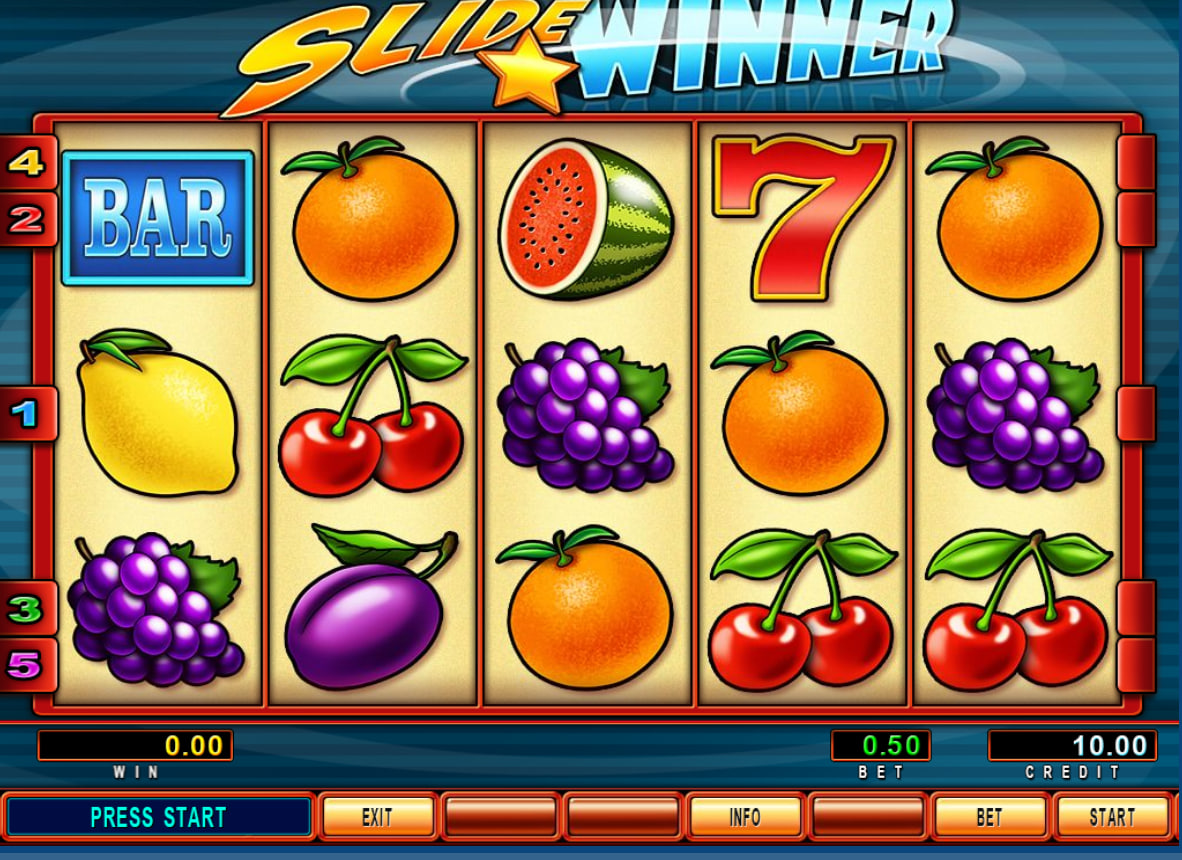
The action unfolds on a classic five-reel, three-row matrix governed by five fixed paylines that require combinations to start strictly from the leftmost reel. Winning symbols lock or shift their positioning while the remaining vacant slots initiate a high-speed slide, giving birth to consecutive payouts from a single initial wager. Payout velocity increases during these sequences because the mechanism refuses to stop until new combinations fail to appear on the grid. This continuous loop forms the absolute baseline of the session experience, transforming what would be a standard dead spin into a prolonged chain of tactical opportunities. Conservative players will find this setup challenging because the absence of traditional wild symbols increases the frequency of empty rounds between successful slide triggers. The visual presentation utilizes bold primary colors and stark animations that deliberately match the mechanical austerity of the code, emphasizing technical performance over cinematic flair.
Unveiling the Hidden Math and Friction Points
The structural framework of this title contains distinct operational choices that dictate how your balance fluctuates over extended playing periods.
Why Does the Absence of Wild Symbols Increase Core Game Friction?
The complete omission of substitute symbols forces the game engine to rely strictly on natural symbol placement to complete any of the five fixed paylines. This layout means you cannot count on a generic icon to salvage an incomplete combination when high-value items land on reels one, two, and four. The symbol economy becomes rigid as a consequence, resulting in sharp spikes of non-paying rounds that can rapidly deplete a modest balance. Every single position on the grid must match perfectly along the payline vector, which increases the difficulty of initiating the sliding mechanic during standard play.
How Does the Fixed Five-Line Setup Affect Bankroll Drain?
Operating with only five paylines means your total bet per round is distributed across a very narrow path of winning trajectories. While this concentrates the payout value into significant individual returns when they do land, it simultaneously widens the statistical distance between wins. The medium volatility rating hides this polarization, creating an illusion of safety while the lack of horizontal or diagonal coverage lines permits symbols to pass harmlessly across the reels without triggering a payout. Grinding through a sequence of one hundred spins requires a clear understanding that your capital is exposed to abrupt drops before a single slide sequence can re-establish equilibrium.
The Technical Matrix and Operational Parameters
A precise breakdown of the mathematical properties reveals the exact boundaries governing the software performance across third-party gaming platforms.
What Are the Exact Limits for Capital Allocation and Returns?
The return to player percentage sits at a stable 96.5% baseline, which aligns with modern industry requirements certified by independent testing laboratories like GLI and iTech Labs. Wagers accept a strict boundary starting at a minimum of $0.01 per line up to a maximum total bet of $20.00 per individual spin of the grid. The highest possible payout is achieved when five Red Seven symbols align across an active payline, serving as the static jackpot cap for the entire math profile.
How Do Symbol Values Categorize Your Payout Opportunities?
The payout table splits into three distinct value tiers that dictate the financial recovery rate of each successful sliding sequence.
- Red Seven: The premier symbol that triggers the maximum game payout when covering all five spots on a line.
- Yellow Star and Blue BAR: High-tier assets designed to provide substantial balance spikes during extended slide chains.
- Grapes and Watermelon: Medium-value components that serve to stabilize the bankroll during mid-session play.
- Plum, Orange, Lemon, and Cherries: Low-tier items where Cherries offer a micro-payout for matching just two icons.
The Mechanic’s Ledger
The core architecture operates under strict technical rules that can be summarized through direct observation of the game logic.
- The return coefficient remains locked at 96.5% across authorized casino deployments without variable operator ranges.
- The Reel Slide feature operates automatically on every winning combination without requiring a separate side bet.
- The system utilizes a five-by-three reel interface with exactly five fixed paylines evaluated from left to right.
- A traditional double-or-nothing gamble mode is accessible to manually risk payouts on a red or black card selection.
- The software includes an integrated fast spin toggle that bypasses secondary reel animations to maximize hourly round efficiency.
- Technical malfunctions immediately invalidate all active wagers and wipe pending slide sequences from the memory buffer.
This slot fits perfectly into the developer philosophy of prioritizing structural innovation over visual bloat, offering high mechanical transparency for analytical players. The profitability relies entirely on capturing back-to-back slides with high-tier symbols, making it a poor match for those seeking casual entertainment or narrative-driven gameplay.
FAQ
Where can I play the Slide Winner demo version?
The slot is available on the Respinix.com website.
What is the certified return percentage of this title?
The default return parameter is set to 96.5% during standard operations.
How many paylines guide the combinations on the grid?
The internal mechanics use exactly 5 fixed paylines evaluating from left to right.
Does Slide Winner include a bonus buy feature?
No direct bonus buy option exists because the slide mechanic triggers naturally on every win.
What is the highest paying symbol inside the game?
The Red Seven delivers the maximum payout when aligning across five grid spots.