
San Loong Fortune by GameArt is a high-speed card comparison game that discards traditional reels for a three-dragon betting layout. Set against a minimalist Asian-themed red felt, the game pits three Dragon hands against a single hidden Tiger card using a six-deck shoe. Payouts start at 1:1, but special Tiger bonuses can boost wins up to 31:1 when defeating Kings. Featuring a dedicated San Loong side bet for triple wins, the game offers a volatile experience for fans of fast-paced table action.
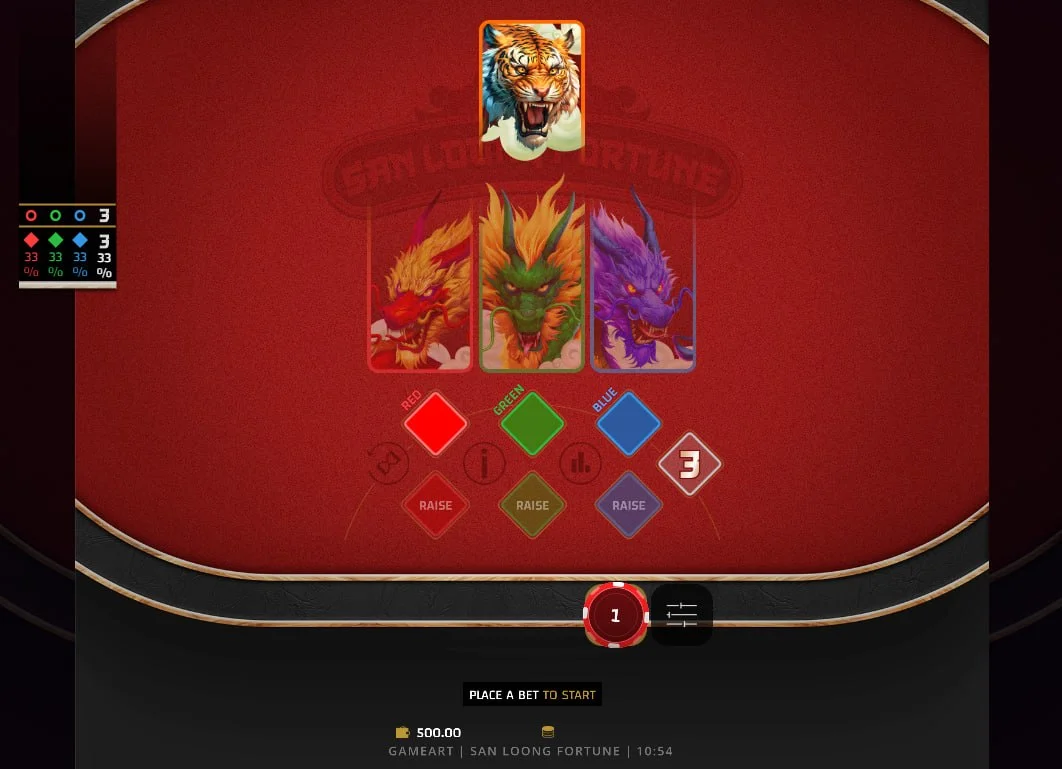
Navigating the mechanics of San Loong Fortune feels like a hybrid of Dragon Tiger and a multi-hand blackjack table. The dealer distributes three face-up cards to the Dragon fields (Red, Green, and Blue) and a single face-down card to the Tiger. Your primary objective is to guess which of these three dragons will hold a card value higher than the Tiger. Winning a standard hand yields a 1:1 payout, but the real volatility is buried in the Tiger’s specific card value. If the Dragon wins and the Tiger reveals a Jack, Queen, or King, the payouts jump to 11:1, 21:1, and 31:1 respectively. This mechanic shifts the focus from merely winning the hand to praying for a high-value loss from the dealer.
The game operates with six standard decks of cards, a setup that slightly complicates card counting but maintains a steady flow of high-value cards. For the grinder, the UI is built for efficiency, featuring clear “Raise” buttons for each Dragon field and a history roadmap on the left to track previous outcomes. But do not let the slick animations fool you; this game is a balance-drainer for the impatient. The 1:1 base wins barely keep your head above water while you wait for those massive King-based multipliers. The pacing is aggressive, forcing you to make split-second decisions on whether to spread your bets across all three dragons or focus on a single color to mitigate risk.
Critically, the design is functional rather than decorative. The dragon graphics are sharp, but they serve as glorified betting zones rather than interactive elements. This is a “math-first” game where the aesthetics are purely secondary to the speed of the deal. If you are looking for deep narrative or complex bonus rounds, look elsewhere. This is built for the gambler who wants to see 60 hands an hour and capitalize on high-value card outliers. The animation of the Tiger card flipping is the only real moment of tension, and GameArt ensures it happens fast enough to keep the adrenaline—and the losses—flowing.
The Hidden Mathematics of the Dragon Trio
The 1:1 payout is the bread and butter of this game, but it is the Tiger’s card value that defines your session profitability. Most players will treat this as a simple 50/50 choice, but the inclusion of three separate dragon fields allows for hedging strategies that are impossible in standard Dragon Tiger variants. By betting on all three dragons, you are essentially betting that at least two of them will overcome the dealer’s single card. This increases your hit frequency but lowers your overall profit margin per round unless a high-value multiplier triggers.
Why the Tiger King is Your Worst Nightmare?
The 31:1 payout for beating a King sounds like a jackpot, but it is a statistical trap for the unwary. To trigger this, the Dragon must peel an Ace (which counts as 1 in some systems, but here cards are ranked by rank) or a higher value, yet the King is the second-highest card in the deck. The window for a Dragon to beat a Tiger’s King is incredibly narrow, often requiring a specific high-card match or a tie-breaker scenario that the game handles as a Push. Most of your 1:1 wins will come against low-value Tiger cards (2 through 9), where no bonus multipliers exist.
The volatility in this specific segment is brutal. You might go 50 hands without seeing the Tiger reveal a face card, during which time your balance is slowly eroded by the house edge inherent in the six-deck shoe. The “Raise” feature encourages you to double down on a dragon you think is “due” for a win, but in a six-deck environment, past results have zero impact on the next card pulled. This is where the game transitions from a simple card game to a psychological test of bankroll management.
The San Loong Side Bet Trap?
The “San Loong” Side Bet is where GameArt caters to the pure degenerates. This bet only pays out if all three dragons beat the Tiger’s card simultaneously. It is an independent wager with its own paytable, completely detached from the results of your base game bets. While the documentation confirms separate payouts for this side bet, the probability of a “triple win” is significantly lower than a standard win. It requires the Tiger to pull a very low card (like a 2 or 3) while all three Dragons pull 4s or higher.
Chasing the Side Bet is the fastest way to empty your wallet in this game. Because it requires four specific card values to align in your favor, the variance is through the roof. It is a classic “sucker bet” that offers high rewards to distract you from the fact that it will fail the vast majority of the time. If you are grinding for a long session, the Side Bet should be a rare treat, not a core part of your strategy. The math simply does not support consistent returns on this feature.
The Dragon’s Ledger
Navigating the technical nuances of San Loong Fortune requires looking past the flashy dragon avatars and into the hard data provided by the engine. The game is built for high-speed turnover, and the following facts dictate the flow of your money.
- The game utilizes exactly 6 decks of cards, which are shuffled at intervals not explicitly disclosed by the UI.
- A Tie (where the Dragon and Tiger have the same rank) results in a Push, meaning your bet is returned rather than lost.
- The “San Loong” Side Bet is entirely independent; you do not need to place a base bet to play it.
- Multipliers are only awarded if the Dragon wins; a high-value Tiger card that beats a Dragon results in a total loss of the bet.
- The hierarchy of bonus payouts is fixed: Jack (11:1), Queen (21:1), and King (31:1).
- The UI includes a “History” roadmap that tracks the last 20+ outcomes, though its predictive value is nil in a multi-deck shoe.
- The minimum bet starts at 1.00, making it accessible for low-stakes testing before moving to higher “Raise” amounts.
- There are no Wilds or Scatters; the game relies entirely on card rank values for all outcomes.
FAQ
What is the maximum payout in San Loong Fortune?
The highest possible payout is 31:1, awarded when a Dragon beats a Tiger’s King.
How many decks are used in this game?
GameArt utilizes six standard decks of cards for every round of San Loong Fortune.
What happens if the Dragon and Tiger have the same card rank?
A tie in card rank results in a Push, returning the player’s bet to their balance.
Where can I find the San Loong Fortune demo version?
The free-to-play demo version of this slot is available on the website Respinix.com.
Is there a side bet in San Loong Fortune?
Yes, the San Loong side bet wins if all three Dragon fields beat the Tiger card.