Rooster Run by Mascot Gaming introduces a unique crash game structure centered around a determined rooster’s platform-to-platform ascent. The game’s atmosphere is minimalist, focusing player attention on the tense journey across an abstract, starry backdrop. Its layout is not traditional reels but a sequence of illuminated platforms, the number of which changes based on the chosen risk. The core gameplay compels players to actively decide whether to cash out their current winnings or press “FORWARD” for a chance at a higher multiplier on the next platform. With a 95% RTP, the game allows players to select Low, Medium, or High volatility through its risk settings. This choice directly influences the potential multipliers and the length of the rooster’s path. The primary interactive element involves this strategic advancement versus securing gains.

Mascot Gaming’s Rooster Run presents a distinctive take on the increasingly popular crash game format. It moves beyond a simple rising multiplier, introducing layers of player agency through selectable risk profiles and a deliberate step-by-step progression. The game’s aesthetic is a curious blend of minimalist, almost abstract, visuals with a cartoonish central figure – the rooster. This creates an atmosphere focused squarely on the core mechanic: the tense decision of when to secure winnings versus pushing for a greater reward. The stark, dark background with illuminated platforms effectively channels the player’s attention to the rooster’s perilous journey and the escalating multiplier values.
Core Gameplay: Controlled Ascent and Calculated Risk
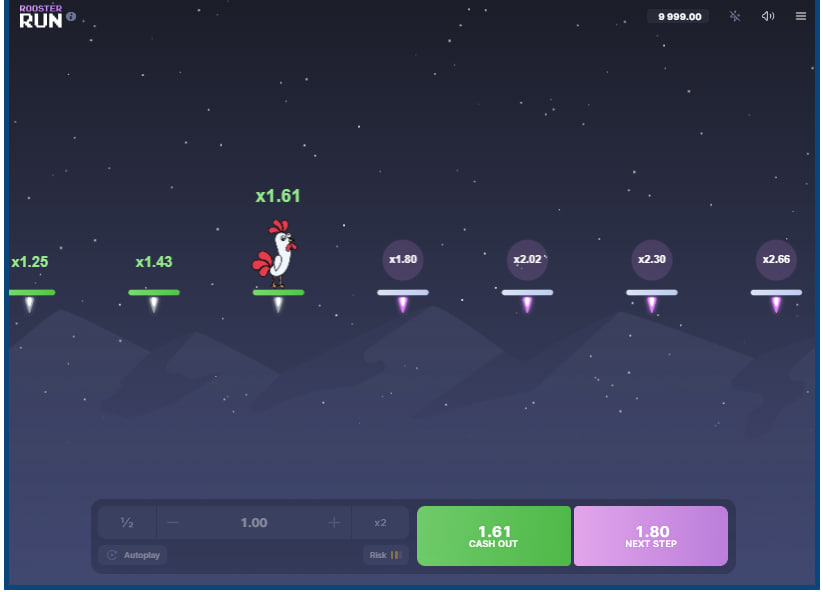
At its heart, Rooster Run is a crash game where participants place a wager and watch a multiplier increase as the rooster successfully hops from one platform to the next. The pivotal decision is to cash out before the rooster “slips and falls,” which results in the loss of the staked amount. What sets Rooster Run apart is the player’s ability to choose a Risk Level prior to commencing a round: Low, Medium, or High. Each level dictates the number of platforms (termed “lines” in the game’s rules – 30, 25, and 21 respectively) and, crucially, the potential maximum multiplier, peaking at a significant x21.49 for Low, x2287.23 for Medium, and a substantial x10000 for High risk. This choice is not merely cosmetic; it fundamentally alters the game’s volatility and the strategic approach required. A lower risk implies more frequent, smaller potential wins across more steps, while higher risk offers a shorter, more precarious path to much larger multipliers.
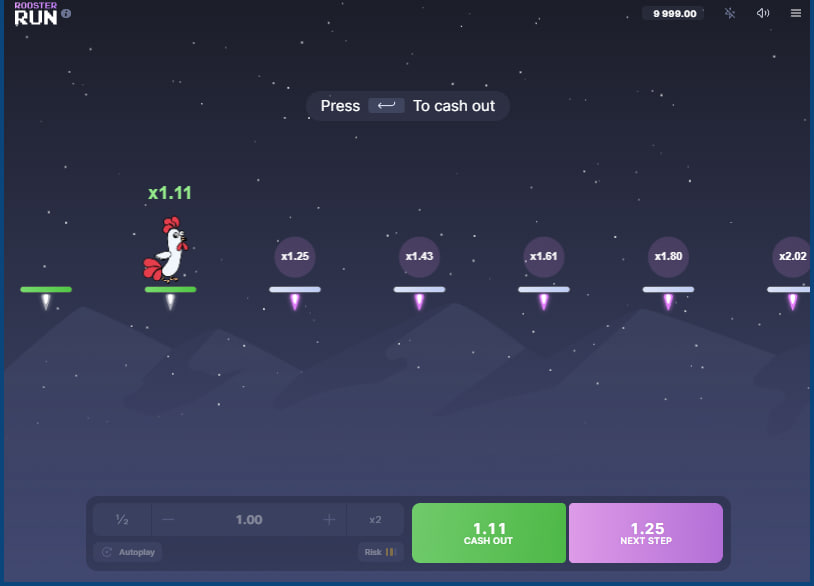
The betting process is straightforward: set a bet amount and initiate the round. Once the rooster begins its ascent, the “BET” button transforms into two distinct options: “CASHOUT” and “FORWARD” (or “NEXT STEP”). This dual-button system is a key element, requiring an active decision to proceed (“FORWARD”) to the next platform and its associated higher multiplier, rather than passively watching the multiplier climb. Each press of “FORWARD” carries the inherent risk of failure. This active engagement in progressing the round heightens the sense of control, and consequently, the tension, as each jump is a conscious gamble. The visual representation of the rooster and platforms directly correlates with this mechanical tension – each successful jump visibly brings the rooster closer to higher rewards but also, metaphorically, closer to a potential misstep.
Advanced Mechanics: Automation, Progression, and Social Elements
Rooster Run incorporates several features that add depth beyond the core jump-and-cashout loop, catering to varied play styles and long-term engagement. The Autoplay function is notably versatile. Players can configure the number of rounds, the desired risk level, and a target multiplier. Critically, it offers two distinct modes: “Step-by-step” and “Instant.” “Step-by-step” automates the rooster’s jumps platform by platform, pausing briefly and allowing manual cashout override, offering a semi-automated experience with maintained control. “Instant” mode attempts to reach the target multiplier in a single leap, resulting in either success or an immediate crash if the target is not achieved. This caters to players seeking rapid outcomes. Furthermore, autoplay can be tailored with stop conditions based on balance increases, decreases, or a significant single win, providing robust bankroll management tools within the automated system.
A Ranking System introduces a gamified progression layer. Players increase their rank based on the cumulative amount of their bets placed within the Rooster Run game over a calendar year. Advancing in rank unlocks cosmetic customization options, such as different cell colors and new avatars. While these customizations do not influence gameplay outcomes, they offer a visual indicator of experience and loyalty to this specific game, potentially fostering a sense of achievement and personalization. The calendar year basis for rank calculation suggests a periodic reset or a long-term dedication path.
The game also features a Bets Table, which adds a social or informational dimension. This table is divided into “All Bets,” “Top,” and “My Bets.” “All Bets” displays wagers from other players in the current round, including their avatar, bet amount, cashout multiplier, and winnings. “Top” showcases the largest wins achieved in the game over the calendar year. “My Bets” provides a personal history of wagers and outcomes. Observing others’ bets and successes (or failures) can subtly influence a player’s own risk assessment and decision-making, creating a communal, albeit indirect, experience.
Unique Attributes and Strategic Considerations
The most pronounced unique attribute of Rooster Run is the explicit choice of risk levels directly tied to the number of progression steps (platforms) and multiplier scaling. This gives experienced players a clear framework for tailoring their sessions to their preferred volatility and strategy. Unlike some crash games where the probability of a crash might feel entirely opaque or uniformly random on each tick of the multiplier, Rooster Run’s “lines” system suggests a finite number of decision points for each risk tier. While the exact probability of a “slip” per jump is not detailed, the structure implies that reaching the end of a 21-platform high-risk run is inherently more challenging, yet more rewarding, than navigating a 30-platform low-risk path.
The “FORWARD” button, requiring active player input to advance, differentiates the game from passive multiplier-watching. It forces a moment-to-moment re-evaluation of risk versus reward. This creates a more deliberate pacing where each jump is a distinct choice. The strategy, therefore, revolves around understanding one’s own risk tolerance in the context of the chosen risk level and the current multiplier achieved. For instance, a player on a high-risk setting might adopt a more aggressive early cashout strategy due to the perceived higher chance of a fall on fewer platforms, or they might leverage the high potential by pushing further, knowing the jumps are fewer but the rewards escalate sharply.
The Autoplay’s “Step-by-step” mode with manual cashout capability is another strong point, blending automation’s convenience with the player’s ultimate control – a feature that should resonate well with experienced users who value strategic oversight even during automated sessions.
Rooster Run by Mascot Gaming is a thoughtfully designed crash game that successfully injects strategic depth into a simple premise. The customizable risk levels, coupled with the active “FORWARD” mechanic, give players a significant degree of control over their experience and potential outcomes. The game’s high volatility, especially at the upper risk tiers (with a stated overall game RTP of 95%), means that while substantial multipliers up to x10000 are possible, so are swift losses.
The additional features like nuanced Autoplay, the cosmetic-driven Ranking System, and the informational Bets Table round out the offering, providing tools for convenience and longer-term engagement. It avoids being a mere reskin of existing crash titles by focusing on these distinct interactive elements.
For experienced players who appreciate crash games but seek more direct influence over risk parameters and game progression, Rooster Run offers a compelling and potentially rewarding challenge. Its design encourages calculated decision-making rather than pure chance-chasing. The game may not appeal to those seeking visually elaborate themes or complex narrative structures, but for aficionados of the pure risk-reward tension inherent in crash games, Rooster Run provides a well-executed and strategically engaging platform. It is a commendable iteration within its genre, recommended for players who understand and can manage the inherent volatility of such high-risk, high-reward mechanics.