
Plinko by TrueLab is a highly volatile arcade-style instant win game featuring an adjustable 8 to 16-line grid and a 96.01% RTP. Players drop balls down a pegboard to hit multiplier slots, with the potential to win up to 5,000x the bet. The game includes customizable risk levels and optional buy features like the Hot Gate and Free Ball. With a dark, neon-lit casino atmosphere, it delivers a fast-paced, math-driven experience where gravity and a certified RNG determine every payout.

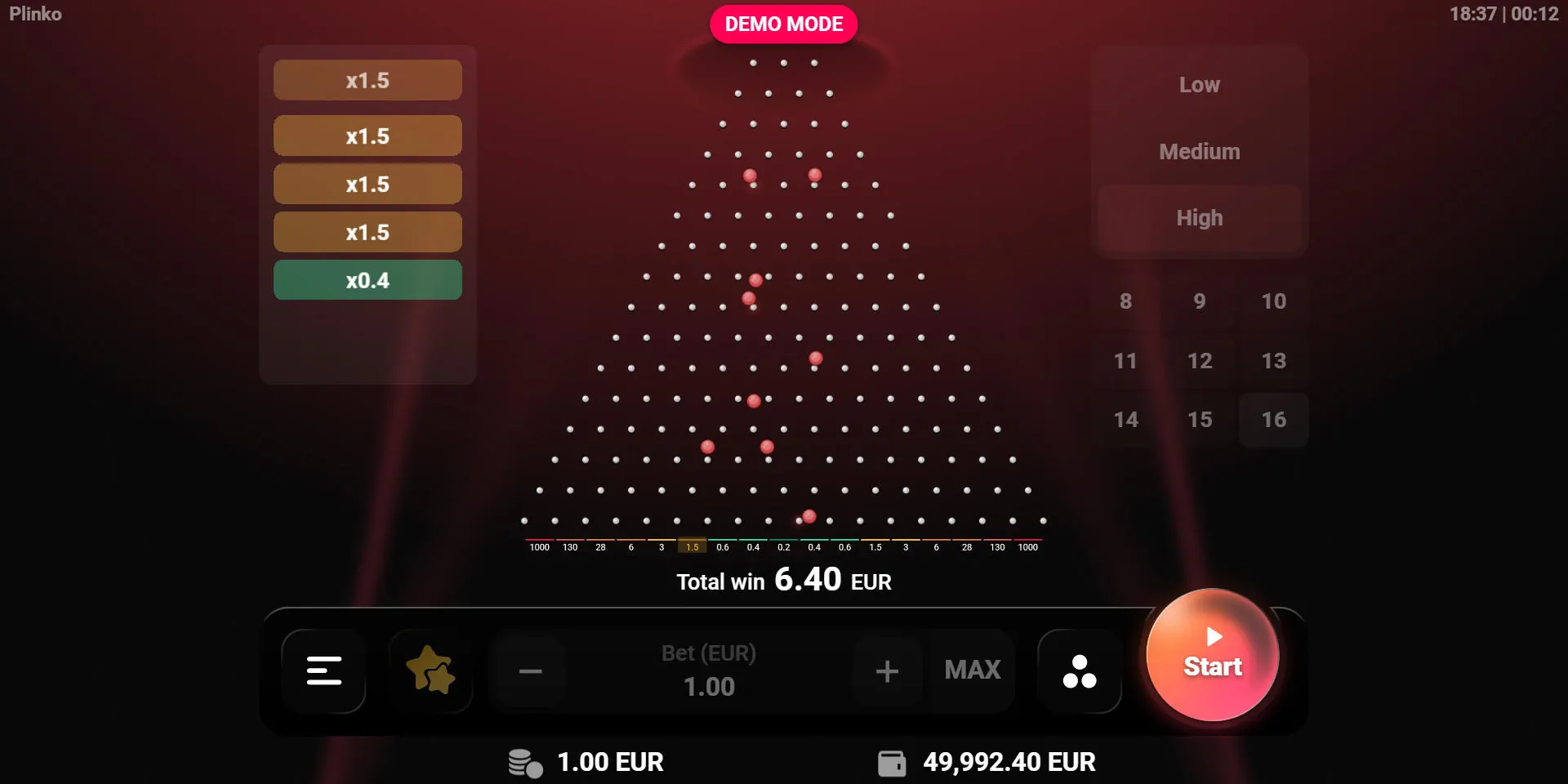
The core loop relies on a customizable pyramid of pins. You adjust the rows from 8 to 16. This directly alters the number of multiplier slots at the bottom. Pushing the grid to 16 lines on High risk creates a brutal variance scenario. The center slots offer dead-spin equivalents of 0.2x returns. The extreme outer edges hold the massive 1000x payouts. The visual feedback shifts with your settings. Low risk keeps the board bathed in a safe green glow. Medium warms it up to a yellow-orange hue. High risk turns the background a harsh red. TrueLab bolted on two optional buy features. The Hot Gate spawns two horizontal pink energy barriers between random pins. If a ball passes through, it changes color and picks up a x2, x3, or x5 multiplier, depending on your risk setting. If it hits multiple gates, only the highest multiplier sticks. The Free Ball feature adds two blue slots at the base. Landing a ball in these triggers 2, 3, or 5 extra drops without deducting from the balance. Activating these features inflates the cost of the spin significantly. The rules state the Hot Gate costs 7x the base bet, while the Free Ball costs 4x. Grinding through 200 drops with both features active is a fast track to zero if those outer slots refuse to hit.
The physics engine feels weighty. But the trajectory is predetermined the millisecond you hit the Spacebar or Enter key to start the drop. The visual bounce is just window dressing for the math model. Players looking for a slow session will hate the multi-drop function. Firing 100 balls at once turns the screen into a chaotic waterfall. The total win counter struggles to keep up with the rapid-fire math. It is a highly volatile setup designed for players who understand that chasing the 5,000x cap requires surviving endless streaks of 0.2x returns. The design is sleek. The dark background and neon accents serve one purpose: keeping your eyes glued to the ball drops while your balance quietly drains. Traditional slot players looking for free spin bonuses and wild symbols will bounce off this immediately. This is pure, unfiltered math visualized as a falling ball. TrueLab usually focuses on narrative slots, so this arcade pivot feels like a raw cash grab aimed at the crypto-casino crowd. My recommendation is to treat this as a high-risk novelty. The potential profitability is entirely dependent on hitting the outer slots. If you miss, the house edge grinds you down fast. The RNG is certified by labs like iTech Labs and GLI, ensuring the drops are fair. Fair does not mean forgiving.
The Mathematical Meatgrinder: Risk vs. Lines
Adjusting the risk level is the primary way to control the bleeding. Low risk flattens the multiplier curve. This ensures the center slots return at least 0.5x to 1x your bet. This keeps the balance afloat during long sessions. High risk guts the middle completely. It drops the central returns to a punishing 0.2x and pushes all the RTP weight to the extreme edges.
Playing on High risk is a war of attrition. You will watch dozens of balls funnel straight down the middle, returning pennies on the dollar. The 96.01% RTP feels distant when the board is red and the balls refuse to bounce outward. The math model demands a massive bankroll if you plan to survive the dry streaks waiting for that one rogue bounce to the outer edge.
The 16-Line Trap
Expanding the grid to 16 lines is where the 5,000x maximum win becomes theoretically possible. It also creates the widest possible spread of dead zones. The distance from the drop point to the outer slots increases. The ball has to win a massive sequence of 50/50 directional coin flips to reach the jackpot. Dropping the lines down to 8 creates a tighter, less volatile game. It caps the maximum potential drastically.
The 16-line setup is a trap for players chasing the top multiplier. The sheer volume of pins acts as a funnel, forcing the vast majority of drops into the low-paying center. The cost of chasing the edge slots on 16 lines will drain a standard deposit in minutes if you run bad.
TrueLab’s Pay-to-Juice Features
The Hot Gate feature attempts to inject slot-style multipliers into the pegboard. Paying the premium spawns two pink gates. Hitting them feels rewarding because the ball changes color. The math reveals a different story. A x5 multiplier on a 0.2x center slot still only returns your base bet.
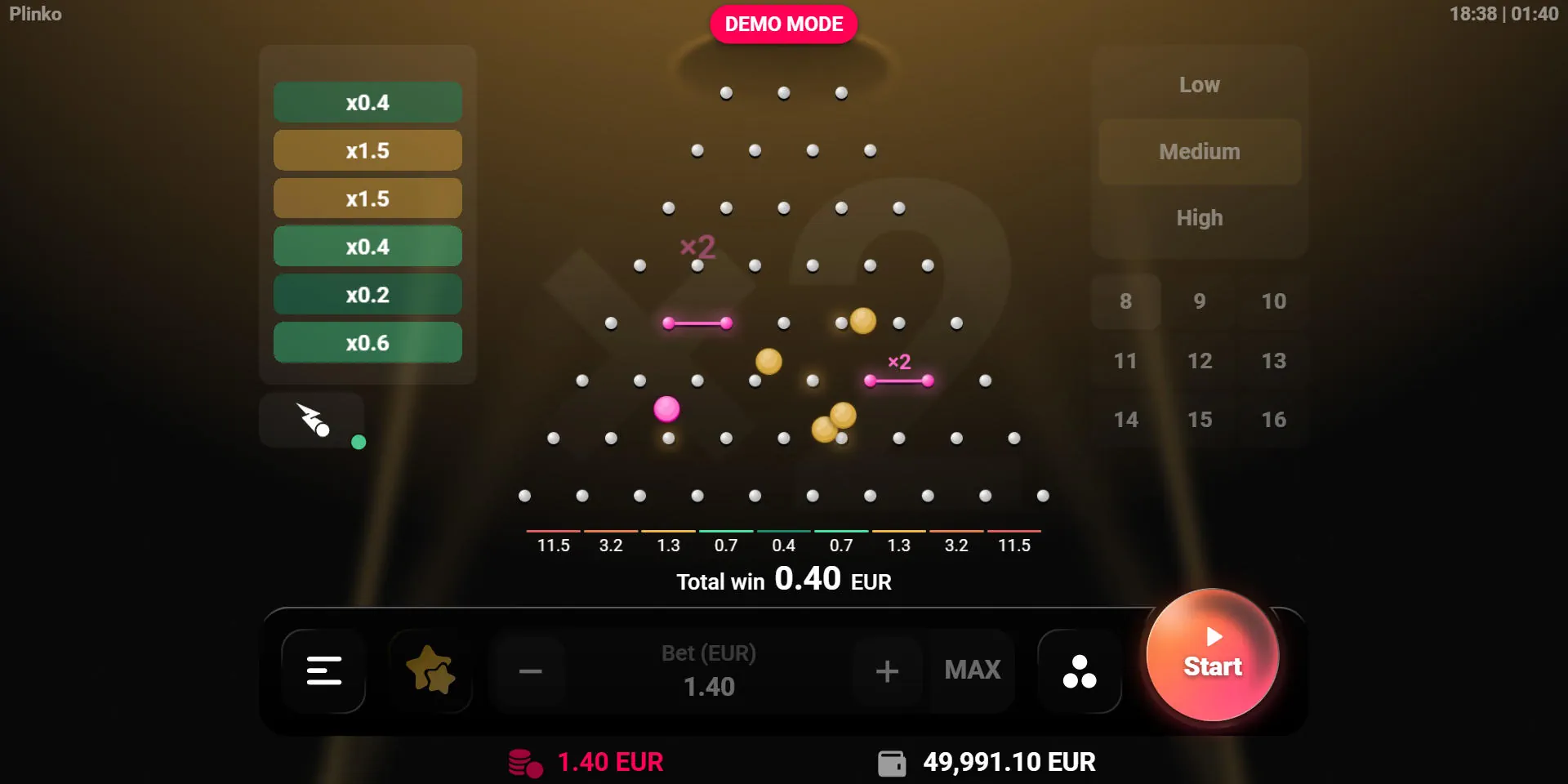
The math only breaks when a Hot Gate ball manages to bounce to an outer slot. A 1,000x slot multiplied by a x5 Hot Gate hits the 5,000x hard cap instantly. The gates spawn randomly. Sometimes they appear at the very edges where balls rarely travel. This makes the premium payment a complete dead loss for that drop.
Adding the Free Ball feature places two blue targets at the bottom of the grid. Landing in one awards up to 5 free drops. It sounds like a solid way to extend playtime. The activation cost eats into the balance fast.
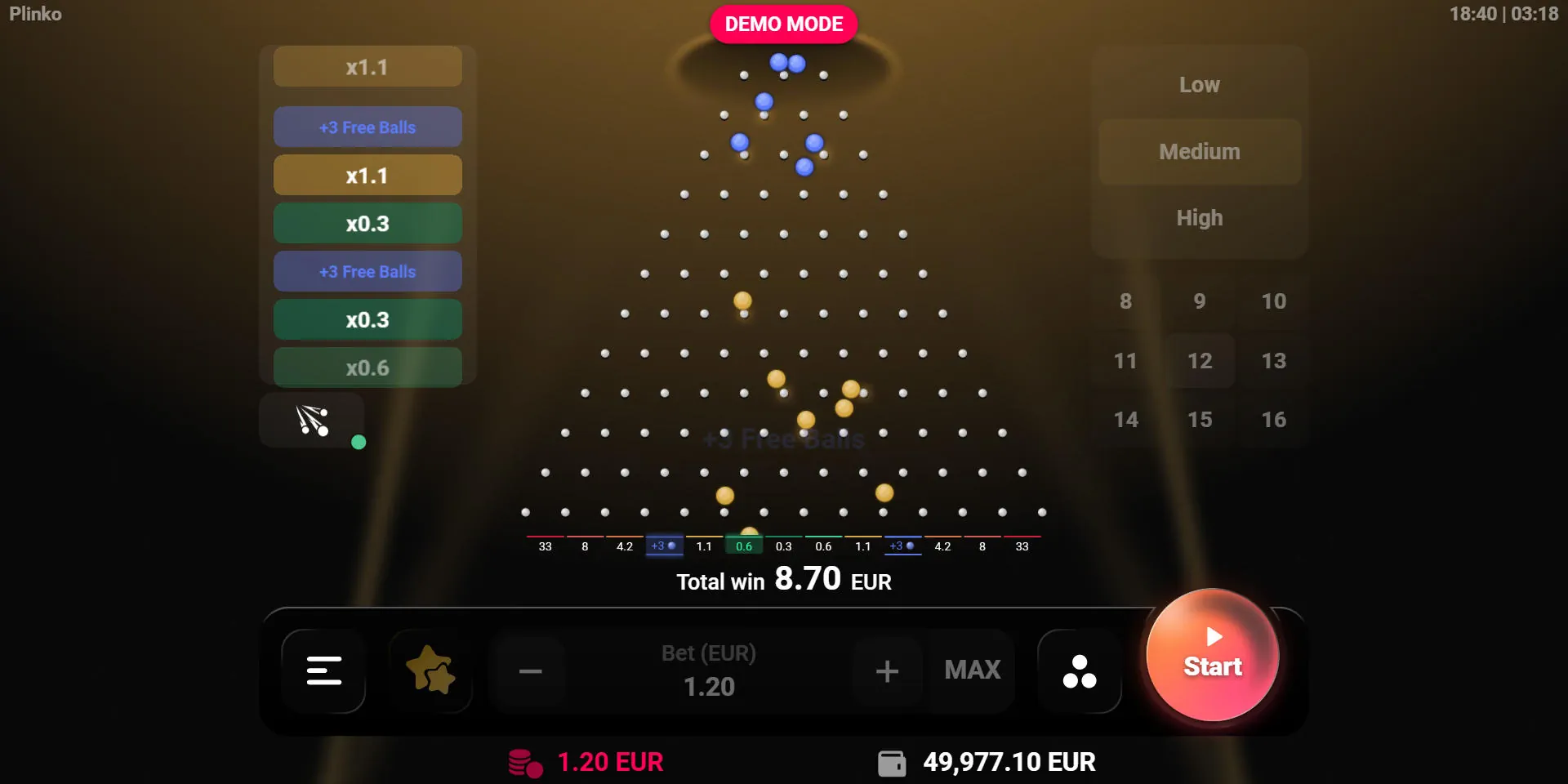
The blue slots often replace mid-tier multiplier slots. You are trading a guaranteed small cash return for the chance at free drops. When the free balls trigger and proceed to land in 0.2x center slots, the illusion of winning shatters. It is a high-risk trade-off that only pays off if the free drops manage to hit the outer edges.
Bankroll Drain & Ergonomics
TrueLab included a feature that lets you drop up to 1,000 balls simultaneously. Setting the counter to 100 and hitting start is the fastest way to zero a balance I have seen. The game processes the drops in rapid succession. It creates a visual traffic jam of spheres.
This multi-drop function bypasses the psychological weight of individual bets. You are no longer watching a single drop. You are watching a macro-RTP simulation play out in real-time. If you hit a bad seed in the RNG, your balance will vanish before the last ball even hits the bottom.
The settings menu is clean. It offers separate volume sliders for sound effects and music, plus a reality check feature and a full-screen toggle. The lack of a detailed statistics page showing your personal hit rate on the outer slots is a missed opportunity. You are left guessing how much you are truly losing to the center slots.
The Autopsy Report
The documentation and UI hold a few specific details that control how this game runs under the hood. TrueLab built this with specific parameters that alter the standard pegboard math.
- The game runs on rules version 1.0.0, finalized on September 19, 2024, with a future release date of March 24, 2026.
- The maximum recorded multiplier win is strictly capped at 5,000x the bet, meaning any Hot Gate combinations exceeding this will be truncated.
- A single ball can pass through multiple Hot Gates, but the multipliers do not stack; the engine only applies the highest value.
- The Hot Gate multiplier values are directly tied to the risk level, maxing out at x5 on High risk.
- The game is built on HTML5 architecture, ensuring the physics engine runs smoothly on mobile devices without dropping frames during 1,000-ball drops.
- The RNG engine is certified to ensure each pin bounce is an independent event, completely detached from previous drops.
FAQ
Where can I play the demo version of Plinko?
The Plinko demo is available to play for free on Respinix.com.
What is the maximum win in Plinko?
The maximum payout is hard-capped at 5,000x your base bet.
How does the Hot Gate feature work?
It adds two pink barriers that multiply the ball’s final payout by x2, x3, or x5 if it passes through them.
Can I change the volatility in Plinko?
Yes, you can manually select Low, Medium, or High risk levels to adjust the multiplier distribution.
What is the RTP of Plinko by TrueLab?
The game operates with a fixed Return to Player rate of 96.01%.