Platipus’s Oasis Poker is a sharp take on classic casino card games. This strategic table game has a 98.96% RTP and its defining twist: pay to exchange cards.
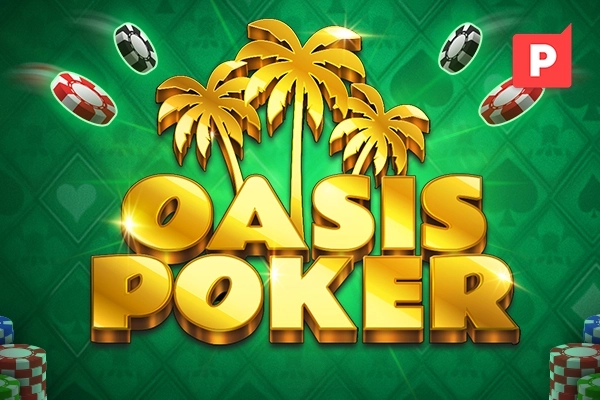 Oasis Poker
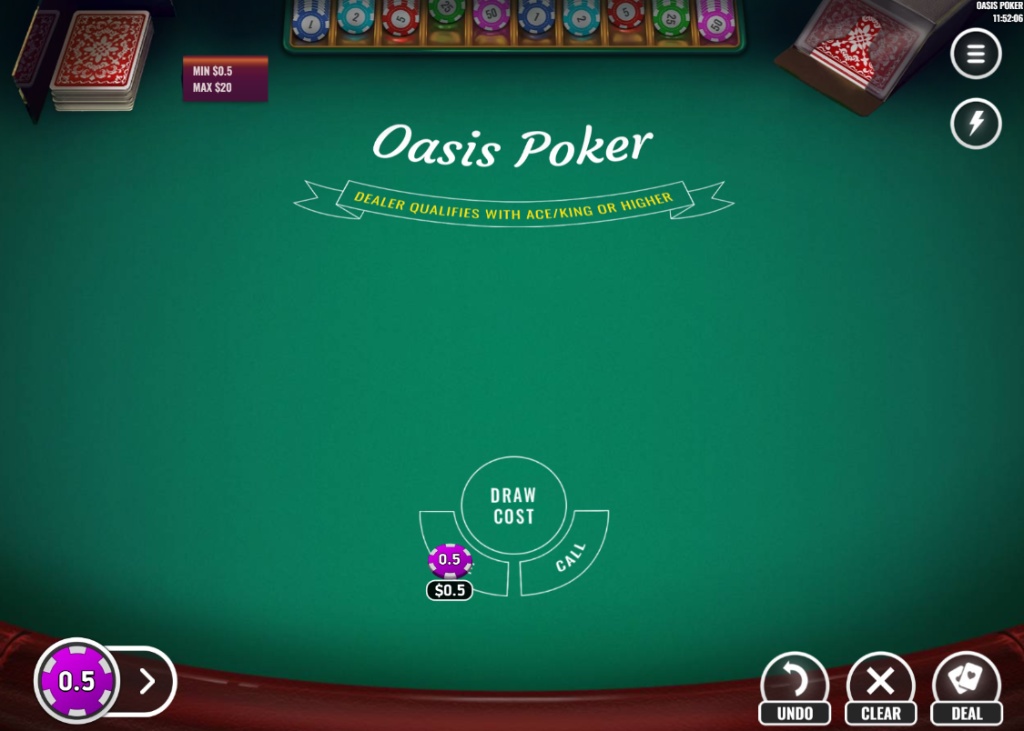
Oasis Poker Game Features
| Feature Name | Description | Trigger / How it Works |
|---|---|---|
| Ante Bet | The initial mandatory bet to start the game and receive cards. | Place a bet in the ‘Ante' circle before pressing ‘Deal'. |
| Card Exchange (Draw) | The game's signature feature, allowing the player to discard and replace 1-5 cards for a fee. | After the initial deal, select the cards to discard and press ‘Draw'. |
| Draw Cost | A fee paid to exchange cards. The cost varies based on the number of cards exchanged. | The fee is automatically deducted. 1 card costs 1x Ante, 2 cards cost 2x Ante, 3 cards cost 3x Ante, 4 cards cost 2x Ante, and 5 cards cost 1x Ante + a forced Call bet. |
| Call Bet | The main bet, placed after the draw decision, to challenge the dealer's hand. It is always 2x the Ante. | After deciding whether to draw or stand pat, press the ‘Call' (or Bet) button. |
| Dealer Qualification | The dealer must have a hand of at least Ace-King high to “play”. | This is an automatic game rule. If the dealer does not qualify, the Ante bet wins 1:1 and the Call bet is a push. |
How Does the Oasis Poker Game Work?
Oasis Poker is a casino poker game where you play against a dealer, with the unique option to pay a fee to exchange one to five cards to improve your hand. The objective is simple: make a better five-card poker hand than the dealer. The game uses a standard 52-card deck.
The entire process is a series of strategic decisions that directly impact your outcome, a feature common in many stimulating Table Games available in our library of free demo games.
The Initial Deal: Understanding the Ante and Upcard
To begin a round, you must place an Ante bet. Once you hit ‘Deal', you and the dealer each receive five cards. Your cards are dealt face up, while the dealer receives four cards face down and one card face up.
This single dealer upcard is the most critical piece of information you have. It's your only clue to the potential strength of the dealer's hand and informs every decision you make from this point forward. It separates this game from standard Video Poker titles, where you play against a static paytable rather than an opponent's hand.
The Core Decision: To Draw or Not to Draw?
Here lies the heart of the Oasis Poker game. You now have the option to discard any number of your cards and draw new ones. This action, however, is not free. The Draw Cost is a multiple of your initial Ante bet. Exchanging one card costs 1x your Ante, two cards cost 2x, and three cards cost a hefty 3x your Ante.
Interestingly, the costs for four and five cards are structured differently to discourage rash decisions. Swapping four cards costs 2x the Ante, and swapping all five costs 1x the Ante but also forces you to place the subsequent Call bet immediately. This is a strategic puzzle that sets it apart from simpler Card games.
Showdown: The Rules of the Call and Dealer Qualification
After you've made your draw decision (or chosen to stand pat), you face the final choice: Fold or Call. Folding forfeits your Ante bet and ends the hand. To Call, you must place an additional bet that is exactly double your Ante.
Once the Call bet is placed, the dealer reveals their hand. The first check is for Dealer Qualification. The dealer’s hand must contain at least an Ace and a King or a higher-ranked hand (like a pair) to “qualify.”
- If the dealer does not qualify: You win even money (1:1) on your Ante bet, and your Call bet is returned as a push. Your hand's strength doesn't matter.
- If the dealer qualifies: The hands are compared. If your hand is better, you win 1:1 on your Ante, and the Call bet is paid according to the game's paytable. If the dealer's hand is better, you lose both bets.
What is the Optimal Strategy for Oasis Poker?
The optimal strategy in Oasis Poker centers on selectively paying to exchange cards, primarily when drawing to strong hands like four-card flushes or straights, and always calling with a pair or better. Unlike the pure chance of a game like Roulette Nouveau, every choice here has a mathematical weight.
Vlad Hvalov's Expert Tip: “The dealer's upcard is your most valuable piece of information. If the dealer shows an Ace or a King, your requirements for calling should be much higher. If they show a 7, even a weak pair in your hand looks much stronger.”
When Should You Exchange Cards?
Deciding when to pay the draw cost is the key to mastering the Oasis Poker demo. It’s not about chasing every possibility, but about investing in hands with a high probability of significant improvement.
As a general rule, you should only consider drawing one card. The cost for drawing two or three cards is prohibitively expensive and rarely pays off. The most common scenarios for a one-card draw are when you hold four cards to a flush (a 19% chance to complete) or four cards to an open-ended straight (a 17% chance to complete). Drawing to improve a pair to three of a kind or two pair is also a valid, though less frequent, play.
The Fold vs. Call Decision: A Mathematical Approach
Your decision to call or fold should be straightforward. You should always Call with a pair or better. Your primary goal is to beat the dealer's qualifying hand, and any pair gives you a statistical edge. Folding a pair is the single biggest mistake a player can make in this game.
You should also Call with Ace-King, especially if your other cards are high (e.g., A-K-Q-J-x). This gives you a strong high-card hand that can beat the dealer if they also qualify with a weaker Ace-King. In all other situations—when you have less than an Ace-King high—you should fold unless you are drawing to a very strong hand.
The Five-Card Draw Trap: A Contrarian View
At first glance, drawing five new cards for the cost of a single Ante seems like a bargain. This is a clever trap. The rules state that a five-card draw costs 1x Ante plus an immediate and forced Call bet. This means you are committing three times your Ante (1 for the draw, 2 for the call) completely blind, with no knowledge of what your new hand will be.
The odds of receiving a strong hand from a random five-card draw are incredibly low. This move eliminates all strategy from your decision and turns the game into a pure lottery with terrible odds. It's a sucker bet, and a disciplined player will never make it. It's a far cry from the controlled risk you see in a game like Blackjack Surrender.
Vlad Hvalov's Self-Control Tip: “The temptation in the Oasis Poker demo is to always try and ‘fix' a hand by drawing. Set a rule for your session: only pay for a draw if you have four cards to a flush, an open-ended straight, or a pair you're trying to improve to trips. This prevents draining your balance on hopeless hands.”
Is Oasis Poker Watchable? A Streamer's Verdict
So, does this game have what it takes to entertain an audience on Twitch or YouTube? Let's break it down.
Visually, it's clean and functional. It’s a classic digital card table. There are no flashy animations or explosive effects like you’d find in Gates of Olympus 1000. The appeal here is minimalist and focused. The game's tension comes from the decisions, not the graphics.
The potential for hype moments is surprisingly high. While the pacing is slower than a typical slot, the decision to draw one card to a Royal Flush or Straight Flush is peak content. A streamer explaining their reasoning, paying the fee, and then hitting that one perfect card for a 100:1 payout is a clip that would go viral in the community. The slow build-up makes the payoff that much more dramatic.
The game is best suited for a specific type of streamer: the strategist. The one who can articulate their thought process, explain the odds, and teach the audience. It’s less of a background-noise game and more of an interactive lesson in optimal poker play. For that niche, it's perfect. For channels built on non-stop action, it might be too slow.
The Royal Court: More Than Just Pictures
While playing, it's easy to see the cards as just tools. But in the long history of Classic games, these symbols carried weight and stories.
| Symbol | Its Historical Significance |
|---|---|
| King | These cards traditionally represent great rulers from history—Charlemagne (Hearts), Julius Caesar (Diamonds), Alexander the Great (Clubs), and King David (Spades). In poker, holding a King is wielding a piece of that authority. |
| Queen | The Queen cards are often linked to powerful female figures, whether mythological goddesses or historical royalty like Judith (Hearts) or Pallas Athena (Spades). She represents wisdom and power, second only to the King. |
| Jack | Known historically as the “Knave,” the Jack represents a loyal knight or squire. He is the lowest-ranking member of the royal court but is essential for making powerful hands and often acts as the pivotal card in a straight. |
Understanding the Payouts and RTP
The pay structure in Oasis Poker is split. The Ante bet, if you win, always pays 1:1. The real money is in the Call bet, which has a tiered payout system for strong hands. The RTP of 98.96% is a theoretical figure based on playing with a perfect strategy.
A Breakdown of the Oasis Poker Paytable
The payouts for the Call bet are what make a successful hand so rewarding. A simple Pair or Two Pair pays 1:1 and 2:1, respectively, which is your bread and butter. However, the potential skyrockets from there:
- Three of a Kind: 3:1
- Straight: 4:1
- Flush: 5:1
- Full House: 7:1
- Four of a Kind: 20:1
- Straight Flush: 50:1
- Royal Flush: 100:1
Achieving that Royal Flush with a $10 Ante would mean a $20 Call bet, resulting in a $2,000 payout on top of your returned wager. These high-tier payouts are the reason you strategically pay to draw cards.
How Does the 98.96% RTP Compare?
An RTP of 98.96% is very high for a Casino table game. It's significantly better than most online slots and is competitive with some variants of Blackjack and Baccarat.
However, this number comes with a crucial caveat: it is achievable only with optimal play. Every time a player makes a mistake—like folding a low pair, chasing an inside straight, or falling for the five-card draw trap—their personal RTP for that session drops. This high theoretical return is a reward for disciplined, mathematically sound decisions. For players looking for more straightforward high RTP games, something like Money Train 2 might be a better fit, as its value is locked into a more random bonus feature.
Oasis Poker Demo vs. Other Poker Variants
To truly appreciate what the Oasis Poker game offers, it's useful to see how it stacks up against its relatives in the poker world. Many games on our full list of themes have similar roots but play out very differently.
Oasis Poker vs. Caribbean Stud: The Key Difference
Oasis Poker is a direct descendant of Caribbean Stud Poker. They share the same core rules: five cards for player and dealer, dealer qualification, and the Ante/Call betting structure. The single, game-changing difference is the option to draw cards.
In Caribbean Stud, you are stuck with your initial five cards. Your only decision is to fold or call. This makes it a much simpler, faster game based purely on the luck of the initial deal. Oasis Poker introduces a profound layer of skill and strategy by allowing you to actively improve your hand, for a price.
How It Differs from Standard Video Poker
In traditional video poker games like Jacks or Better or a more modern take like Joker Maxima, you also get five cards and can draw new ones. However, there are two key distinctions. First, the draw is free. Second, there is no dealer. You are playing to achieve a minimum hand ranking on a static paytable.
Oasis Poker’s structure, with a dealer and the qualification rule, creates a more dynamic contest. You aren't just trying to make a good hand; you're trying to make a hand that is better than your opponent's, adding a competitive and psychological layer that video poker lacks.
Vlad Hvalov's Expert Tip: “Players often overpay to chase inside straights. Unless you have high cards to fall back on, paying an Ante to chase one of four outs is a losing proposition in the long run. Stick to open-ended straights and four-card flushes.”
Games with a Similar Strategic Feel
If the calculated, decision-based gameplay of Oasis Poker appeals to you, there are other titles that scratch a similar itch, even with different themes and mechanics.
- Royal Riches Roulette: While Roulette is a game of chance, this specific variant adds layers of side bets and bonus payouts that require a strategic approach to bet placement, moving beyond a simple red-or-black choice.
- Wild Heist at Peacock Manor: A slot game, yes, but its bonus round involves picking features like multipliers and walking wilds. This pre-bonus strategy phase, where you build your own feature, echoes the decision-making of improving your hand in Oasis Poker.
- Danger High Voltage: This iconic slot from Big Time Gaming famously offers two distinct free spins features. Choosing between the high-volatility “Gates of Hell” sticky wilds and the “High Voltage” wild reel requires the player to assess risk and reward, a mental exercise familiar to any Oasis Poker player.
Final Thoughts
I think Oasis Poker is an outstanding game for a specific type of player. If you're looking for mind-numbing spins and flashy lights, this isn't it. This is a game that respects your intelligence. It provides you with a set of tools and asks you to make the right call. The paid draw mechanic is a brilliant twist that elevates a simple card game into a compelling strategic exercise.
It perfectly fits the Platipus philosophy: solid, well-executed mechanics are more important than superfluous flair. The game doesn't scream for your attention; it earns your respect through its clever design. For anyone wanting to sharpen their poker skills, understand probabilities, or just enjoy a more engaging alternative to standard casino poker, the Oasis Poker demo is an absolute must-play. I recommend it. It's a thinking person's game, and it's better for it.
FAQ
What is the main difference in Oasis Poker?
The key difference is the option to pay a fee, based on your Ante bet, to exchange one to five cards to improve your hand against the dealer.
What does it mean for the dealer to ‘qualify' in Oasis Poker?
The dealer must have a hand containing at least an Ace and a King; otherwise, your Ante bet wins automatically and your Call bet is returned.
Is it a good strategy to exchange all five cards in Oasis Poker?
No, it is a very poor strategy because it forces you to make a blind Call bet, committing 3x your Ante on a completely random new hand.
What is the highest payout in the Oasis Poker game?
The highest payout is 100-to-1 on your Call bet for achieving a Royal Flush.
Is Oasis Poker a game of skill or luck?
It's a blend of both; while the cards dealt are luck, the decisions on when to draw and call are based on skill and strategy.
Where can I play the Oasis Poker demo for free?
A free demo version of the Oasis Poker game is available to play directly on the Respinix.com website.
What is the RTP of the Oasis Poker game by Platipus?
The theoretical Return to Player (RTP) for Oasis Poker is 98.96%, assuming optimal strategy is used.
Should I always place the Call bet with a pair?
Yes, optimal strategy dictates that you should always make the Call bet when your hand contains any pair or better.