
Neon Plinko Dice by Darwin Gaming offers a captivating chance-based experience, distinct from traditional reel slots. The game presents a minimalist neon aesthetic, focusing on a pyramid-shaped board where dice descend through a field of pins. This title cleverly revitalizes the classic Plinko concept, challenging players to anticipate the final resting place of their dice within 15 multiplier slots. Gameplay centers around purchasing dice, singularly or in packs, with four dice types (1x, 2x, 5x, 10x) whose appearance frequencies shift with pack selection. Winnings are a product of individual die cost, the die’s intrinsic value, and the achieved slot multiplier. A key feature is this dynamic dice value distribution, adding a subtle strategic consideration to each round. With a strong RTP of 97.00%, Neon Plinko Dice provides a transparent and engaging arcade-style diversion. The core appeal lies in its straightforward mechanics and the visual journey of each die.


For the seasoned player accustomed to the intricacies of digital gaming, Neon Plinko Dice by Darwin Gaming offers a distinct diversion from the common reel-based slot architecture. This title revisits the classic Plinko concept, a game of chance rooted in physics-based probability, and presents it with a contemporary neon aesthetic. It eschews traditional paylines and symbol combinations for a more direct, yet potentially nuanced, descent into fortune. This review will dissect its mechanics, payout structure, and overall appeal to an audience seeking transparent and engaging gameplay.
Visual Presentation and Atmospheric Design
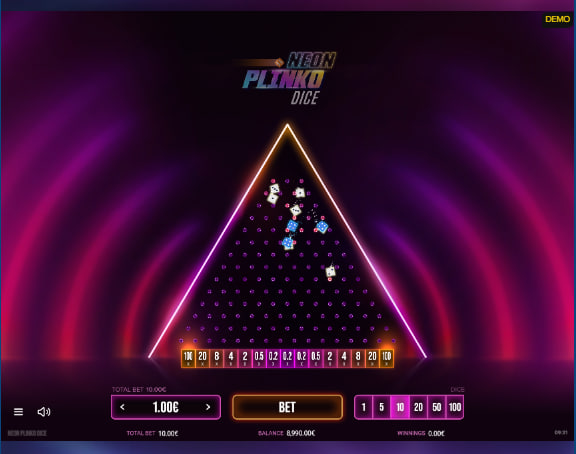
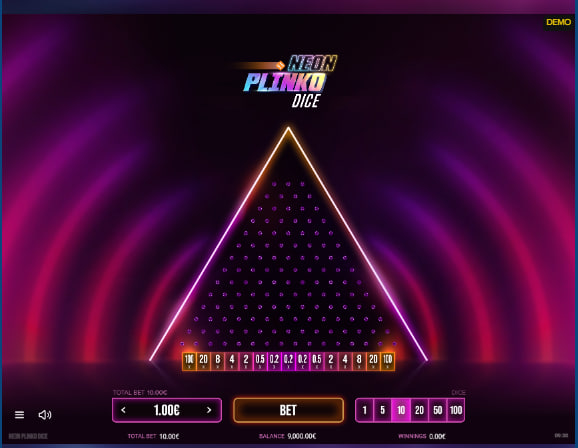
Neon Plinko Dice immediately establishes a minimalist yet visually striking environment. The game screen is dominated by a triangular pegboard, outlined in vibrant neon, set against a pulsating background of concentric magenta and purple light waves. This choice creates a retro-futuristic ambiance, reminiscent of 80s arcade halls or Tron-esque digital landscapes, but with a clean, modern execution. There are no superfluous characters or narrative elements; the focus remains squarely on the game board and the falling dice.
The sound design complements this visual approach. Expect synthesized tones and subtle effects accompanying the dice drops and their interactions with the pegs. This auditory feedback is functional, enhancing the anticipation of where each die will ultimately settle without becoming distracting. The overall atmosphere is one of focused simplicity, allowing players to concentrate on the game’s probabilistic nature.
Core Gameplay Mechanics: A Cascade of Chance
The fundamental operation of Neon Plinko Dice is straightforward. Players initiate a round by placing a bet, which then releases one or more dice from the apex of the triangular pegboard. These dice, rendered as classic six-sided cubes, tumble downwards, their paths randomly altered by a dense field of illuminated pegs. The objective is for the dice to land in one of several designated multiplier slots arrayed along the base of the pyramid.
Unlike slot machines where outcomes are determined by RNGs simulating reel stops, Plinko offers a visual representation of random distribution. Each peg encountered by a die presents a binary directional choice – left or right – leading to a cascade of these small deviations that ultimately determines the final resting slot. The game allows for the selection of the number of dice to be dropped per round, from a single die up to a pack of 100, impacting the total wager and the pace of play.
The Strategic Nuance: Dice Types and Pack Selection
A significant layer of mechanical depth in Neon Plinko Dice comes from the introduction of four distinct dice types, each carrying an inherent value: 1x, 2x, 5x, and 10x. This “Dice Value” is a crucial component in the final win calculation. More intriguingly, the game states that the relative frequency of these dice types varies between dice packs. When a player adjusts the number of dice to purchase for a round (e.g., 1, 5, 10, 20, 50, 100), the game interface graphically indicates a shift in the probable distribution of these dice values.
This mechanic introduces a subtle strategic consideration. While the player cannot choose specific dice values, the selection of a particular dice pack subtly alters the statistical profile of the dice entering play. A player might observe that larger packs, for instance, could potentially favor a different distribution of dice values compared to smaller ones, or vice-versa. This element prevents the game from being a purely passive experience, allowing for a degree of player agency in shaping the potential value of the dice before they even begin their descent. The cost per die remains constant for a given bet level, with the total bet simply being the cost per die multiplied by the number of dice selected.
Multiplier Array and Payout Determination
At the base of the Plinko pyramid are 15 distinct slots, which house 7 unique multiplier values. Based on the provided visuals, these appear symmetrically distributed, starting with lower values towards the center and increasing towards the edges. The typical array seen is: 100x, 20x, 8x, 4x, 2x, 0.5x, 0.2x, 0.2x, 0.5x, 2x, 4x, 8x, 20x, 100x. This symmetrical distribution is a classic Plinko characteristic, creating a bell curve-like probability where dice are statistically more likely to land in the central, lower-multiplier slots, while the high-multiplier slots on the peripheries are less frequently hit but offer greater rewards.
The calculation for winnings per die is transparent and explicitly stated:
Winnings = Individual Die Cost x Dice Value x Multiplier.
For example, if a player’s individual die cost is $1.00, a 2x Dice Value die lands in a 4x Multiplier slot, the win for that specific die would be $1.00 x 2 x 4 = $8.00. When multiple dice are purchased in a pack, the game aggregates the winnings from all individual dice after they have come to rest, presenting a total win for that round. This direct formula allows players to readily understand how outcomes are derived.
Return to Player and Statistical Profile
Neon Plinko Dice reports an overall Return to Player (RTP) of 97.00%. This figure, representing the long-term theoretical percentage of wagers returned to players, is notably competitive, especially when compared to many contemporary video slots. The RTP is calculated over an extensive simulation of 100 million plays, conducted by an independent testing company, ensuring its adherence to regulatory compliance.
For the experienced player, a 97.00% RTP signifies a game with a relatively lower house edge over extended play. While short-term results will always exhibit high variance due to the nature of chance-based games, this RTP suggests a more favorable statistical proposition for sustained engagement compared to games with lower theoretical payback percentages. It’s important to remember that this figure does not guarantee individual session outcomes but reflects the game’s payout behavior over a vast number of iterations.
Neon Plinko Dice by Darwin Gaming successfully translates a classic arcade probability game into a sleek, modern digital format. Its strength lies in its transparency, the visually engaging descent of the dice, and the subtle strategic layer introduced by variable dice value frequencies tied to pack selection. The 97.00% RTP is a commendable aspect that will appeal to players conscious of statistical returns.
The game is not designed for those seeking complex narratives, intricate bonus rounds, or a multitude of special symbols. Instead, it caters to players who appreciate the purity of chance mechanics, the anticipation of a physical-like outcome, and a clear understanding of how winnings are achieved. The potential for repetition is inherent in its design, but the quick succession of rounds and the direct correlation between bet, dice value, and multiplier offer a consistently engaging core loop. For players looking for an alternative to traditional slots that offers a different kind of probabilistic thrill with a favorable statistical profile, Neon Plinko Dice warrants consideration as a well-executed and focused gaming experience.