
Miner Donkey Rider Crashback offers a focused crash game experience with a distinct mining theme. Developed likely by Play’n GO, the game presents a cartoonish prospector and donkey duo whose mine cart journey represents a rising multiplier. The core gameplay involves placing a bet and attempting to cash out before the round randomly crashes. Set within a cavern atmosphere, the visual presentation supports the simple yet tense anticipation. The game’s defining characteristic is the Crashback feature, allowing a potential re-entry into the same round after an initial cashout, albeit at an additional cost. This mechanic introduces a layer of post-decision strategy uncommon in standard crash games. While lacking traditional slot elements like reels or paylines, its high-volatility nature stems from the pursuit of multipliers up to a 5000x maximum against the risk of sudden loss.

Miner Donkey Rider Crashback enters the arena of online crash games, presenting a familiar core concept overlaid with a distinctive feature aimed at altering post-decision gameplay. Developed likely by a studio specializing in this increasingly popular genre , this title centers around the escalating multiplier mechanic common to crash games. Players are presented with a prospector and his trusty donkey in a mine cart, visually representing the rising potential payout against the ever-present risk of a sudden ‘crash’. What sets this iteration apart is the introduction of the ‘Crashback’ function, offering a potential route back into a round after an initial cashout has been secured. This review will dissect the game’s mechanics, the specific operation of its unique feature, the user interface elements, and the overall thematic presentation, targeting experienced players seeking detailed insights into its operational nuances.
Core Gameplay Loop and Betting Mechanics
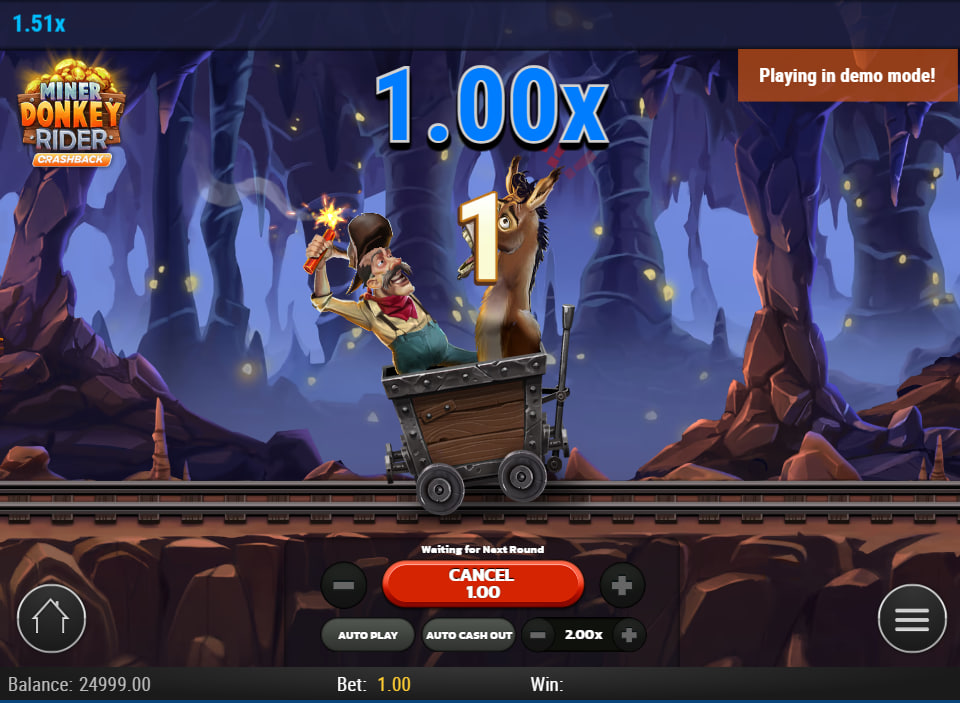
The fundamental structure of Miner Donkey Rider Crashback aligns with the established principles of crash gaming. Each round commences after a betting window, during which players select their desired stake. The interface provides straightforward ‘+’ and ‘-‘ buttons flanking the main bet amount display, allowing for granular adjustment of the wager size before the round initiates. Crucially, bets must be finalized before the mine cart begins its journey. A short countdown timer is typically visible, indicating the remaining time to place or adjust wagers.
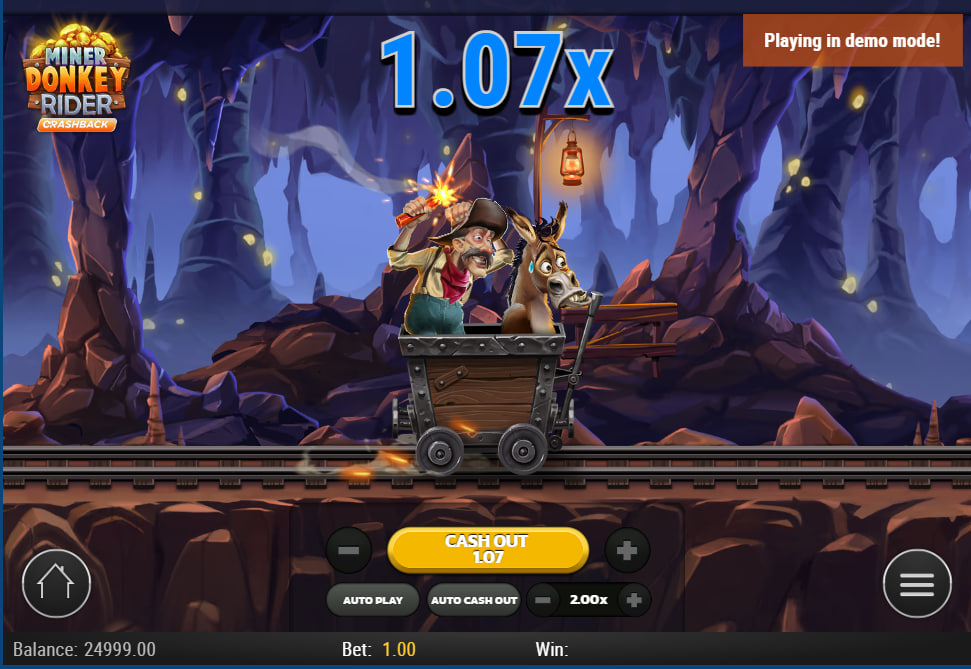
Once the betting phase concludes, the round starts. The mine cart, carrying the miner and donkey duo, starts moving along the tracks depicted on screen. Simultaneously, a multiplier figure, beginning at 1.00x, starts to climb. The rate of increase can vary, contributing to the game’s unpredictable nature. The primary objective for the player is to manually activate the ‘CASH OUT’ button before the round randomly terminates in a ‘crash’. Successfully timing the cashout secures a win equal to the placed bet multiplied by the exact multiplier value displayed at the moment the button is pressed. For instance, cashing out at a 5.25x multiplier on a $1.00 bet results in a $5.25 return.
The tension inherent in this genre stems directly from the conflict between securing a modest multiplier early and holding out for potentially much larger gains, all while knowing the round could end instantaneously without warning. If the crash occurs before the player cashes out, the entire stake for that round is forfeited. This core risk-reward dynamic is the engine driving the gameplay. The game explicitly states a maximum multiplier cap of 5000x the total bet. Should the multiplier miraculously reach this ceiling during a round, any active bets are automatically cashed out at this peak value, representing the game’s ultimate potential return on a single wager. It’s also vital to understand that the game clarifies that “Each round is randomly generated from a pre-determined list of mathematical outcomes,” reinforcing that visual progress does not influence the predetermined crash point.
The Distinguishing Crashback Feature
The defining element that attempts to differentiate Miner Donkey Rider Crashback is its eponymous Crashback mechanic. This system provides a conditional opportunity for players who have already cashed out of a round to potentially re-engage with that same ongoing round. The premise is straightforward: if a player executes a cashout, perhaps at a relatively low multiplier like 2.5x, but observes the mine cart continuing its journey and the multiplier climbing significantly higher (e.g., reaching 10x or more), the Crashback feature may become available for a limited time.
Activation of Crashback is not automatic and requires player intervention within a specific, albeit brief, timeframe after their initial cashout. If a player decides to utilize this feature, it comes at a cost. The game rules specify this cost as “the difference between the previous cashout and the current multiplier.” This phrasing suggests the cost is deducted from the player’s balance, representing the additional risk capital required to re-enter at the higher, ongoing multiplier level. For example, if a player cashed out $2.50 (1.00 bet at 2.5x) and the multiplier is now 10x, re-entering via Crashback might require an additional input reflecting the potential gain difference (in this conceptual example, related to the 7.5x increase), allowing them to then ride the multiplier further from the 10x point. The exact cost calculation method is a critical detail. If the specific formula or timing constraints regarding Crashback activation feel unclear during gameplay, utilizing the demo Miner Donkey Rider Crashback version is advisable. Accessing the integrated help section, often marked with an ‘i’ or ‘?’ icon within the game interface after launching the demo, should provide the developer’s precise explanation of the Crashback cost and its operational rules.
This Crashback feature introduces a fascinating tactical layer. It potentially allows players to mitigate the regret of an overly cautious early cashout. However, it’s a double-edged sword. Re-entering consumes additional funds and re-exposes the player to the risk of a crash before they can cash out again at an even higher multiplier. It transforms the single cashout decision point into a potential two-stage process, adding complexity and another layer of risk management assessment for the player. It fundamentally alters the standard fire-and-forget nature of cashing out in typical crash games. The psychological impact is also noteworthy, potentially encouraging riskier initial cashouts with the knowledge that a second chance might be possible, or conversely, adding pressure to decide quickly whether to use the Crashback option before the opportunity vanishes or the round crashes.
Automation and Control Options
Miner Donkey Rider Crashback incorporates standard automation features designed to facilitate extended play sessions or execute pre-defined strategies. The AUTO PLAY function enables players to set a specific number of consecutive rounds for which the game will automatically place the currently selected bet amount. This allows for hands-off participation over multiple rounds. Importantly, the game rules clarify that bets placed via Auto Play for upcoming rounds can generally be cancelled before the next round begins, offering a degree of flexibility. Furthermore, Auto Play is designed to be automatically cancelled if the Crashback feature is triggered, preventing unintended automatic re-entries.
Complementing Auto Play is the AUTO CASH OUT feature. This allows players to pre-set a specific multiplier value at which the game should automatically attempt to cash out their bet. For instance, a player could set an Auto Cash Out target of 3.00x. If the round multiplier reaches or exceeds this value, the system will execute the cashout command. Holding the ‘+’ or ‘-‘ buttons associated with this feature allows for quicker adjustment to higher or lower target values. However, the game explicitly and correctly warns that “AUTO CASH OUT does not guarantee a win!” This is a critical disclaimer. If the game crashes before the multiplier reaches the pre-set Auto Cash Out target, the bet is still lost. Therefore, Auto Cash Out serves as a tool for disciplined profit-taking at a desired level, but it cannot circumvent the fundamental risk of the crash occurring early. These tools are useful for players employing consistent strategies or those who prefer automated execution, but they require careful configuration and an understanding of their inherent limitations.
Theme, Atmosphere, and Visual Execution
The game adopts a lighthearted, cartoonish aesthetic centered around the gold-mining theme. The central characters, a grizzled prospector and his slightly bewildered-looking donkey, are rendered in a simple, colorful style. They ride in a wooden mine cart along tracks set against a backdrop of a dimly lit cavern with stalactites and stalagmites. The visual focus is squarely on the mine cart’s progression and the prominently displayed, rapidly increasing multiplier value. Animation is functional rather than elaborate; the cart trundles along, emitting puffs of smoke, and the multiplier digits update dynamically.
The atmosphere generated is one of building anticipation, primarily driven by the rising multiplier rather than intricate visuals. The sound design typically complements this, often featuring ambient mine sounds, the clatter of the cart, and potentially musical cues that escalate as the multiplier climbs, culminating in a distinct sound effect for the crash itself. While the theme is generic within the broader slot and gaming world, its application here serves its purpose: providing a simple visual metaphor for the journey towards potentially higher rewards. The graphical style is clean and performance seems optimized for quick loading and smooth animation of the core elements, which is essential for a game reliant on split-second timing decisions. The overall presentation is competent and serves the gameplay well, though it lacks groundbreaking artistic direction. It successfully creates the intended mood of hopeful speculation against impending random termination.
Mechanical Considerations and Player Experience
Miner Donkey Rider Crashback, at its core, operates on a Random Number Generator (RNG) system that determines the crash point for each round before it begins, drawn from a predefined mathematical model. This ensures outcomes are statistically random and unpredictable over time, adhering to fair gaming principles. The player’s interaction is limited to setting the bet, deciding when (or if) to cash out manually, potentially utilizing the Crashback feature, and configuring automation settings. There is no player skill involved in influencing when the crash occurs; the skill lies entirely in risk management and timing the cashout decision relative to one’s risk tolerance and the observed multiplier progression.
The user interface is designed for clarity and rapid interaction. Large, distinct buttons for Bet/Cancel and Cash Out are essential, given the time-sensitive nature of the gameplay. The display of the current multiplier is paramount and typically rendered in large, easily readable digits. Additional interface elements show the player’s balance, current bet amount, and potentially a history of recent crash multipliers, which some players use (fallaciously) to try and identify patterns. The inclusion of the Crashback feature adds an extra decision point that experienced crash game players might find adds a refreshing layer, forcing a re-evaluation even after securing an initial win. For players new to this style of game, the concept is relatively easy to grasp, though mastering the timing and understanding the implications of the Crashback cost require attention. The game appears best suited for players who appreciate the simple, volatile nature of crash mechanics but are looking for a slight twist on the standard formula, offering a potential, albeit costly, way to recover from perceived premature cashouts. The directness of the cause-and-effect – cash out in time or lose the bet – provides a clear and immediate feedback loop.