
Magnificent Phoenix by IGT is a 5-reel Asian-themed slot featuring 20 paylines and a unique triple-bonus ecosystem. The game uses a 5×3 grid that expands into three vertical sets during the Phoenix Triple Reels feature. With a math model focused on stacked wild transformations and a red packet prize picker, it offers fixed jackpots up to $100 on a $0.38 bet. The atmosphere is traditional and high-contrast, designed for players who prefer layered mechanics and bonus chasing.

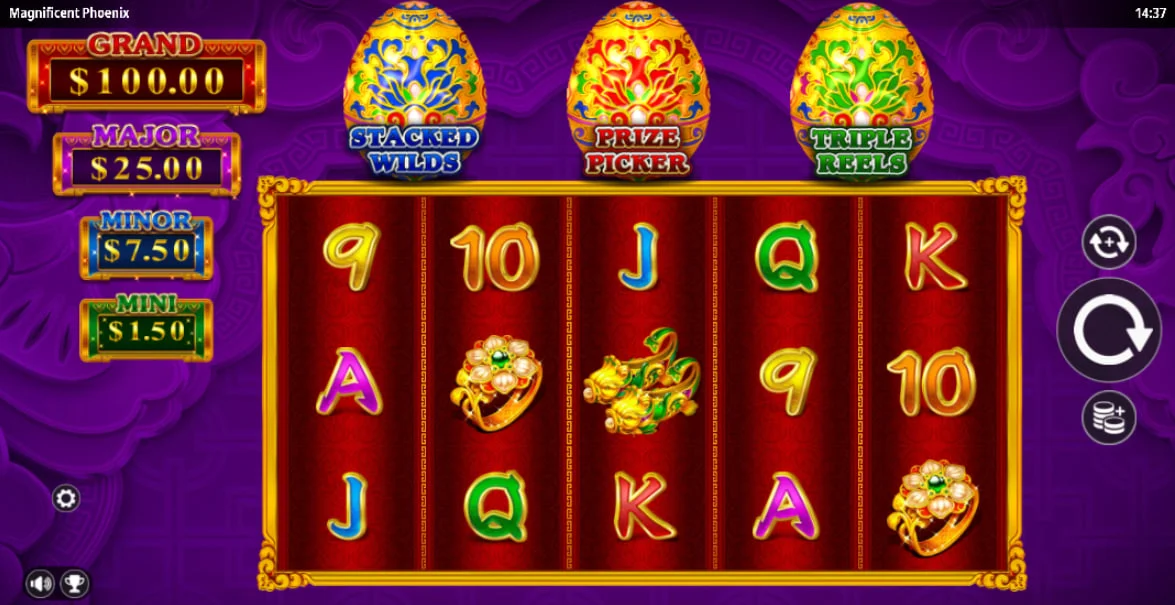
The core loop revolves around the interaction between the primary 5×3 grid and three distinct colored coin scatters. After grinding through 200 spins in a demo session, it becomes clear that the game is a war of attrition where you are constantly chasing the synergy between Blue, Red, and Green coins. IGT has built this on a 20-payline framework where every spin costs exactly 38 times your selected coin value, creating a specific betting floor that might catch casual players off guard.
The Triple-Threat Bonus Ecosystem
Everything in this slot is a precursor to the moment one of those eggs finally cracks. Unlike many modern titles that rely on a single “free spins” gate, here you are looking at three separate features that can, and often do, trigger simultaneously for a massive volatility spike.
The blue coin is your ticket to the Magnificent Stacked Wilds Feature. When this 8-spin round triggers, the game engine checks every reel after it stops spinning. If a reel is filled with the same symbol, the entire vertical column transforms into Wilds. This mechanic significantly alters the hit frequency, turning what would be dead spins into full-screen connections. But don’t expect it to happen every time; the variance here is brutal, and you will often see “near misses” where two matching symbols tease a transformation that never comes.
Is the Green Egg the Real Money Maker?
The Phoenix Triple Reels Feature, triggered by the green scatter, is where the screen real estate literally triples. You move from a standard grid to three vertically stacked 5×3 reels, all spinning independently but sharing the same bet. This effectively increases your winning opportunities by 300% without increasing the cost of the spin, though the base paytable remains the same.
The real chaos begins when you land the Green and Blue scatters together. In this hybrid mode, if you land a full stack of matching symbols on just one of the three reel sets, that entire column transforms into Wilds across all three sets of reels. It is a powerful multiplier of potential that justifies the often long dry spells in the base game. Watching three sets of reels turn wild simultaneously is the only way to really push toward the upper limits of the game’s payout ceiling.
The Red Packet Paradox
The Red Coin Scatter serves as the gatekeeper for the Prize Picker Feature. While the blue and green eggs focus on reel modifications, the red egg is a pure “pick-and-win” game that shifts the perspective away from the spinning symbols.
You are presented with 20 Red Packets. Behind these envelopes lie coin prizes ranging from 10 to 100 times your coin value, or jackpot-colored coins. It is a classic “collect three” mechanic: three pink coins for the Major, three blue for the Minor, and so on. What makes this frustrating for some is the “pre-determined” nature of the picks; while you feel in control, the documentation suggests that your selections do not influence the final outcome. It is a psychological anchor designed to keep you clicking, even if the result was decided the millisecond the feature triggered.
How Often Do the Jackpots Reset?
One technical nuance often missed is that you can actually win the same jackpot multiple times in a single session. The game allows the gem meters to clear and reset up to three times per feature. This means if you have an incredible run of luck with the 8 picks (and any extra picks found in the packets), you could theoretically bag the Grand prize three times over. However, the probability of this is astronomically low, as the math is heavily weighted toward the smaller coin prizes and the Mini jackpot.
Breaking the Golden Egg
The most elusive symbol in the entire ecosystem is the Golden Egg, which only appears during the enhanced versions of the bonus rounds. These eggs are the only way to effectively “retrigger” or extend the volatility of the Stacked Wilds + Triple Reels combo.
Each Golden Egg adds 2 extra spins to the counter and provides additional picks for the prize wall. In a high-friction environment like this, those extra two spins are the difference between a total “bust” bonus and a session-saving win. During my testing, I found that without at least one Golden Egg or a few Red Coin extra spins, the 8-spin base feature often ends before the Wild stacks can truly align across the three grids.
The Auditor’s Technical Ledger
Magnificent Phoenix is a calculated exercise in “feature layering” that IGT has perfected for the floor-style casino audience. It rewards patience but punishes those with a shallow bankroll who can’t survive the gaps between egg triggers.
- The game utilizes a 20-payline structure with a fixed 38-unit bet multiplier.
- Stacked Wild transformations are reel-independent in the single-grid mode but sync across all grids in Triple Reels mode.
- Jackpots are fixed amounts tied to the coin value: Grand ($100), Major ($25), Minor ($7.50), and Mini ($1.50) at a $0.38 total bet.
- The Prize Picker allows for a maximum of 3 jackpot awards per category in a single trigger.
- Red Coin Scatters are the only special symbols that remain active during free spins to award +1 or +2 spins.
- UI efficiency is handled through a toggle that switches between coin-based and currency-based displays.
The Invisible Ledger: Blind Spot Analysis
Behind the vibrant colors and phoenix animations lies a rigid mathematical framework that dictates exactly how and when the game “pays back.” Understanding these hidden layers is the only way to approach the slot with a realistic strategy.
Why is the Prize Picker a Mathematical Trap?
The Prize Picker is often viewed as the “main” bonus, but it serves as a volatility buffer. Because the coin prizes are tied to the “coin value” rather than the “total bet,” a 100-coin prize sounds massive but actually only equates to roughly 2.6x your total bet (since 100 / 38 = 2.63). You can spend 8 picks collecting these and walk away with less than 15x your stake, which feels like a loss after waiting 150 spins to trigger the feature. The real value is exclusively in the Major and Grand jackpots; everything else is just balance maintenance.
The Ergonomics of the Turbo Grind
For players who value efficiency, IGT has tucked away the Turbo and Auto Spin settings on the right-hand side of the interface. The “grinders” will notice that the reel stop animations are relatively slow compared to modern “no-limit” style slots. However, the game is designed to be played in a “currency display” mode to avoid the confusion of the 38x bet multiplier. Toggling this early is vital for tracking your actual burn rate.
The “Mortal” Symbol Economy
Notice the 9, 10, J, and Q symbols. These are the “blockers” of the game. Because the Stacked Wilds feature requires an entire reel to be filled with the same symbol to transform, these low-value symbols frequently “clog” the reels. Landing a full stack of 9s isn’t exciting for the payout, but it is the only way to get that reel to turn Wild. The frustration arises when you get a “mixed stack” of a high-value Phoenix and a low-value 10; this prevents the Wild transformation and effectively kills the potential of that spin.
FAQ
Where can I find the Magnificent Phoenix demo version?
The Magnificent Phoenix slot is available for free play on the Respinix.com website.
How do the Stacked Wilds work in the triple reel mode?
If a full stack of matching symbols lands on one reel set, all corresponding reels across all three sets transform into Wilds.
What is the maximum number of jackpots I can win in one Prize Picker?
You can win each of the four jackpot levels up to three times during a single Prize Picker feature.
What are the four jackpot levels in Magnificent Phoenix?
The game features Grand, Major, Minor, and Mini fixed prizes which are triggered by collecting three matching colored coins.
Do my choices in the Red Packet picker affect the prize I win?
No, the official game rules state that selections made during the Prize Picker do not affect the final outcome of the feature.