
Magic Plinko from Ludo Land is an arcade-style title set within a tropical jungle environment. Shunning traditional spinning grids, the game utilizes a stone monolith featuring a fifteen-box prize zone at the bottom. The math model delivers adjustable volatility with payouts scaling from 0.5x up to a 7x maximum win. Wagering starts at a fixed entry point of $0.10 per drop. Key features include an advanced Mythic mode that introduces specialized bonus pipes, 2X multipliers, and free balls.

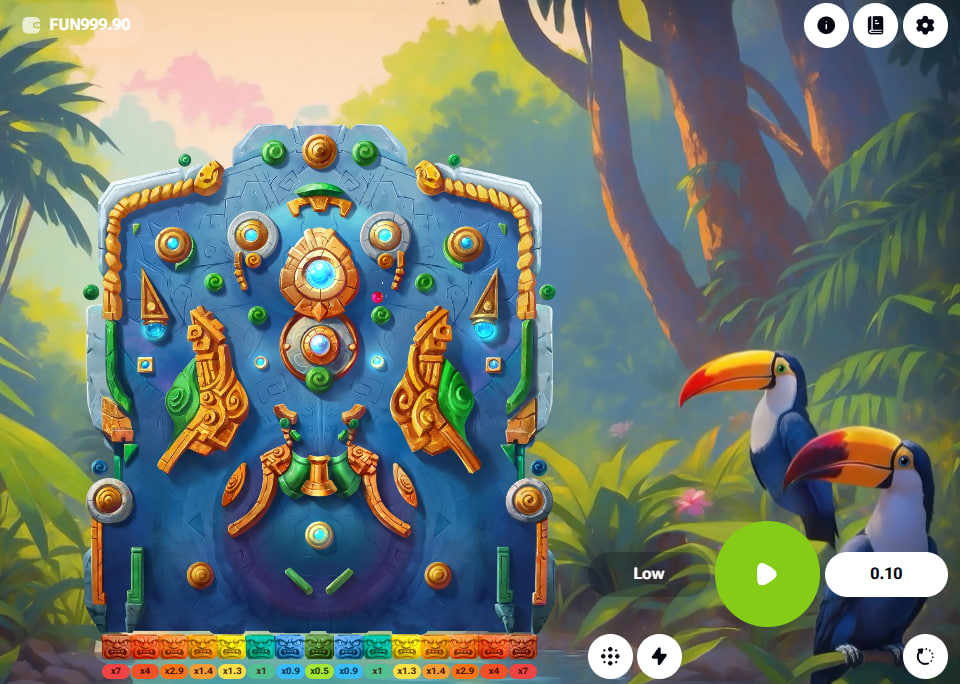
The gameplay loop operates entirely on physical drops rather than matching combinations across traditional grids. Initiating a round releases a single ball from the topmost peak of the central stone structure. As the sphere descends, it interacts with physical pegs and carved obstacles, altering its lateral momentum before it reaches the prize zone.
The baseline field configuration utilizes a complex arrangement of pins that forces unpredictable paths. Unlike standard pyramid configurations where the probability heavily favors the dead-center positions, this layout introduces distinct architectural blockers. Central carved faces and lower green flippers actively redirect the balls away from predictable straight paths. This design means that watching the initial drop gives zero indication of the final destination, maintaining absolute volatility during the entire downward journey.
Deciphering the Fifteen Prize Boxes
The bottom section of the monolith houses fifteen distinct prize boxes that determine the financial payout of every drop. Each box contains a fixed multiplier value that reacts dynamically to the underlying settings configured before the round begins.
A central green box carries a sub-one multiplier of 0.5x, functioning as a partial loss that slowly bleeds the active bankroll. Flanking this central pocket are blue boxes valued at 1x, which simply return the initial cost of the drop. Moving further toward the outer boundaries reveals yellow and orange pockets scaling through 1.1x, 1.3x, 1.4x, and up to 2.9x rewards. The highest potential payouts reside at the absolute horizontal edges, where deep red boxes offer a 7x multiplier. Reaching these extreme pockets requires massive lateral deflection off the upper pegs, making edge hits infrequent occurrences during extended sessions.
Navigating the Mythic Mode Paradox
Activating the advanced tier switches the operational mechanics into Mythic mode, transforming the visual theme and altering the baseline payout parameters. The entire stone board glows with deep purple energy, altering the physical behavior of the drop paths via specialized structures.
This setting introduces functional bonus pipes at the lower sections of the board, flanked by glowing violet skulls. Rolling a ball directly through these pipes triggers a 2X multiplier modifier on the destination box while simultaneously awarding a +1 Free Ball to the current ammunition pool. While the promise of doubled values and free drops looks highly attractive on paper, the physical entry points to these pipes are narrow. The balls often bounce off the pipe edges entirely, deflecting into the low-value central pockets and showing that higher risk does not guarantee immediate compounding returns.
Technical Dissection of the Interface
The control deck places all critical session metrics along the lower right section of the display interface. A prominent green button triggers individual ball drops, while adjacent toggles allow immediate adjustments to the underlying configuration.
- The wagering spectrum permits a minimum entry of $0.10 per drop, keeping the barrier to entry accessible for low-stakes sessions.
- The balance tracker sits in the upper left corner, displaying values in FUN credits to separate testing environments from active currency pools.
- A dedicated lightning bolt icon switches the interface into turbo delivery mode, eliminating the physics animation delay to resolve drops instantly.
- A secondary circular icon opens the automated play panel, letting players queue up consecutive drops without manual interface intervention.
Technical Blind Spots and Balance Traps
Operating a session requires a clear understanding of how the difficulty settings alter the underlying math model. Toggling between Low, Medium, and High directly recalibrates the fifteen prize boxes at the bottom of the field.
Is the Low Difficulty Setting a Financial Illusion?
Selecting the low difficulty profile compresses the multiplier variance, removing the massive top-end payouts to shield the balance from rapid destruction. The outer red boxes drop from their maximum potential down to stable values, while the central pockets sit comfortably at 0.5x and 1x. While this looks safe, the compressed math model creates an environment where your balance slowly dissolves through constant 0.5x returns. It mimics the sensation of sustainable play, but without high multipliers at the edges, there is no mechanical mechanism to recover from a long string of central deflections.
Why Do the Central Blockers Cause Severe Variance?
The physical design of the stone monolith contains a massive golden medallion in the upper center and dual green statues along the lower flanks. These are not decorative items; they act as absolute deflection shields that reject balls attempting to pass through the center. This architectural choice forces the ball path into erratic lateral movements early in the descent. Grinding through 100 drops reveals that these blockers frequently catch balls that were on track for moderate yellow zones, forcing them back into the low-paying green and blue sectors.