
Laughing Buddha is a compact 5×3 slot from Eurasian Gaming with 25 fixed paylines, a narrow 1-3-5 scatter trigger, and a bonus that lives or dies on what reel 3 turns into at entry. The temple-and-cherry-blossom look stays readable, but the real point is mechanical: gold symbols, ingot-based free spins, and a Fast-Play mode that skips the drag of base spins. This suits players who like sharp feature-led slots more than broad, busy reel games.
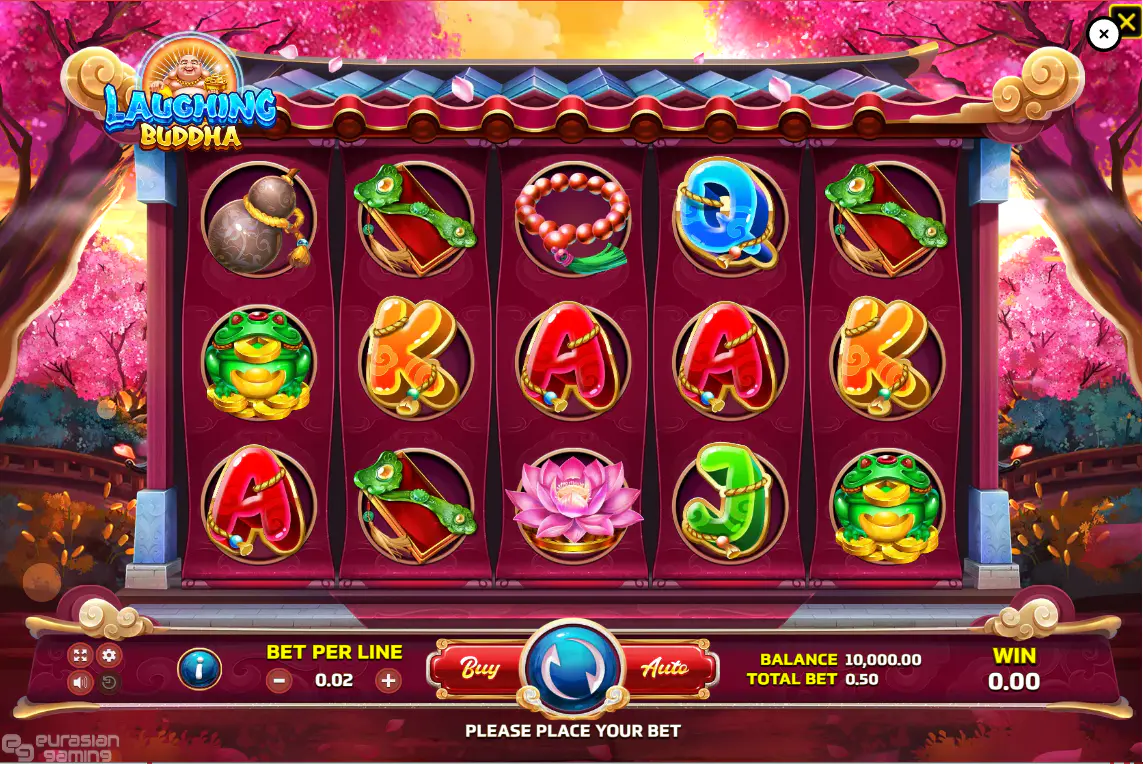
The first thing the slot does well is clarity. You get 5 reels, 3 rows, and 25 fixed lines. Wins pay left to right on adjacent reels. Scatter wins count anywhere and stack on top of line wins. The minimum visible setup on the info screens shows 0.50 total bet and 0.02 bet per line, which fits the game’s old-school line structure perfectly. You do not need long to understand what is happening on screen, and for a demo session that matters. A slot with this little mechanical padding has to be readable fast. Laughing Buddha is.
The paytable is compact and clean. The Lotus tops the premium set with 20.00 for 5 of a kind, 10.00 for 4, and 2.00 for 3. The frog pays 15.00, 5.00, and 1.50. The envelope, beads, and gourd each pay 10.00, 5.00, and 1.00. Then the royals slide in: A pays 5.00, 3.00, 1.00; K pays 4.00, 3.00, 0.50; Q pays 4.00, 2.50, 0.50; J pays 3.00, 2.50, 0.50. That spread tells you exactly what kind of base game this is. Premium hits matter. Royal-line noise exists, but it does not transform the mood of the session. You are not living off low symbols here.
The trigger pattern is where the slot starts to feel stricter. You need 3 Scatter symbols, and they appear on reels 1, 3, and 5 only. Scatter also pays 2.00 for 3. That is a narrow gate. I like the precision of it, but there is no point pretending it feels generous. It does not. In demo mode, this is one of the first questions worth answering for yourself: does the 1-3-5 trigger create tension, or does it make the game feel too gated? Demo can show that in minutes. What it cannot show is how that rhythm will feel after a long money session when dead space starts to matter more than novelty.
Once the trigger lands, the slot finally becomes itself. Free spins do not start as a fixed pack. The game moves to a collection screen. All characters on reel 3 turn into Gold Symbols, and the number of gold ingots collected becomes your exact free spin count. That is the smartest part of the design. It gives the trigger phase a second layer and makes two bonus entries feel meaningfully different instead of stamped from the same mold. The ingot screen also gives demo real value, because you can judge whether that setup phase feels satisfying or just theatrical.
Reel 3 is the whole machine. During free spins, the gold symbols shown when the bonus is triggered become wild and substitute for all symbols except scatter. That means the value of the bonus is shaped the moment the trigger lands. If reel 3 turns strong premium symbols gold, the round has teeth. If it turns weaker symbols, the feature still works, but the practical upside looks thinner. I would be careful not to turn that into fake math certainty. Still, as a play-read judgment, it matters. Laughing Buddha does not have a generic bonus. It has a conditional one. The quality of the bonus starts before the first free spin is even dealt.
That is why the base game can feel underfed. There is no dense modifier layer, no expanding reel trick, no collector ladder, no second feature family waiting behind the first. You spin a 5×3 grid, chase a narrow trigger, and wait for reel 3 to matter. Some players like that stripped shape. Others will call it a sparse slot with a good idea bolted into the middle. I lean toward the second view, even though I think the central mechanic is good enough to justify a demo.
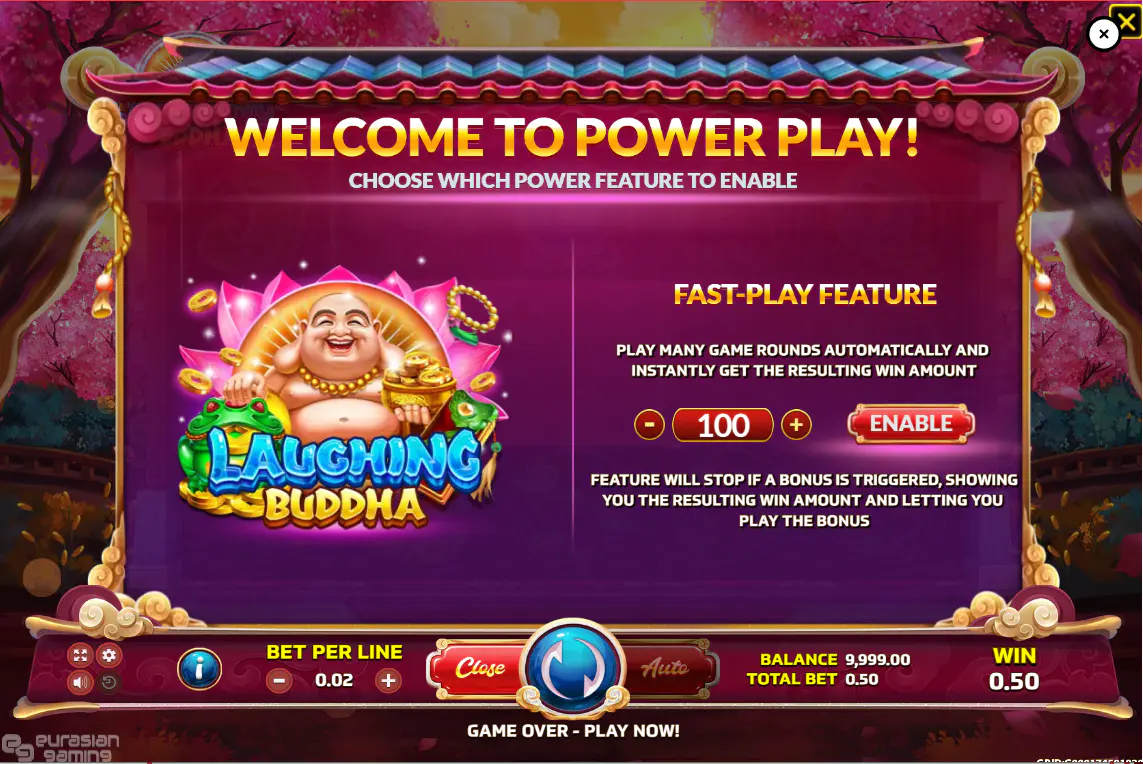
Then there is Fast-Play, and this is where the slot gets blunt. The Power Play menu lets you choose a set of automatic rounds – 100 is shown directly – and the game resolves them fast, showing the resulting win amount without forcing you through every visual stop. If a bonus triggers, the feature stops automatically. That is a practical tool, but it also tells on the slot. Fast-Play exists because the base game can feel repetitive enough that players may prefer compressed resolution over watching every spin. Compared with ordinary autoplay in older 25-line games, this feels more intentional. Compared with modern turbo features in busier slots, it feels more necessary.
The Buy button pushes the same message from another angle. If you want to inspect the slot’s main idea without sitting through the base-game drag, you can go straight to the feature. That does not make the slot deeper. It just makes it easier to judge. And for demo play, that is useful. You can test the reel-3 gold-symbol logic, the ingot collection phase, and the free spin shape without pretending the base game suddenly became rich because a shortcut exists.
The Gamble feature is smaller than both Fast-Play and Buy, but it still matters. After a win, you can choose red or black and try to double the amount. The game allows this up to 5 times. It can also be disabled in settings, and it is unavailable during autoplay. Good. That keeps Gamble where it belongs – as a post-win risk toy, not as the center of the session. Compared with classic card-gamble systems from older line slots, this is straightforward and familiar. Compared with the slot’s own reel-3 bonus, it is clearly secondary.
The visual side helps more than it seduces. The temple-and-blossom theme is not there to amaze anyone. Its job is to keep the mechanics readable, and on that front it does its work. The gold-state switch is obvious. The premium icons are easy to separate. The screen never gets so decorative that you lose track of reel 3, and that is important. Compared with cluttered Asian-themed slots that drown in lacquer and gold trim, Laughing Buddha is cleaner. Compared with bigger modern feature-first releases, it is almost plain. I prefer plain to messy when the entire slot depends on spotting a state change fast.
The audience split is easy to map once you stop arguing with the slot and just accept its shape.
| Low tolerance for dry spells | High tolerance for dry spells | |
|---|---|---|
| Wants simple feature logic | Strong fit, because 5×3 reels, 25 fixed lines, and one clear reel-3 bonus idea make the slot easy to read fast. | Good fit, though the narrow 1-3-5 trigger still puts pressure on patience if the session stretches out. |
| Wants layered feature pressure | Weak fit, because Fast-Play, Buy, and Gamble add access and pace tools, not true feature density in the base game. | Niche fit only, and only if you accept a sparse reel model in exchange for a conditional free spins structure. |
That split matters more than any theme summary. Laughing Buddha is not broad enough to fake universal appeal. It is for players who can tolerate a lot of structural simplicity as long as one mechanic lands cleanly.
There is another reason demo makes sense here. You can answer three useful questions before spending real money. First, does Fast-Play improve the session or just expose how little the base game has to offer spin by spin? Second, does the ingot collection screen make the free spins entry feel earned? Third, do the gold symbols on reel 3 create enough visible lift once the bonus starts? Demo is good at answering all three. It is bad at proving long-run payout character, and this slot gives you no reason to pretend otherwise.
Fast-Play is not a convenience tool here
In many slots, autoplay is just a rhythm option. Here, Fast-Play changes the way the whole game is approached. When a slot offers an instant batch of up to 100 rounds and stops only when the bonus arrives, that is not mere convenience. It is a design confession. The game knows its strongest material sits after the trigger, not before it.
That also means Fast-Play has two faces. For one player, it is the best feature outside the bonus because it compresses the boring parts. For another, it is a warning sign because it admits the boring parts exist. Both readings are fair. What matters is that Laughing Buddha becomes much easier to judge once you use it.
What the paytable quietly tells you
A few details say more than the theme ever will.
- The paytable is top-heavy by this slot’s standards: 20.00 for 5 lotus symbols is four times the 5.00 paid by 5 A symbols.
- Scatter pays 2.00 for 3 while also acting as the only bonus key, so its value is structural as much as financial.
- Reel 3 does not merely support the bonus; it determines what kind of bonus you get because gold-state conversion starts at the trigger.
- Fast-Play stopping at bonus entry makes it better for demo diagnosis than standard autoplay, since it isolates the slot’s main mechanic.
- Gamble being locked out during autoplay keeps the session’s speed tools and risk tools separated, which is cleaner than many older line slots manage.
Laughing Buddha is worth trying in demo if you like compact 25-line slots with a strong central hook and enough honesty to hand you acceleration tools. I would skip it if I wanted a lively base game, richer feature layering, or a bonus system that keeps evolving after the first reveal. What deserves attention here is not the Buddhist decor. It is the narrow 1-3-5 trigger, the ingot-based spin count, the reel-3 gold conversion, and the fact that Fast-Play may be the clearest statement of intent the whole slot makes.
FAQ
How do you trigger free spins in Laughing Buddha?
You need 3 scatter symbols, and they land on reels 1, 3, and 5.
What does reel 3 do during the bonus?
All characters on reel 3 turn into gold symbols, and the gold symbols shown at bonus entry act as wilds.
How is the free spin count decided?
The number of free spins matches the number of ingots collected by the gold symbols.
How does Power Play work in Laughing Buddha?
Power Play runs a chosen batch of rounds quickly and stops as soon as the bonus is triggered.
Can you gamble wins in Laughing Buddha?
Yes, you can guess red or black and repeat the gamble up to 5 times after a win.
Is Laughing Buddha better tested in demo first?
Yes, because demo play quickly shows whether Fast-Play and the reel-3 bonus structure suit your taste.