
Joker Loot from Jade Rabbit Studio is a 5×5 dungeon-themed slot built on a highly volatile ways-to-win math model offering up to 3215 paths. Featuring an RTP of 95.95%, the game utilizes a unique multiplicative calculation system where stacked symbols on adjacent reels multiply payout values. The dark underground vault design houses eleven distinct symbols, including substituting wilds and high-value relics, delivering a gritty session tone aimed at high-variance slot enthusiasts.

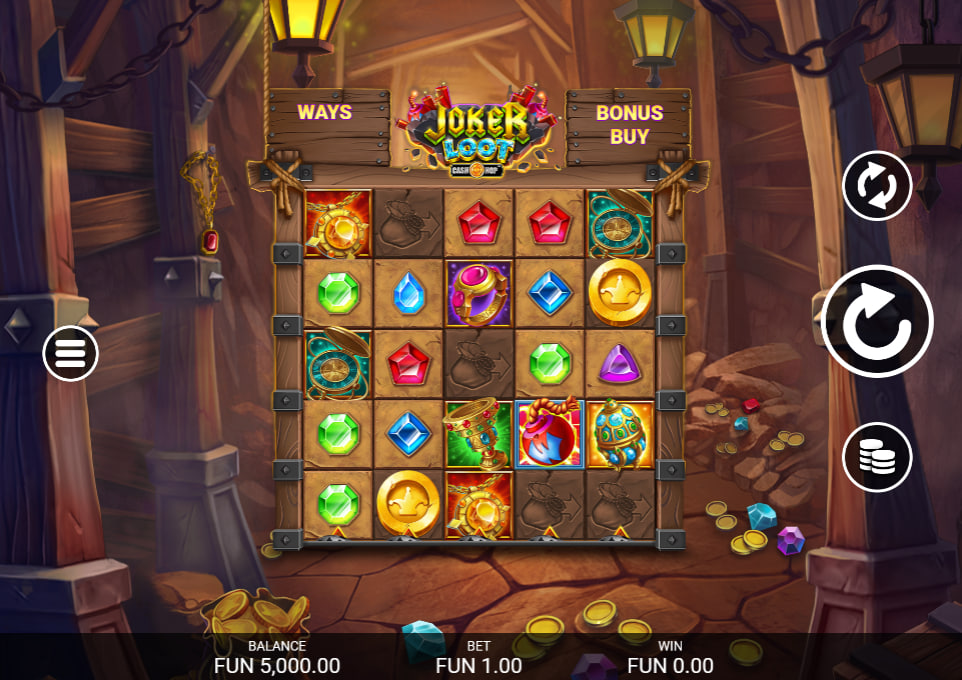
Matching symbols across three or more adjacent positions from the leftmost reel constitutes a way win. Instead of simple additions, multiple matching symbols landing on a single reel contribute to the payout multiplicatively, accelerating the line value when a high-tier item stacks. The base game mechanics run with a solid 95.95% theoretical return to player, forcing a highly aggressive variance pattern where the main balance protection comes from stacked top-tier symbols rather than frequent micro-returns.
Is the 3215-Way Multiplicative Matrix Sustainable for a Long Session?
The engine forces a distinct trade-off where traditional paylines are tossed out for a dynamic grid structure that fluctuates on every single round.
Because the total number of win paths changes depending on the specific symbol arrangement landing in view, predicting hit patterns becomes impossible. The multiplicative multiplier behavior on individual reels means landing three matching symbols on reel one, two on reel0 two, and one on reel three does not just award a standard three-of-a-kind; it multiplies the base paytable value by six. This mechanic shifts the weight away from standard five-of-a-kind hits, making compact, vertically stacked blocks on the first three reels the primary method for maintaining your bankroll.
The downside for grinders is the structural friction during the base game. When the grid drops scattered singles across the reels, the layout feels incredibly restrictive despite the theoretical thousands of ways to win. If you fail to land matching items on the first two reels, the entire spin is instantly dead, rendering any high-value stacks on the back end completely useless. This creates an all-or-nothing rhythm that will quickly alienate players who prefer steady, low-volatility sessions with constant visual feedback.
Unmasking the Hidden Friction Points in the Dungeon Matrix
A close look at the data structure reveals several operational traps designed to drain a passive bankroll before a major feature hits.
Why is the Multiplicative Way Rule a Double-Edged Sword?
The payout system relies entirely on the longest matching combination for each distinct symbol type. While the multiplicative calculation can turn a low-tier gem hit into a decent return, it also compresses the value of isolated five-of-a-kind connections. If you land five symbols spread flat across the rows without any vertical stacking, a premium icon like the crown pays a flat 1.50 dollars on a 1.00 dollar bet. This means a perfect five-reel connection across the grid barely covers the cost of the spin unless you get multi-symbol reel duplication.
What are the Technical Operational Rules of the Spin Cycle?
Once you hit the manual or automated trigger, the bet level is strictly locked for that specific round, preventing any strategic bet hedging while the reels are in motion. Furthermore, any technical malfunction voids all plays and pays immediately, wiping out pending combinations. Incomplete games do not hang indefinitely; the system automatically resolves unfinished grid states after two days, pushing any calculated winnings straight to your balance without letting you replay the spin.
The Math Inside the Pouch
The game architecture divides its twenty-five symbol grid into distinct payout tiers dominated by high-value relics and geometric gemstones.
Do the Premium Relics Justify the Extreme Variance?
The paytable is topped by an ornate blue and gold chalice, which returns 5.00 dollars for a five-of-a-kind hit on a 1.00 dollar wager, dropping down to 1.50 dollars for four items and 1.00 dollar for three. Directly below it sits a green dagger hilt awarding 2.50 dollars for five matching spaces, 1.00 dollar for four, and 0.50 dollars for three. The mid-tier values feature a golden crest at 1.50 dollars for a maximum combination, alongside a purple ring and a green crescent emblem that both top out at 1.00 dollar for five inline.
How Badly do the Low-Tier Gemstones Bleed the Balance?
The lower portion of the math model is populated by five distinct geometric stones that offer minimal protection against high-friction spins. The light blue teardrop gem pays 0.75 dollars for five, while the green square, red diamond, purple triangle, and dark blue diamond gems return a flat 0.50 dollars when filling all five reels. Landing only three of these low-tier gems returns a microscopic 0.10 dollars, meaning a standard three-reel connection loses ninety percent of the triggering bet value.