
Jelly Hunter Quadspins from Swintt is a high-variance 5-reel, 3-row slot merging a playful sweets theme with a technical betting engine. The game features a $0.05 to $100.00 stake range with a fixed 1 coin to $0.01 ratio. Players navigate a grid of grumpy animal symbols and jellies, bolstered by a 100% RTP Card Risk gamble feature. With a 100,000-coin max win and precision autoplay limits, it offers a gritty, transparent session for those prioritizing math over fluff.
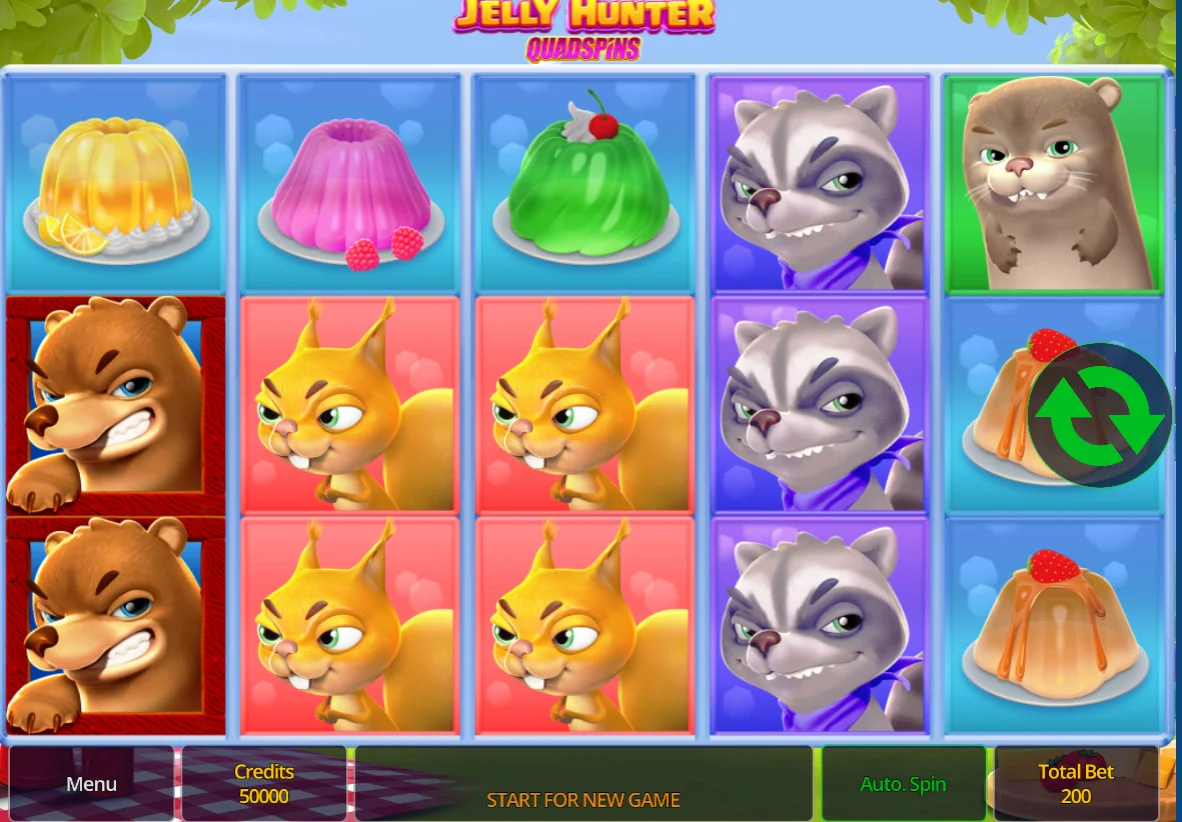
The core loop centers on high-frequency symbol matches across the 5×3 grid, but the real weight of the session sits in the Quadspins mechanic. Playing with a total bet of 200 coins translates to a $2.00 stake, with a fixed conversion rate where 1 coin equals exactly $0.01. This transparency is refreshing, stripping away the obfuscation often found in modern high-volatility slots. Winning combinations feel heavy, especially when the raccoon and marmot high-payers align. However, the base game can be a brutal drain on the bankroll, often characterized by long sequences of dead spins that test your resolve. The inclusion of a dedicated stop button and space bar support indicates Swintt is catering to “grinders” who prioritize spin-per-minute efficiency over flashy animations.
A standout element of Jelly Hunter Quadspins is the visceral risk-reward cycle of the Card Risk feature. After any base game win, the UI presents a sharp choice: take the profit or bet the entire amount on a red-or-black prediction. Unlike many competitors who hide their gamble mechanics behind several menus, Swintt puts the Risk Button front and center. You have the opportunity to double your win up to 10 consecutive times, or until you hit the 100,000 coin ceiling. The mathematical purity here is staggering, with the developer claiming a 100% RTP for the gamble feature itself. It is a coin-flip in its most honest form, providing a path to turn a mediocre $5.00 win into a $50.00 boost if you have the nerves to weather the 50% success rate.
The Mechanics of Multi-Window Jelly Hunting
The Quadspins system effectively multiplies the action, allowing for a concentrated burst of volatility. When you click the play button, you are not just watching one reel set; you are engaging with a betting structure designed to maximize turnover. The raccoon symbol acts as a primary motivator, and seeing several of these high-value predators land simultaneously provides the only real protection against the slow bleed of the lower-value green and pink jellies.
The animal symbols, particularly the marmots, dominate the paytable. Landing five of these can significantly shift the session momentum. Yet, the game demands respect for its volatility. If you are not hitting those top-tier combinations, the jellies—pink, orange, green, yellow—act as filler that rarely keeps the balance afloat on their own. This creates a “top-heavy” experience where you are essentially hunting for the animal symbols to justify the cost of the spin.
For players who prefer a hands-off approach, the Autoplay suite is surprisingly robust. You are forced to set win and loss limits before the software allows the reels to spin unattended. If you set a win limit of 0, the feature remains disabled, forcing a level of financial discipline that is often absent in lower-tier slots. This is a game for the tactician who wants to set a strategy and watch the math play out in real-time.
Decoding the Mathematical Blind Spots
Behind the colorful jelly exterior lies a set of rules that most players ignore, often to their detriment. Understanding these hidden layers is the difference between a controlled session and a total balance wipeout.
Is the Gamble Feature a Mathematical Trap?
The Card Risk game is often misunderstood as a “sucker bet,” but the data suggests otherwise. With an isolated RTP of 100%, it is actually the most “fair” part of the game. However, the trap lies in the 50,000 coin cap. If your win exceeds $500.00, the option to gamble disappears entirely. This means the game prevents you from taking a massive win and potentially doubling it into a jackpot-level payout. It is a built-in safety rail for the house, limiting the maximum exposure Swintt has on any single successful streak.
The Illusion of “Past Results” in Risk Mode
One of the most critical psychological hurdles in Jelly Hunter Quadspins is the display of previous cards in the gamble feature. The game manual explicitly states that the cards shown have no influence on the result of the gamble. Each flip is a fresh 50/50 RNG event. Watching a string of five red cards does not make a black card “due.” Many players fall into the Gambler’s Fallacy here, but the engine is cold and indifferent to history.
Efficiency for Grinders: The Space Bar Advantage
While casual players click the mouse, the pros use the space bar. Swintt built the game with keyboard shortcuts to facilitate rapid-fire sessions. This reduces the friction between spins, allowing for a much higher volume of play. When combined with the win/loss limits in Autoplay, it allows you to run through hundreds of spins in a fraction of the time, which is essential when chasing the animal symbol peaks in a high-variance environment.
The Grinder’s Toolkit
This section highlights the technical nuances that define the Jelly Hunter Quadspins experience, separating it from the crowd of generic sweet-themed slots.
- The minimum stake is a low 5 coins ($0.05), while high rollers can push the limit to 10,000 coins ($100.00) per round.
- The conversion rate is fixed at 1 coin = $0.01, ensuring you always know exactly how much “real” money is at risk.
- Feature games and Autoplay sessions automatically disable the Risk Button to prevent accidental losses of large accumulated wins.
- The Risk Game has a hard limit of 10 rounds, meaning even the luckiest streak has a mandated end point at 100,000 coins.
- The “Take Button” serves as a vital emergency brake, allowing you to bank a win if you lose your nerve during a gamble sequence.
- The game UI includes a real-time Credits display in both coins and the local currency (e.g., Euros or Dollars), providing constant financial feedback.
- Unlike many modern slots, the cards shown during the gamble feature are purely aesthetic and do not use a “shuffled deck” logic; it is a pure RNG outcome.
Jelly Hunter Quadspins is a calculated, high-friction slot that masks its brutal math under a layer of marmots and jellies. It appeals to players who value transparency, high-speed gameplay, and the ability to control their variance through the Card Risk feature. If you enjoy the chase of high-value symbols and the binary thrill of a 50/50 flip, Swintt’s offering provides a platform where the numbers are the real stars.
FAQ
What is the maximum win in Jelly Hunter Quadspins?
The game features a maximum win cap of 100,000 coins, which translates to $1,000 at the default coin value.
How does the Card Risk gamble feature work?
You predict if the next card will be red or black to double your win, up to 10 times consecutively.
Where can I play the Jelly Hunter Quadspins demo?
A free demo version of the slot is available for testing on the Respinix.com website.
Can I use the gamble feature during Autoplay?
No, the Risk Button is automatically disabled if you have an active Autoplay session running.
What is the coin value conversion in this slot?
Each in-game coin is worth exactly $0.01, meaning a 200-coin bet equals a $2.00 stake.