
iMoon Crash by iMoon presents a focused interactive gaming experience centered on a stark space theme and a gripping atmosphere of escalating risk. The game’s history is one of immediate player decisions, reflected in its minimalist single-screen layout which prioritizes the ascending rocket and its crucial multiplier. Core gameplay involves players placing bets and deciding the optimal moment to cash out before the rocket’s unpredictable explosion, with a potential multiplier reaching up to 100x the stake. A key strategic element is the Auto Cash-Out feature, allowing players to pre-set a multiplier for automatic withdrawal. This game structure offers a direct test of nerve and timing rather than traditional reel-spinning. Player interface provides round history and clear betting controls for an engaged session.


iMoon Crash positions itself in the arena of interactive gaming not through intricate narratives or a complex tapestry of symbols, but via a singular, potent mechanic: an escalating multiplier tied to a visually minimalistic yet thematically resonant rocket ascent. The game eschews traditional slot architecture, presenting instead a direct confrontation with probability and nerve. Its atmosphere is one of focused anticipation, a digital representation of a high-stakes waiting game where the primary colors are the dark expanse of space and the bright, hopeful trajectory of your potential winnings. The aesthetic is deliberately uncluttered, ensuring player attention remains riveted to the crucial numerical climb.
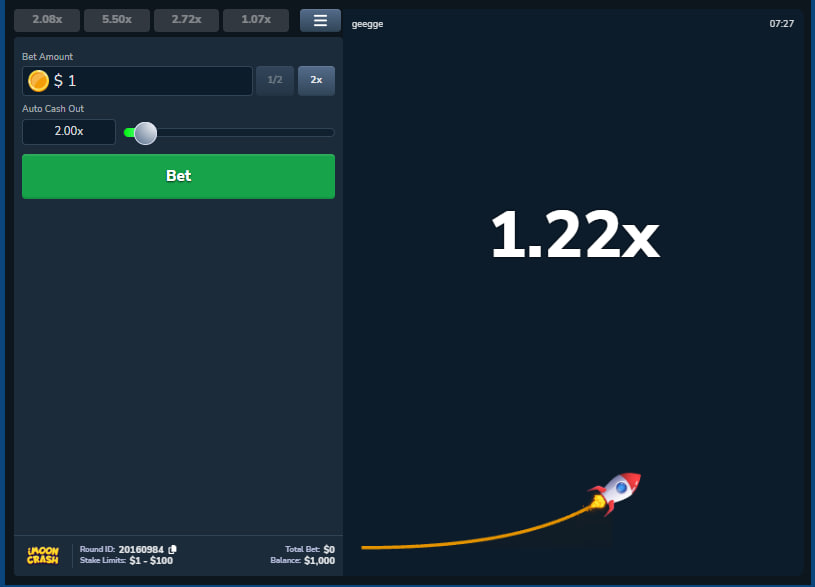
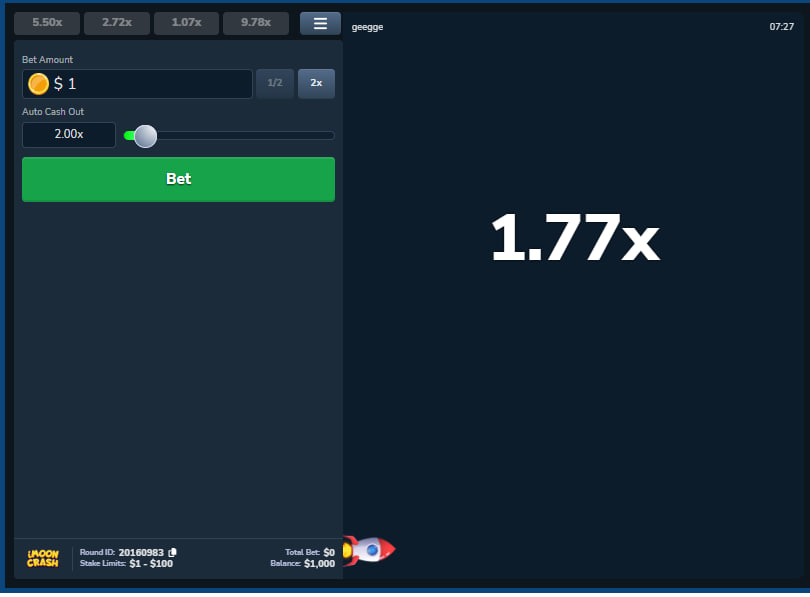
The visual presentation is stark, almost Spartan. A simple rocket icon traverses the screen, its journey inextricably linked to the multiplier that dominates the display. This simplicity is deceptive, as it belies the considerable psychological tension inherent in the gameplay. There are no elaborate animations beyond the rocket’s travel and its eventual, inevitable termination. Sound design, if present and enabled, typically complements this by offering auditory cues for the game’s phases – the launch, the climbing multiplier, and the definitive sound of the ‘crash’ – further heightening the immediacy of each round. This focused design choice ensures that cognitive load is minimized, allowing for rapid decision-making, a crucial element given the game’s core loop.
Core Gameplay Mechanics: The Ascent and Its Attendant Risks
The fundamental cycle of iMoon Crash revolves around a singular, ascending numerical value – the multiplier. Each round commences after a brief interlude, typically a 7-second countdown, signaling the next betting window. Players place their wagers before the rocket icon begins its upward journey from a baseline multiplier of 1.00x. As the rocket climbs, so does the multiplier, incrementally increasing the potential return on the staked amount. The critical unknown, and the source of all the game’s tension, is the unpredictable point at which the rocket will explode, or ‘crash’. This stochastic event immediately ends the round for any players who have not already secured their winnings.
Betting itself is straightforward. An interface allows for direct input of the wager amount for the upcoming round. Auxiliary controls, such as ‘1/2’ and ‘2x’ buttons, permit swift adjustments to the current stake, catering to dynamic bankroll management strategies or reactive betting based on recent outcomes. The maximum achievable multiplier is explicitly stated as 100x, providing a defined ceiling for potential gains, though reaching such heights is statistically infrequent. The game operates on a continuous loop of betting, launching, multiplying, and crashing, with minimal downtime between rounds, fostering a rapid, almost staccato rhythm of play. This structure demands constant vigilance and an active participatory role, contrasting sharply with the more passive experience of watching reels resolve in traditional slot games.
Strategic Interventions: The Cash-Out Imperative
The player’s primary interactive tool, and indeed the locus of all strategic decision-making in iMoon Crash, is the Cash-Out button. At any point during the rocket’s ascent, while the multiplier is actively increasing, a player can elect to press this button. Doing so immediately secures their current wager multiplied by the value displayed at that exact moment. The timing of this action is paramount; a premature cash-out might lead to modest gains, while delaying too long risks forfeiture of the entire stake should the rocket explode before the player acts. This creates a dynamic interplay between risk appetite and reward expectation.
A pivotal component for strategic engagement is the Auto Cash-Out function. This feature allows players to pre-determine a specific multiplier value at which the game will automatically attempt to secure their winnings. For instance, setting an Auto Cash-Out at 2.00x means that if the rocket reaches or surpasses this multiplier, the system will trigger the cash-out, relieving the player of the need for manual intervention at that critical juncture. This mechanism allows for a degree of pre-defined risk management, appealing to individuals who favor a systematic approach over purely reactive decision-making. It’s a critical tool for players looking to implement consistent strategies or step away momentarily without missing a target multiplier. The nuance here is that the game processes actions sequentially, so in moments of extreme volatility or server lag (though rare in well-designed systems), the actual cash-out might be slightly different, but the intent is for precision.
Informational Framework and User Interface
The game interface is designed for clarity and immediate informational access. The Multiplier Display is the most prominent element, centrally located and constantly updated in real-time, reflecting the rocket’s current height and the corresponding payout factor. Adjacent to this, players will find their current Balance and the field for entering their Bet Amount. A crucial informational resource is the History panel. This typically displays data from previous rounds, including the multiplier values at which past crashes occurred. While past performance is not an indicator of future results in a truly random system, many players utilize this data to inform their betting patterns or cash-out thresholds, looking for perceived trends or deviations.
Further interface elements include Stake Limits, clearly defining the minimum and maximum permissible wagers, which frames the game’s accessibility for different bankroll sizes. Each round is assigned a unique Round ID, a useful reference for tracking play or for any queries with support. The menu system typically provides access to sound controls, a “How to Play” guide detailing the game rules (as sourced for this review), and sometimes a chat function allowing for interaction with other concurrent players, adding a social dimension. The presence of “Last Crashes” history, often in a more summarized visual form, reiterates the recent volatility and outcomes, feeding into the player’s decision-making loop, however subjective that process may be.
Operational Contingencies and Gameplay Flow
iMoon Crash is characterized by its fast-paced gameplay. The short intervals between rounds and the rapid escalation of the multiplier mean that players are constantly engaged. This design caters to those seeking immediate results and frequent decision points. The game’s integrity relies on stable performance, and the rules account for potential disruptions. In the event of a detected malfunction, established protocols dictate that all affected bets and corresponding payouts are voided, and stakes are typically refunded, ensuring fairness.
A significant consideration is how disconnections are handled, particularly when an Auto Cash-Out has been set. The provided information suggests that if a player’s connection is interrupted, the game will attempt to honor the pre-set Auto Cash-Out multiplier if it is reached during the round. If no Auto Cash-Out was enabled, or if the disconnection occurred before any meaningful game action, the round might be treated as lost if no action was taken before the explosion. This level of detail in contingency planning is vital for player trust and demonstrates an understanding of the potential friction points in online real-time gaming. The system aims to default to the player’s pre-defined strategy (if one was set via Auto Cash-Out) during such events.
iMoon Crash is a specialized gaming instrument, distinct from the feature-rich environment of modern video slots. Its appeal lies in its directness, the palpable tension of the escalating multiplier, and the high degree of player agency in determining the outcome of their wager through the cash-out mechanic. The game demands a cool head and a clear strategy, particularly concerning the use of the Auto Cash-Out feature. It is less about chasing elusive bonus rounds and more about consistent, disciplined application of risk management against a backdrop of pure probability.
This game is likely to resonate with experienced players who appreciate transparency in mechanics and who enjoy games where their decisions have an immediate and significant impact on results. It will appeal to those who understand variance and are comfortable with a model where many small wins (or deliberately taken early cash-outs) might be punctuated by the occasional larger multiplier, or conversely, the loss of a stake due to holding on too long. Players seeking complex narratives, elaborate bonus features, or diverse symbol interactions will find this experience too focused. However, for individuals who appreciate a pure test of nerve and timing, and who value strategic tools like a well-implemented Auto Cash-Out, iMoon Crash offers a compelling and undiluted form of multiplier-chasing engagement. It stands as a testament to the idea that profound engagement does not always require complex systems, but rather a single, well-executed core concept that directly involves the player’s judgment.