Honey Rush 100 is a high-volatility hexagonal grid slot from Play’n GO featuring a nature-themed aesthetic. The game utilizes a cluster pay system across 37 symbol positions, requiring five or more adjacent matches for a win. Players progress through a three-level Rush Meter to trigger Drone, Worker, and Queen Colonies. Sticky Wilds must reach the grid’s bottom edge to increase the global multiplier. The game includes an Overcharge mode for symbol upgrades and a multiplier-boosting pot.
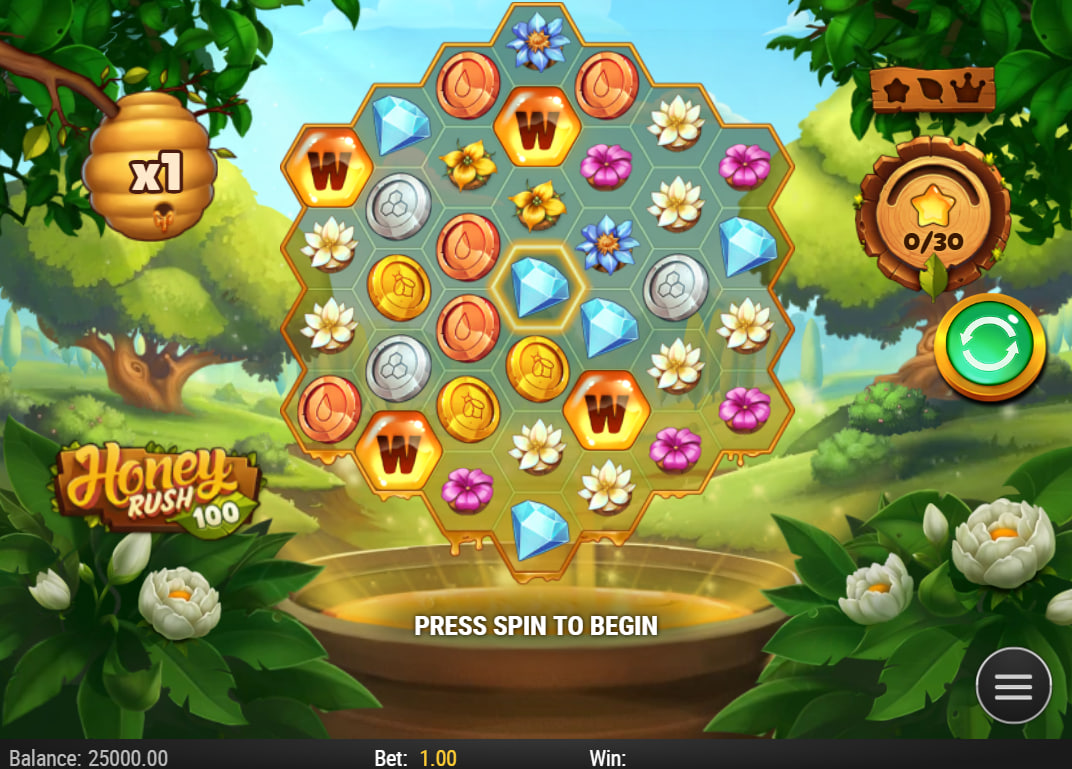
The hexagonal grid is a cluster-pay meat grinder designed to bait you into thinking momentum is easy. Success here relies on the Rush Meter, a three-level progression system that resets every single round. To hit Level 1, you need 30 winning symbols, which triggers a Drone Colony—a feature that clones the center symbol to create a cluster of at least 7 matching icons. The real grind begins as you push for Level 2 at 60 symbols for a Worker Colony (10-15 symbols) and the elusive Level 3 at 90 symbols for the Queen Colony. This isn’t some friendly bonus round; it’s a war of attrition where the Queen Colony can cover up to 37 spots, virtually the entire grid, but reaching it requires a sequence of cascades that the math model frequently interrupts with dead zones.
The design effectively integrates the Sticky Wild mechanic, which is the only real way to build a multiplier. Unlike standard slots where Wilds just sit there, these icons must move to the absolute bottom edge of the grid to be collected into the honey pot. Only then does the global multiplier increase. This creates a frustrating dynamic where a Wild stuck in the upper rows is technically useless for your multiplier until the symbols beneath it vanish. The multiplier logic is tiered: base collection adds +1, but if you collect them after a Drone Colony, it jumps by +2. Post-Worker or Queen Colony, each Wild awards a +3 boost. It’s a calculated risk—you need the colonies to trigger to make the Wilds truly valuable, but you need the Wilds to survive the cascades to reach the colonies.
If you’re the type of player who hates waiting, the Hyper Spin feature is a double-edged sword. By holding the spin button, the game cycles through rounds at a breakneck pace, which is great for high-volume sessions but lethal for a dwindling balance. This mechanic highlights the developer’s focus on efficiency for “grinders” who want to burn through 300+ spins to find that one Overcharge sequence. The visual feedback is sharp, with symbols dropping vertically to fill gaps, but don’t let the polish fool you—this slot is designed to punish players who don’t understand the multiplier collection lag.
The Hexagonal Mathematics of Balance Depletion
Why is the bottom edge collection a death sentence for most sessions? The Sticky Wilds in Honey Rush 100 aren’t just there to help form clusters; they are the gatekeepers of the multiplier. Because they only move down when they participate in a win, you can often find yourself with a x1 multiplier despite having three Wilds on the screen if they are stuck in the “shoulder” positions of the hexagon. This mechanical bottleneck ensures that the global multiplier stays low during the early stages of a cascade sequence.
The symbol economy is equally unforgiving. Since the game clones the center symbol for its Colony features, the value of your entire bonus depends on what lands in that one central spot. If you land a natural Wild in the center, the Colony feature becomes significantly more potent, but the probability of this alignment is low. Most players will find themselves frustrated as a Drone Colony clones a low-value flower symbol, providing just enough symbols to keep the meter moving but not enough to actually profit.
Decoding the Statistical Mirage of Overcharge
What happens when you actually cross the 90-symbol threshold? Once the Rush Meter is maxed out, the game enters Overcharge mode. Every 15 additional symbols collected will upgrade the middle symbol, increasing its payout tier until it can’t go any higher. If you manage to max out these upgrades, each subsequent 15-symbol set adds +3 to the global multiplier. It sounds lucrative, but the sheer volume of symbols required—105, 120, 135—means you are deep into a statistical outlier territory.
Is the Queen Colony a guaranteed win? Absolutely not. While a cluster of 20-37 symbols is massive, if your global multiplier is still sitting at x2 or x3 because your Sticky Wilds never reached the bottom pot, the payout will be underwhelming compared to the effort of charging the meter. This slot is a lesson in variance; the potential is locked behind the simultaneous success of the cascade length and the Wild movement logic.
Is the 90-Symbol Target a Realistic Goal?
For most players, the answer is a resounding no. Reaching the Queen Colony requires a chain of clusters that almost always necessitates multiple Sticky Wild involvements to keep the cascades alive. Given the hit frequency and the way symbols drop, you will often find the meter stalling at 58 or 88 symbols, just short of the next tier. This “near-miss” design is intentional, keeping you in the seat for “just one more” attempt at the 90-symbol milestone.
Does Hyper Spin Actually Benefit the Player?
The Hyper Spin function, activated by holding the spin button, is purely an ergonomic tool for those who value speed over the “show.” It doesn’t change the RNG or the 90-day expiration for unfinished games, but it significantly increases the “cost per minute” of your session. For grinders who analyze the patterns of symbol drops, it’s a shortcut to the high-intensity Overcharge phase, but for casuals, it’s a fast-track to a zero balance.
Field Intelligence: The Hive’s Hidden Logistics
Before you commit your bankroll to the hive, you need to understand the logistical quirks that Play’n GO has baked into the game info. These aren’t your standard fruit machine rules; they are the specific parameters that define the 100-series volatility.
- Winning combinations are not restricted to simple lines; they pay if symbols are connected horizontally, vertically, or even diagonally, provided they are adjacent.
- Sticky Wilds are only removed from the grid once they reach the absolute bottom edge and drop into the honey pot.
- The center symbol is the “DNA” of the Colony feature; it is chosen before being cloned outward to create the cluster.
- The global multiplier is not persistent; it resets completely at the end of every game round, regardless of how high it reached during Overcharge.
- Unresolved bets in incomplete games are voided after exactly 90 days, so don’t leave a triggered meter hanging.
- Worker Colony creates a cluster ranging from 10 to 15 symbols, while the Queen tier spans a massive 20 to 37 icons.
- Each 15 symbols collected in Overcharge mode upgrades the center symbol’s value tier.
- Malfunction of the software or hardware voids all plays and payouts, which is the standard safety net for the house.
FAQ
How does the Sticky Wild multiplier work in this slot?
Wilds increase the global multiplier only after participating in a win and reaching the grid’s absolute bottom edge.
What is the difference between Drone and Queen Colonies?
A Drone Colony creates a cluster of 7 symbols, while the Queen Colony expands to cover 20 to 37 spots.
What happens during the Overcharge mode?
After 90 symbols, every additional 15 icons collected will upgrade the center symbol or increase the multiplier by +3.
Where can I find the Honey Rush 100 demo version?
The slot is available for free play on the Respinix.com website.
Is the multiplier persistent across different spins?
The global multiplier resets at the conclusion of every individual game round and does not carry over.