
Hamsterpunk Crash by Riddec Games delivers a high-volatility steampunk experience where a goggled rodent powers a mechanical wheel. Operating on a crash mechanic with a 90% to 98.00% RTP range, the game demands rapid decisions within a 6-second betting window. Players manage dual betting panels with limits from $0.10 to $50.00, chasing a massive 10,000x maximum multiplier. The Provably Fair system ensures transparent rounds, while auto-cashout features help mitigate the brutal variance.

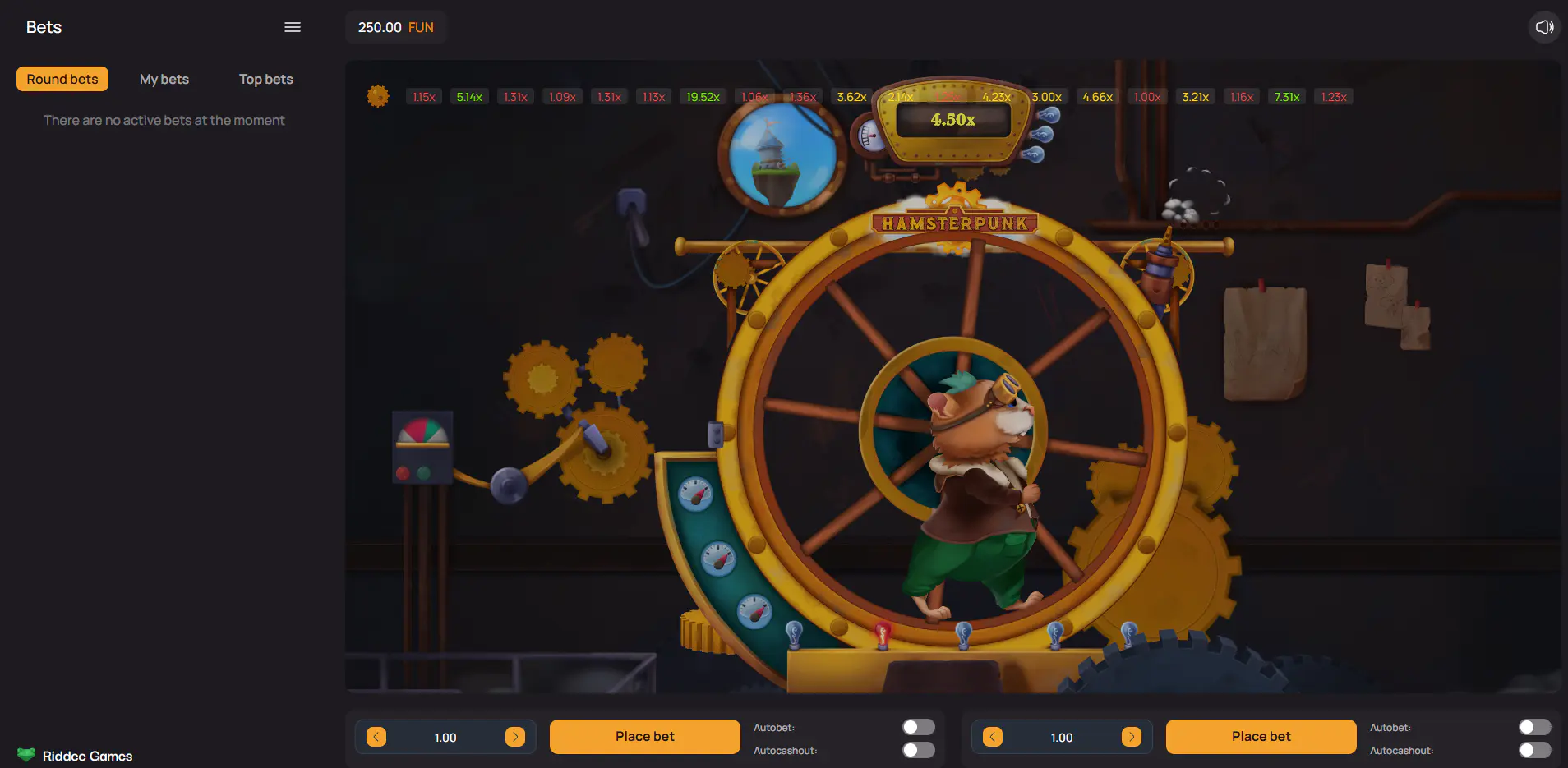
The base mechanic relies on a standard crash format. The visual execution centers entirely on the Hamsterpunk Crash protagonist. As the round starts, the hamster sprints inside a mechanical wheel. This action drives a multiplier scaling upward. A longer run equals a higher potential payout. The risk of a sudden system overload increases every millisecond. When the crash happens, the wheel stops. The hamster tumbles. Any uncollected bets are wiped out. Riddec Games implemented a strict 6-second interval between rounds. This forces rapid decision-making. You can place a new bet immediately after cashing out. The pace remains relentless.
From a profitability standpoint, the math model offers a theoretical RTP of 98.00%. Operators can adjust this down to 90%. Playing on the lower end of that spectrum turns the game into a fast-paced bankroll drain. The dual-betting panels allow for risk mitigation. You can set one panel to auto-cashout at a conservative 1.50x. You can let the second panel ride toward the 10,000x cap. The UI displays a history of previous crash points at the top. These numbers are color-coded to show cold streaks and rare spikes. Seeing a string of 1.00x to 1.15x crashes is common. This reflects the high volatility.
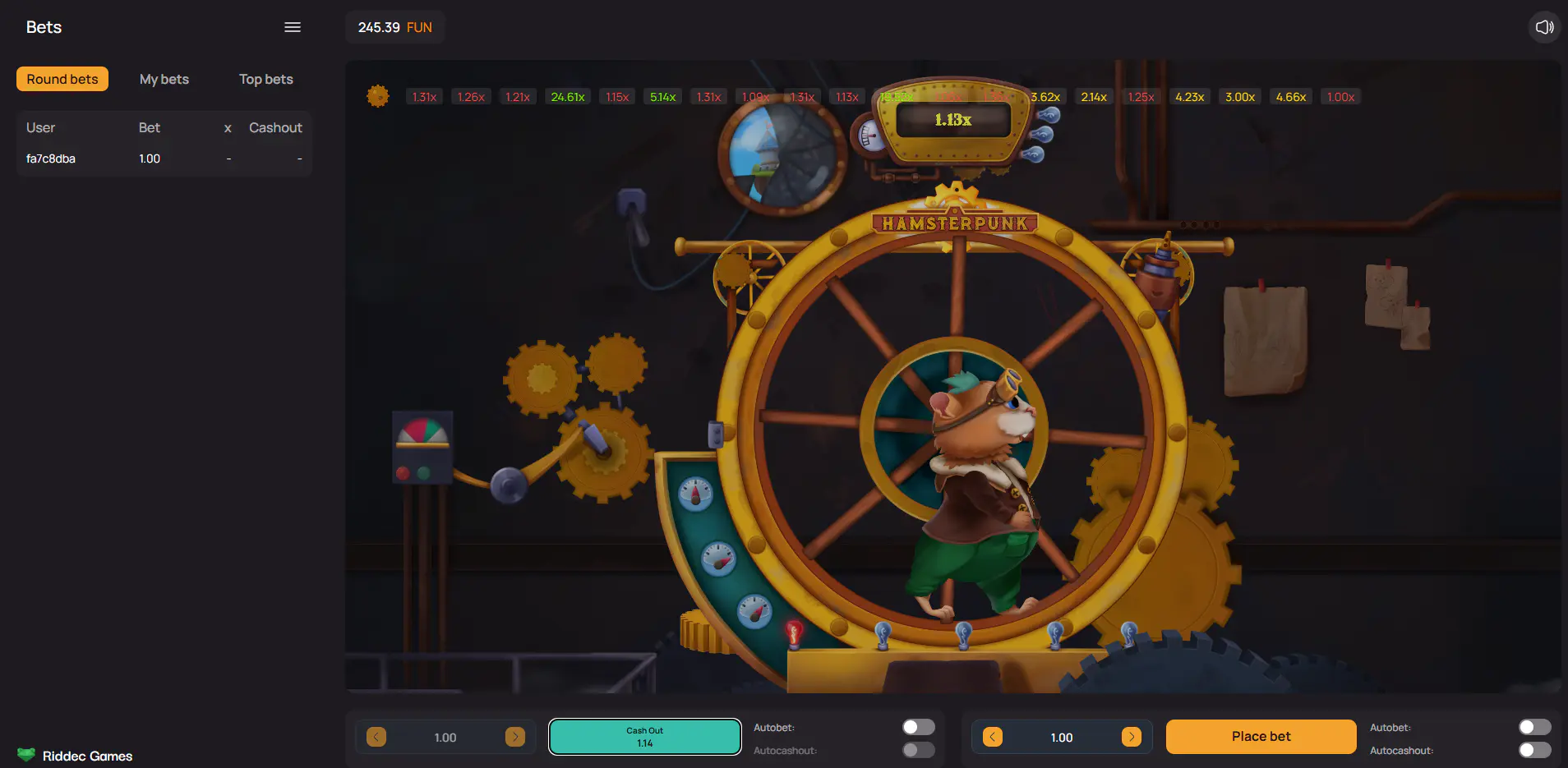
The design leans heavily into brass gears, pressure gauges, and steam pipes. A small porthole in the background reveals a floating island. This adds depth to the mechanical laboratory setting. But the constant spinning animation can become visually fatiguing during long sessions. Players looking for complex bonus rounds or narrative progression will hate this format. It caters strictly to gamblers wanting fast resolution and direct control over their risk exposure. The minimum bet of $0.10 makes it accessible. The $50.00 maximum bet per panel means high rollers chasing the $250,000.00 absolute maximum win need to hit a massive 5,000x multiplier on a max bet to cap out.
The Brutal Reality of the 10,000x Chase
Chasing the maximum multiplier requires navigating extreme variance. The game engine allows the multiplier to scale up to 10,000x. Reaching that ceiling is a rare event.
Operating on a high-volatility math model, the game frequently terminates rounds before the 1.50x mark. The Provably Fair system uses secure hashing to combine server and client seeds. This guarantees the crash point is predetermined and unalterable. With the RTP fluctuating between 90% and 98%, the house edge can double depending on the casino’s configuration.
Watching the balance bleed during a cold streak is a standard part of the experience. A string of instant 1.00x crashes will wipe out both betting panels before you can even react. The dual-bet strategy often creates an illusion of safety. The small wins on the first panel barely cover the losses of the second panel chasing a 10x or 50x payout.
The developer explicitly categorizes this under the “Probability” model. This emphasizes the raw mathematical nature of the draw. The 6-second betting window between rounds is intentionally tight. It keeps the action moving and prevents overthinking.
Ergonomics and Bankroll Drain
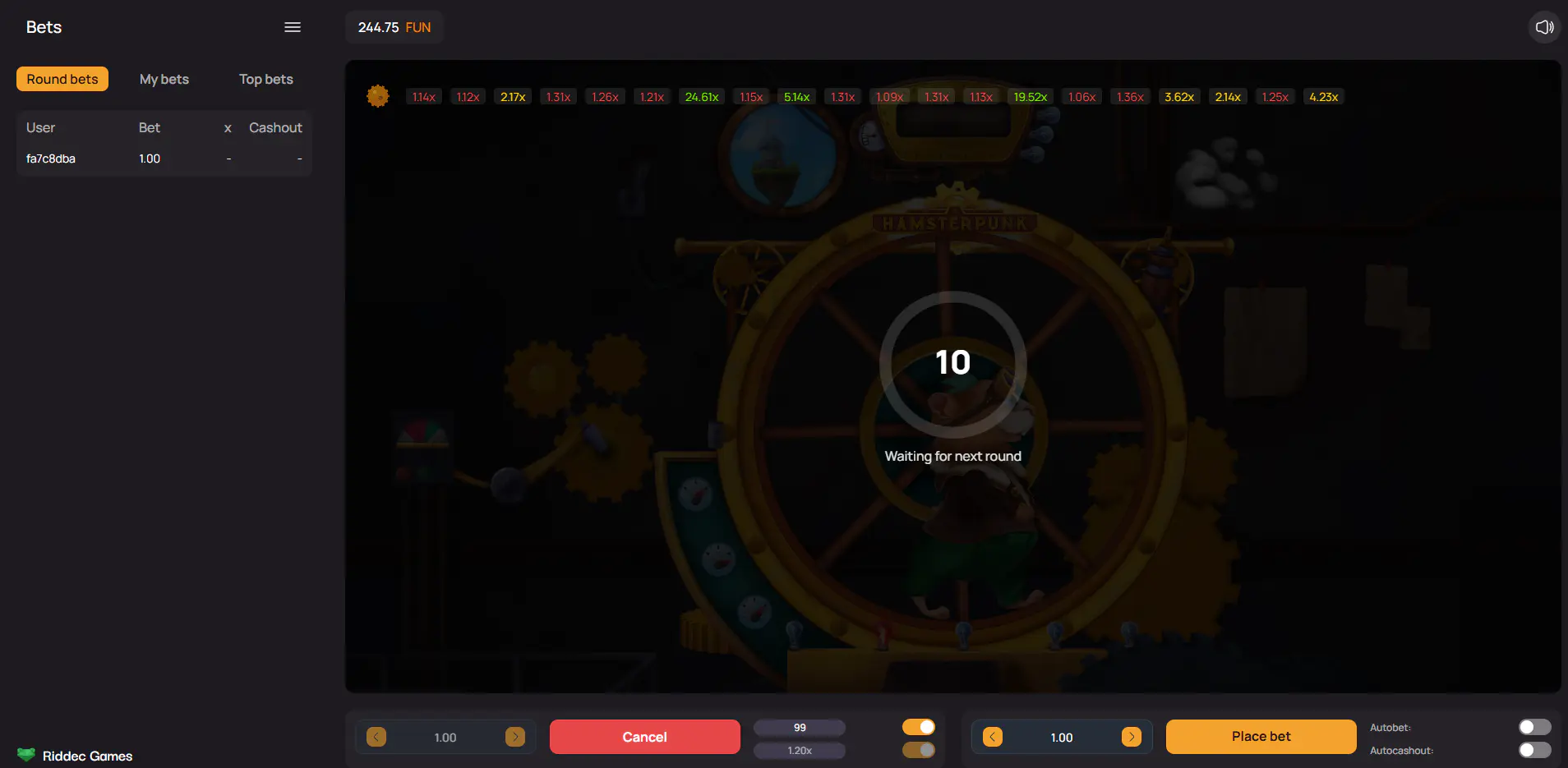
The user interface controls how fast you lose or win your money. The dual panels at the bottom of the screen house the Autobet and Autocashout toggles. These are mandatory tools for surviving the fast-paced rounds.
Setting an Autocashout at 2.00x on a $5.00 bet guarantees a $10.00 return if the wheel holds together. This bypasses human reaction time. The betting range from $0.10 to $50.00 per panel allows for a total exposure of $100.00 per round. If the game hits a 1.00x crash, that entire $100.00 disappears instantly.
Relying on manual cashouts is a massive mistake. The latency between your click and the server registering the command can cost you the bet. This is especially true when the multiplier accelerates past 5.00x. The Autocashout feature secures the exact multiplier you target. It eliminates the friction of network delays.
The UI also includes a “Round bets” tab. This shows other users’ active wagers and cashout points in real-time. This social element often triggers FOMO. It forces players to hold their bets longer than they should just because they see a high roller staying in the round.
The Engineer’s Blueprint
Understanding the mechanics requires looking past the spinning hamster and focusing on the raw data. The engine operates on strict parameters dictating the flow of the session.
The Provably Fair system guarantees transparency. The configurable RTP means the math model is not static across all platforms. Here are the core technical specifications driving the wheel:
- The maximum monetary payout is hard-capped at $250,000.00 per round.
- Operators can select an RTP setting anywhere from 90% up to the maximum 98.00%.
- The interval between active rounds is locked at exactly 6 seconds.
- Players can place bets for the upcoming round while the current round is still active, provided they have already cashed out.
- The game is fully optimized for both Mobile and Desktop environments.
- The maximum multiplier limit is programmed to stop at exactly 10,000x.
FAQ
Where can I play the Hamsterpunk Crash demo?
The demo version is available on Respinix.com.
What is the maximum win in Hamsterpunk Crash?
You can win up to 10,000x your bet, capped at a maximum payout of $250,000.00 per round.
How does the dual bet mode work?
You can place two independent bets per round, allowing you to set different auto-cashout multipliers for each panel.
What is the RTP of this crash game?
The theoretical return to player ranges from 90% up to 98.00%, depending on the operator’s configuration.
How long is the interval between rounds?
Players have exactly 6 seconds to place their bets before the next round begins.
Is the game provably fair?
Yes, it uses secure hashing to combine server and client seeds, ensuring the crash point is predetermined.