
Gold Hit: Viva Las Robot by Playtech is a high-energy slot set in a neon-drenched futuristic Vegas. Featuring a distinct 4-4-6-6-6 reel layout, the game centers on the Gold Hit mechanic where cash coins lock for three spins. Players must fill entire reels to collect prizes, including four fixed jackpots topping out at 500x. With a blend of classic casino icons and robotic flair, this high-variance experience demands precision and patience to unlock its full potential.

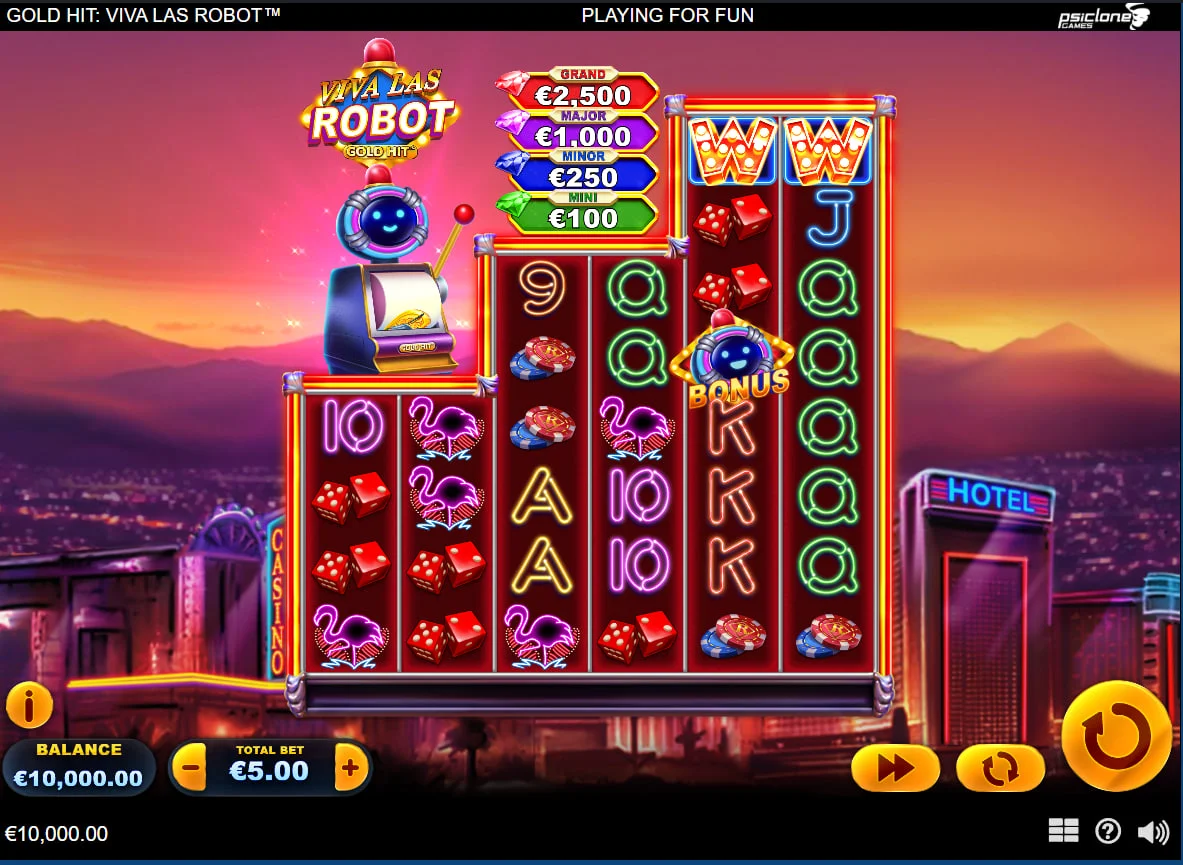
The gameplay experience revolves almost entirely around the Gold Hit mechanic, which turns the standard slot loop into a frantic race against the clock. When coin symbols land, they don’t just pay out and disappear; they lock in place for a minimum of 3 spins. This creates a persistent state of tension where you are constantly watching the countdowns on various reels. To actually bank the money, you have to fill an entire reel with these coins. If you manage to stack 6 coins on reel five, the total value is finally liberated and added to your balance. During a 100-spin demo run, it became clear that this game is a war of attrition. You will often see a reel nearly full, only for the timers to expire on the bottom symbols just as a new one lands on top, resetting the frustration.
The lopsided reel structure, featuring 4 rows on the first two reels and 6 on the remaining three, dictates a very specific hit pattern. Most of your base game wins will feel like tiny speed bumps, with the top-paying Gold 7 symbol only returning 10x your bet for a full line of six. The real weight of the math is tucked away in the Diamond Prize coins. These are the only way to sniff the 500x Grand Jackpot, which, at a $5.00 bet, sits at a fixed $2,500. Comparing this to other Playtech titles like the Age of the Gods series, the win potential here feels more grounded and less reliant on astronomical multipliers, appealing instead to those who prefer the tactile satisfaction of filling meters and locking symbols.
Visually, the game leans heavily into the “Viva Las Vegas” trope but adds enough robotic flair to keep it from feeling like a generic clone. The animations are sharp, especially when a reel is close to being completed and the robot begins to react. However, the design also serves a cold, functional purpose. The bright neon borders around the reels make it easy to track which sections are currently “active” with locked coins, a necessity when you have 26 positions to monitor. For a casual player, the constant locking and unlocking might feel cluttered, but for a grinder who enjoys tracking symbol persistence, it provides a layer of engagement that standard video slots lack.
Neon Logic and Algorithmic Hurdles
The mathematical structure of this slot is designed to keep you in a state of “almost winning,” which is the most dangerous zone for a bankroll. Because coins lock for only 3 spins, the game creates a high-friction environment where the cost of the spin often outweighs the frequency of reel completions.
Why is the 3-Spin Lock a Double-Edged Sword?
The 3-spin persistence is the heartbeat of the slot, but it’s also its primary drain. In a standard session, you might have four coins locked on reel three, but if the fifth and sixth coins don’t land within those 3 spins, the entire stack evaporates. This forces a psychological loop where you feel compelled to keep spinning to “save” the coins currently on the board. From an efficiency standpoint, the game is designed to maximize the number of spins per minute by keeping several reels “live” at all times.
Is the Symbol Economy Built for the Player?
Looking at the paytable, there is a massive gulf between the high-tier symbols and the low-tier neon royals. A line of six 9s through Aces pays a meager 1.6x your bet. Even the Chips and Flamingo symbols, which occupy the mid-tier, only cap out at 6x and 8x respectively. This means the base game is purely a holding action; you are effectively paying a premium in dead spins for the rare chance to fill a 6-row reel. The robot might be smiling, but the math is unforgivingly focused on the Gold Hit triggers.
The Silicon Sin City Ledger
While the surface of the game is all bright lights and robotic chirps, the underlying data reveals a slot that rewards patience and a very specific type of risk management. It’s less about chasing a single massive multiplier and more about managing the “inventory” of coins on the screen.
- The 4-4-6-6-6 layout creates a total of 26 symbol positions, significantly more than a standard 5×3 grid.
- Gold 7 symbols are the highest value non-special icons, paying $50.00 for a six-of-a-kind on a $5.00 wager.
- The Grand Jackpot is fixed at 500x the total bet, providing a clear mathematical ceiling for the session.
- Reels 1 and 2 are the easiest to fill with only 4 rows, making them the most frequent sources of minor payouts.
- Reels 3, 4, and 5 require 6 coins to trigger a payout, representing the high-variance zones of the machine.
- Wild symbols substitute for all standard icons but are useless for triggering the Gold Hit or Bonus features.
- Diamond Prize coins are the only way to access the four fixed jackpots: Mini, Minor, Major, and Grand.
- The Bonus symbol, featuring the robot’s face, is the key to unlocking the free games, which are separate from the main game’s coin-locking logic.
FAQ
How does the Gold Hit feature work?
Coin symbols lock on the reels for 3 spins and pay out only when an entire vertical reel is filled with them.
What is the maximum win in Gold Hit: Viva Las Robot?
The top prize is the Grand Jackpot, which awards a fixed payout of 500 times your total bet.
Where can I play the Gold Hit: Viva Las Robot demo version?
The free-to-play demo version of this slot is available directly on the Respinix.com website.
What is the reel layout for this game?
The slot uses an unconventional 5-reel grid with a row height configuration of 4-4-6-6-6.
How do you trigger the jackpots?
Jackpots are triggered by landing Diamond Prize coins, which can award Mini, Minor, Major, or Grand prizes.