
Gold Hit O’Reilly’s Riches from Playtech delivers a highly volatile, grimly realistic approach to Irish folklore across an asymmetric 4-4-6-6-8 grid with 4,608 ways to win. Featuring a strict 95.21% RTP, this slot hinges on an innovative three-spin countdown system where coins lock onto specific rows. Full column saturation awards cash prizes or fixed jackpots up to 500x. Free games lock all tokens permanently, introducing a multiplier wheel up to x10 for maximum returns.

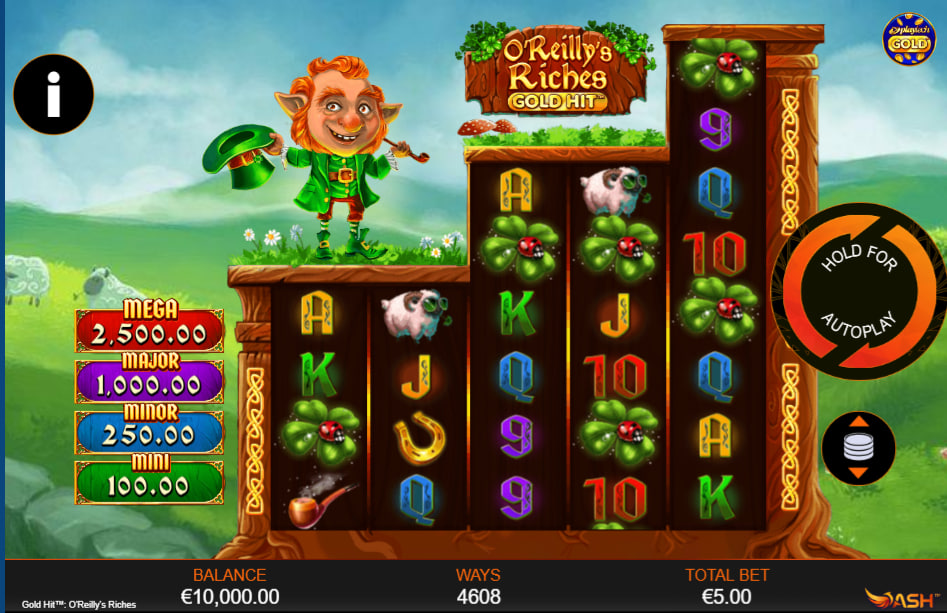
The setup instantly breaks away from industry standard configurations, deploying an asymmetric 4-4-6-6-8 grid that yields exactly 4,608 ways to win. Winning combinations pay out from the leftmost position to the right across adjacent rows, meaning your standard symbols must align across severe structural steps to sustain your session. The theoretical RTP sits at a tough 95.21%, though regional software configurations can drop this baseline value down to an unforgiving 93.31%. Operating on high volatility, this engine is built for deep bankroll drawdowns where regular symbol payouts often act as mere filler to distract you from the rapid cost of the spin.
The foundational feature driving this title is the persistent collection mechanic that operates directly inside the base game. Landing a golden Coin pins that specific symbol to its coordinates while triggering an independent three-spin counter directly below that specific reel. Each subsequent coin that locks onto that identical column resets the countdown timer back to three. Your objective is absolute saturation. To actually claim the cash rewards displayed on these tokens, which range from a low 0.5x up to 10x your total bet, you must fill every vertical cell of that specific reel before the counter hits zero. If the counter reaches zero before the column is filled, the engine wipes the progress completely, converting your spent capital into pure dead weight.
Why the Three-Spin Reset is a Psychological Trap
The countdown timer is a masterclass in player friction, designed to make you chase incomplete columns. Watching a reel with six open slots collect five coins only to starve on the final spin causes rapid tilt, yet the math dictates that partial reel states are worth absolutely nothing. Because each column tracks its own independent cycle, you will routinely find your focus split across multiple countdowns, burning through cash just to keep separate rows from resetting simultaneously.
The Role of Blocker Symbols and Low Base Line Wins
The top symbol is O’Reilly the Leprechaun himself, returning a modest 5.0x your stake for five of a kind, while secondary symbols like the spectacled sheep or the ladybug pay a tight 3.0x. These meager values mean that regular layout connections fail to offset the baseline spin costs during long dry spells. The grid routinely fills with low-tier card values from Ace down to Nine, which pay a miserable 1.5x for full combinations, effectively acting as blockers that choke your paths to organic line wins.
Hidden Friction and Technical Ergonomics
The built-in user interface hides its efficiency tools behind standard interaction patterns, requiring you to hold the spin button down to unlock the manual Autoplay configuration options. This menu allows you to automate sequences of 5, 10, 20, 50, or 100 rounds, alongside a dedicated conditional setting that runs uninterrupted until a feature triggers. Grinders looking to bypass long visual sequences must actively engage the independent Turbo toggle, which cuts animation cycles to maximize the hourly rate of rounds.
The system relies strictly on third-party verification to ensure that its asymmetric random generation paths remain fair, processing all calculations through rigorous testing labs like GLI and iTech Labs. You can configure your stake across an expansive range from a minimum of $0.10 up to a staggering maximum of $350.00 per spin, meaning a single misclick on the coin-stack interface can radically alter your exposure. There is no artificial bonus buy shortcut included in the software architecture, meaning every player must grind through the base game to unlock the true potential of the engine.
The Multiplier Wheel in Free Games
Landing three, four, or five pot-of-gold Scatter symbols across the layout triggers 10, 12, or 15 free games respectively. In this advanced state, the temporary three-spin countdown rule is completely removed from the code, allowing every landed coin to remain locked for the duration of the entire bonus feature. This shift significantly reduces session friction, turning the endgame into a calculation of total grid saturation.
When you successfully fill an entire vertical column during this mode, a specialized Multiplier Wheel activates directly above that specific track. The needle spins to award an additional multiplier ranging from x2 up to x10, which multiplies the value of every single coin accumulated on that specific column. All winnings are held by the software until the very last free game concludes, which means a single unfilled column represents massive lost potential.
Shamrock Records
- The asymmetric 4-4-6-6-8 matrix requires exactly 28 coins to achieve complete screen saturation across all 4,608 ways.
- The Clover Coin jackpot system relies entirely on filling a reel containing a Shamrock token to award fixed prizes up to 500x.
- The absolute mathematical ceiling for a single game cycle is capped by the developer at a rigid 2,500x total stake.
- Card symbols from Ace to Nine make up the majority of dead screen space, keeping base hits well below your spin cost.
- The Multiplier Wheel uses discrete weighting, making the coveted x10 multiplier significantly harder to land than the x2 baseline.
- The title is developed by Ash Gaming, a specialized studio operating under the parent umbrella of Playtech’s software delivery network.