Gods Gone Wild is a high-variance slot from AvatarUX that swaps traditional lines for a Pay Anywhere engine. Set against a stylized mythological backdrop, the game requires 8 identical symbols to trigger a win, with payouts capping at 12 icons. Featuring a variable RTP ranging from 96.01% to 96.07% across various bonus tiers, the math model is built for intense sessions. The grid-based gameplay focuses on symbol volume and free spin collection, offering a cynical challenge for seasoned grinders.

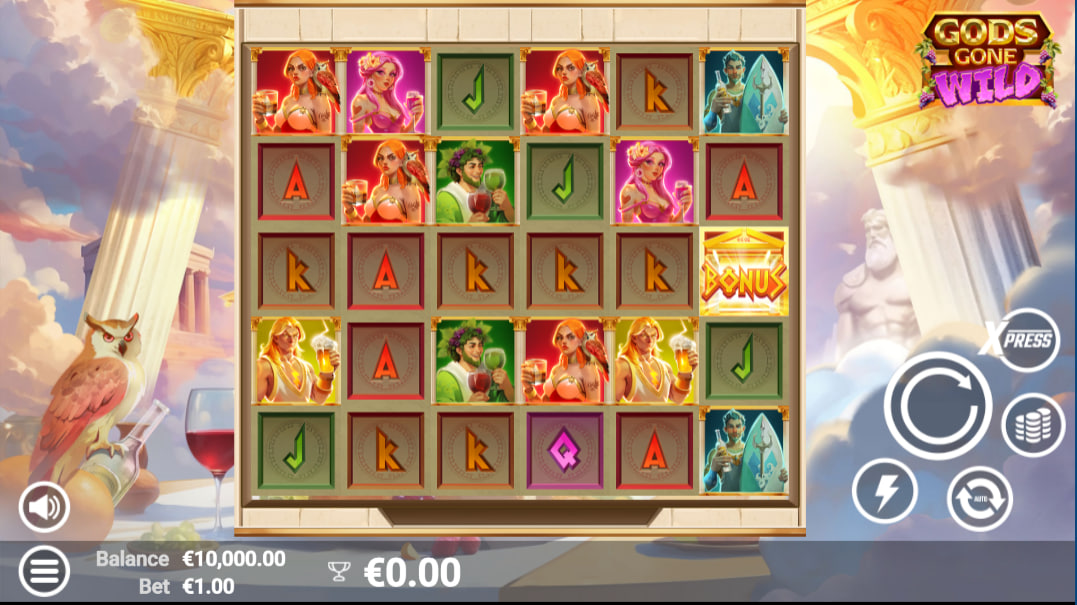
Gods Gone Wild operates on a Pay Anywhere system that ditches traditional paylines for a more chaotic approach to winning. You are not looking for left-to-right connections or adjacent clusters. The grid demands volume. Landing 8 symbols is the entry fee, but the math caps the payout scaling at 12 symbols. This means if you hit a massive screen of 20 matching deities, you are getting paid the same as if you hit 12. This ceiling is a clear indication that AvatarUX wants to control the volatility and prevent the engine from melting during a lucky cascade. The visual presentation is sharp, with stylized gods that look like they belong in a modern comic book rather than an old history text. But do not let the polished animations distract you from the fact that the hit frequency requires serious patience. You will go through streaks of dead spins where symbols land in groups of 6 or 7, mockingly staying just below the payout threshold. The profitability here hinges entirely on the bonus rounds, as the base game serves as a war of attrition designed to drain your credits while you chase a collection of free spins.
Decoding the Volatility Trap
AvatarUX provides a rare level of transparency regarding their testing, noting that the expected payback was calculated from 1,000,000,000 simulated game rounds. This billion-spin benchmark proves that the 96.06% RTP is not a suggestion but a statistical certainty over the long haul. When you are grinding through a session, you will feel the weight of those simulations. The variance is high enough that your short-term experience will likely look nothing like the theoretical return. You might see your balance evaporate in 50 spins, or you might hit a localized spike that defies the average.
The scatter pay mechanic changes the psychology of the spin. In a standard slot, you are tracking lines. Here, you are counting icons. It is a different kind of friction. The low-paying royals like J, K, and A appear frequently to clutter the grid, acting as blockers for the high-value gods. You need to see the screen clear out these low-tier symbols to make room for a payout that actually matters. Because there are no paylines, the grid feels more open, but the 8-symbol requirement is a steep hill to climb. If you are the type of player who gets tilted by “near misses,” this math model will test your resolve.
The Hidden Math of the Pantheon
The most cynical aspect of Gods Gone Wild is found in the specific RTP breakdowns for the bonus buy options. Most players assume that paying more for a “Max” bonus automatically buys them better odds. The data proves otherwise. While the base game and standard bonus sit at a respectable 96.06%, the Bonus Plus option actually offers the highest return at 96.07%. Meanwhile, the most expensive tier, Bonus Max, drops the RTP down to 96.01%. It is a subtle but significant trap for the uninitiated. You are literally paying a premium for a mathematically inferior return-to-player percentage.
Why would a developer lower the RTP for the most expensive feature? It likely comes down to the sheer explosive potential of the Max bonus. To offset the risk of a massive payout that could bankrupt the prize pool, the engine slightly tightens the overall return. It is a trade-off that many high-rollers are willing to make, but from a purely analytical standpoint, it is a sucker bet. You are chasing the ceiling at the expense of your long-term equity. The 12-symbol payout cap also plays a role here. Even in the most boosted bonus round, you cannot escape the fact that the game stops rewarding symbol quantity once you hit that dozen mark.
Strategic Ergonomics for the Session
For the serious grinder, the interface offers the standard suite of tools, but the game is built for speed. The interruption policy is generous, allowing you to replay a round within 24 hours if the software fails. This is a standard compliance feature from labs like iTech Labs or GLI, ensuring that your 8-symbol miracle does not vanish into the ether because of a server hiccup. If you choose to skip the replay, the win is added instantly, which is the preferred move for those who care more about the balance than the animation.
The symbol economy is heavily weighted toward the gods, as they carry the multipliers and values that actually move the needle. The low-value royals are essentially there to take up space and increase the friction of the session. If you are not seeing at least one high-tier god symbol every few spins, your session is likely heading for a crash. The game does not offer a gamble feature or a complex second-screen bonus; it is all about the grid and the symbols. This simplicity is either its greatest strength or its biggest weakness, depending on whether you value mechanical purity or varied gameplay.
The Oracle’s Dirty Ledger
The internal logic of this slot reveals several technical details that the casual player will likely miss during a standard session on Respinix. These facts are the backbone of the engine and dictate exactly how the money moves through the Mount Olympus theme.
- The Bonus Max feature has the lowest RTP of all available modes at 96.01%, making it the least efficient way to play despite its high cost.
- Bonus Plus is the mathematical sweet spot of the game, offering a peak RTP of 96.07% which exceeds the base game average.
- A billion-round simulation was used to verify the math, a massive sample size that ensures the volatility is tightly controlled by the developer.
- The payout scaling completely flatlines after 12 symbols, meaning 13, 15, or 20 symbols pay exactly the same as 12.
- There is no payout for landing fewer than 8 symbols, creating a high-friction environment where small wins are non-existent.
- Malfunctions void all play, a standard clause that serves as the ultimate shield for the house against software anomalies.
- The 24-hour replay window is a hard limit; after that, the system automatically settles the bet without player input.
- Symbol wins are calculated by simple count, removing the complexity of “adjacent” or “touching” rules found in cluster slots.
FAQ
What is the minimum number of symbols needed for a win?
You must land at least 8 identical symbols anywhere on the grid to trigger a payout.
Does landing more than 12 symbols increase the payout?
No, the paytable caps symbol wins at 12 icons, meaning 13 or more symbols pay the same.
Which bonus buy option has the best mathematical return?
The Bonus Plus feature offers the highest RTP at 96.07%.
Where can I find the Gods Gone Wild demo version?
The slot is available to play for free on the website Respinix.com.
Is there a gamble feature in this slot?
The game focuses on scatter pays and bonus buys without a traditional card-based gamble mechanic.
What happens if the game freezes during a spin?
Players can replay the interrupted round within 24 hours of restarting the software.