
Fruit Cube is a high-volatility slot from Spinmatic built on a 5×3 grid with 5 fixed paylines. Abandoning standard flat designs, it presents a distinct outdoor market atmosphere where every symbol appears as a geometric three-dimensional block. The gameplay is anchored by a versatile pink bird wild and a dynamic mystery scatter feature that triggers a symbol transformation game. With a low entry cost of $0.10, this title challenges players to manage sharp variance while hunting for premium five-of-a-kind watermelon alignments worth up to $16.00.
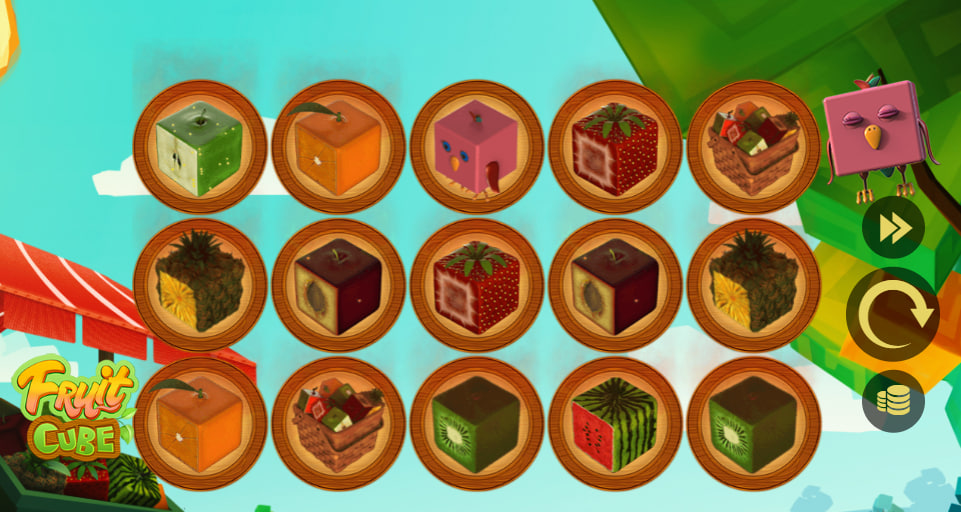
The structural arrangement relies on a 5×3 grid supported by 5 fixed paylines, which immediately indicates that every single hit needs substantial volumetric weight to counteract the narrow betting paths. Landing a basic winning sequence requires symbols to match in succession from the leftmost reel to the rightmost reel along an active payline. Payout lines are uncompromisingly rigid, so a single misplaced cube breaks the chain entirely, forcing players to rely on the special substitute characters to complete fragmented patterns. While the default betting range starts at a conservative $0.10 per spin, the economic model forces a brutal realization that low-tier connections frequently pay back significantly less than the total bet amount.
The core gameplay loop centers on a distinctive pink blocky bird symbol acting as the wild substitute, which possesses the ability to replace all regular paying elements across the board with the sole exception of the special feature triggers. Grinding through 200 spins demonstrates how heavily the game relies on this avian wild to turn dead layouts into modest recovery hits. Low-paying items like the kiwi cube require at least two matching items on a line to return $0.02, while five of a kind brings a minor $0.60 reward on a baseline stake. Green apple cubes and orange cubes step up the values slightly, offering $0.60 and $0.80 respectively for complete five-of-a-kind alignments, though getting these premium symbols to line up seamlessly without a wild intermediary is an extremely rare occurrence during standard play.
The volatility curve swings dramatically when the mystery scatter symbols land, as these specific triggers do not follow standard payline constraints and instead activate regardless of their position on the grid. Hitting three or more of these mystery scatters at the exact same time shifts the environment entirely by triggering the main Feature Game. Instead of acting as a typical passive trigger, these scatters conceal regular icons beneath their square surfaces. Clicking or selecting one of the revealed positions causes all matching scatter structures on the board to transform into that specific uniform symbol, computing the final payouts instantly based on the newly uniform array.
Decoding the Volatility in the Cubed Orchard
The underlying mathematics of this environment create a highly volatile structure where the nominal win frequency feels compressed, making the base game feel like a prolonged war of attrition. Session tracking highlights a strict hit pattern where the five-line system prevents casual, frequent line connections, meaning your balance will consistently bleed down unless a multi-line premium or a scatter feature intervenes. Players looking for constant low-value feedback will find this architecture frustratingly silent during baseline spins.
This severe variance means that the true return potential is locked tightly behind the multi-symbol scatter transformations. Because the win amount is limited to the number of mystery scatters present on the grid, small three-trigger entries rarely provide explosive returns unless they reveal the highest-paying fruit symbol. The software requires a massive volume of spins to show its true capability, which might alienate casual enthusiasts who expect immediate bonus action.
Why is the Symbol Reveal So Highly Unpredictable?
The entire bonus mechanism hinges on a single choice that determines whether a bonus round is highly profitable or completely dead. When the feature initiates, the transformation of all active scatters into a single matching fruit icon dictates the entire payout potential of that round. If the hidden mechanism selects a low-tier fruit like the kiwi, the combined payout across the line matrices remains disappointing despite the rarity of triggering the feature.
This creates a high-variance bottleneck where triggering the feature is only half the battle. A player can grind through hundreds of frustrating dead spins to finally secure three scatters, only to watch the selection process reveal an apple or orange that barely covers the cost of the session. The lack of a guaranteed minimum win threshold within the feature game underscores the uncompromising nature of the developer’s design philosophy.
How Do Line Constraints Restrict Feature Wins?
The mechanical restriction of the game dictates that even during high-paying scatter transformations, the regular payline directionality must be honored. Wins only pay out when symbols land in succession from the leftmost reel, meaning that if your mystery scatters are concentrated primarily on the fourth and fifth reels, their transformation might yield absolutely zero line connections.
This hidden dependency on grid positioning means that a high number of scatters does not automatically guarantee an astronomical payout. The interface limits the win potential directly to the layout structure, forcing players to watch potentially massive symbol transformations go completely unrewarded if the first two reels fail to connect.
What Hidden UI Mechanics Exist for High-Speed Play?
Grinders looking to maximize spin efficiency can access the integrated turbo-play functions located via the overlay buttons adjacent to the primary spin icon. Activating this fast-spin mode removes the rotational delays of the 3D fruit blocks, dropping them into place instantly to reduce the cycle time of each round to under a second.
This high-speed layout allows high-volume players to run through defensive betting cycles rapidly while chasing the scatter triggers. However, the lack of an advanced auto-stop condition based on balance loss means that using this turbo function without manual oversight can liquidate a small bankroll before the player can react to a bad streak.
How Do Testing Standards Protect the Math Integrity?
The software operates under strict regulatory compliance frameworks verified by independent international testing laboratories to ensure the RNG layer remains uncompromised. Algorithms governing the placement of the pink wild bird and the distribution of the hidden scatter symbols are subjected to millions of simulated rounds before public deployment.
This ensures that despite the brutal dead streaks inherent to a five-line, high-variance design, the stated return metrics remain mathematically fair over long-term operations. The game fits perfectly into the developer’s broader philosophy of pairing simplistic, casual visual themes with demanding, volatile casino math models.
Analytical Hub
The structural and historical framework of this release presents several distinct technical features that differentiate it from standard retro fruit installations:
- The entire visual framework uses full three-dimensional isometric modeling for classic symbols like kiwi, apples, and watermelons instead of using traditional two-dimensional flat sprites.
- Top-tier payouts are heavily weighted toward rare five-of-a-kind connections, with the premium watermelon symbol delivering up to $16.00 on a baseline stake.
- The system configuration strictly enforces a single-highest-win-per-payline calculation rule, though simultaneous wins across different lines are added together during the final evaluation.
- Technical or system malfunctions automatically void all active plays and payouts, resetting the hardware state to safeguard operational integrity.
- The interface features a prominent, decoupled pink blocky bird that hovers independently on the right side of the screen to signal bonus transitions and active wild substitutions.
- The game operates cleanly within standard web browser environments without requiring external plug-ins due to an optimized HTML5 engine footprint.