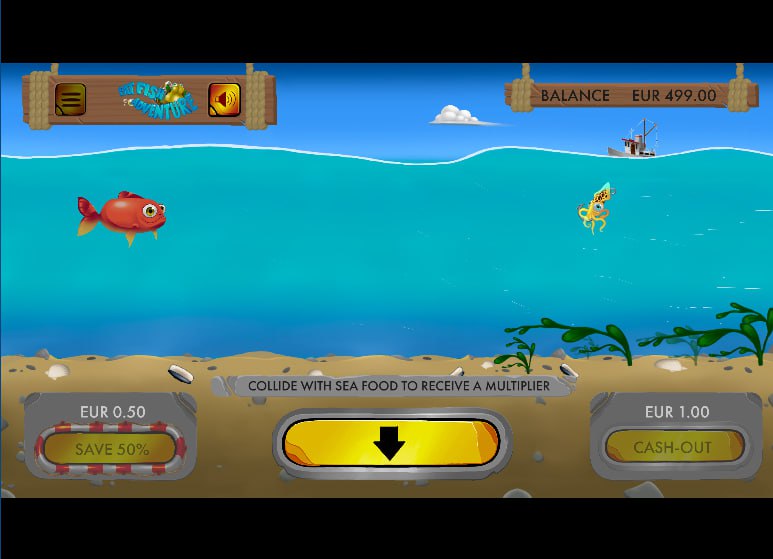
Fat Fish Adventure by Gamanza Games is an interactive title that departs from standard online slots, utilizing a crash game framework. The game features a vibrant, cartoon-style underwater theme where functionality and clarity are prioritized. Gameplay occurs across two horizontal lanes, where players guide a fish to consume sea foods and accumulate a growing win multiplier. The central conflict arises from avoiding hidden items that award a zero multiplier, which concludes the round at a loss. Player agency is paramount, with direct control over lane switching to pursue rewards or evade risk. The core strategic depth comes from its distinct bonus features: a full “CASH-OUT” option and a “SAVE 50%” function. This partial cash-out allows players to bank half their winnings while continuing the round with the remaining amount. This design creates a dynamic based on player timing and risk management rather than reel mechanics.
Gamanza Games presents Fat Fish Adventure, a title that positions itself far from the conventional architecture of reel-based slots. This game forgoes paylines and spinning symbols entirely, opting instead for an interactive arcade framework built on the principles of a crash-style game. However, it introduces a critical layer of direct player control that fundamentally alters the experience. The central concept revolves around navigating a character through a hazardous environment to accumulate multipliers, with the entire session’s success resting on a player’s timing and risk assessment. The game establishes a constant tension between securing current gains and pushing forward for potentially greater, yet uncertain, rewards. This design choice caters to a player base that seeks more active participation in the outcome of each round, moving beyond the passive observation typical of many online games.
The Core Gameplay: Risk Management and Multiplier Accumulation
The gameplay loop in Fat Fish Adventure is direct and intuitive. A round begins with the player setting a bet amount. Once initiated, their chosen fish character starts swimming horizontally across the screen. The primary objective is to make contact with various “sea foods” that appear in the fish’s path. Each item of food consumed—be it a Worm, Shrimp, or Squid—instantly awards a multiplier that is applied to the initial stake. This creates a progressively growing pot, with the potential value increasing with every successful collection. The simplicity of this accumulation phase makes the game immediately accessible, as the feedback is instantaneous and the goal is clear: eat to grow the winnings.
This straightforward process is built around a single, critical element of risk: the Multiplier 0. Concealed among the valuable food items are traps that, upon contact, award a zero multiplier. This event immediately terminates the round, and the entire accumulated amount, along with the initial stake, is lost. The game does not signal the appearance of these traps, making every moment of forward progression a calculated gamble. The three different food types—Worm, Shrimp, and Squid—are described as representing “different set of multipliers.” While the game’s internal paytable specifies the exact values, this structure implies a hierarchy of rewards, compelling the player to make split-second decisions about which food items to pursue, weighing the potential reward against the ever-present danger of the round-ending zero multiplier.
Player Agency and Strategic Decision-Making
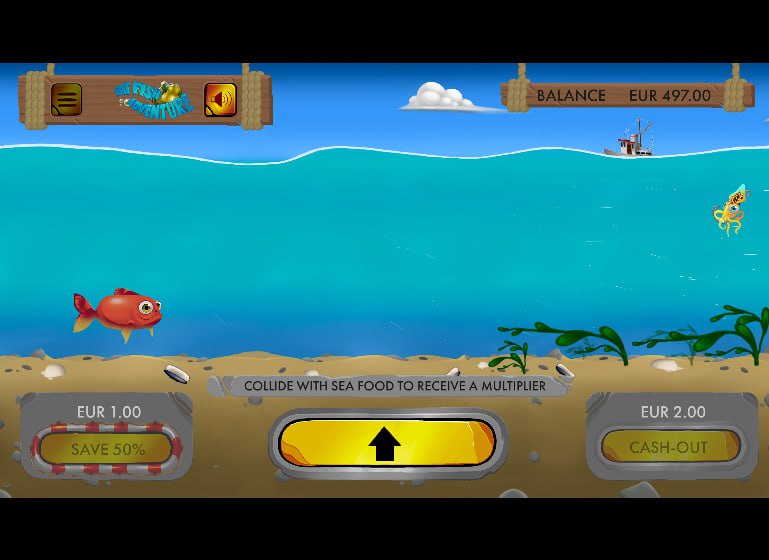
What distinguishes Fat Fish Adventure from standard crash games is the degree of control granted to the player. The game screen is divided into two horizontal lanes, an upper and a lower path. Using simple arrow controls, the player can instantly switch the fish between these two lanes at any time. This mechanic is not merely cosmetic; it is the primary tool for interaction. Food items and potential traps can appear on either lane, requiring the player to actively react and navigate to collect rewards while avoiding hazards. This adds a component of reactive skill, or at least the perception of it, that transforms the player from a passive spectator into an active participant whose choices directly influence the immediate outcome of the game round.
The most significant strategic layer comes from the game’s cash-out system. At any point during the swim, before a round-ending event occurs, the player has two distinct options for securing their winnings. The first is a standard “CASH-OUT” button, which immediately ends the round and awards 100% of the currently accumulated multiplier value. The second, more nuanced option is “SAVE 50%”. Activating this function allows the player to bank half of their current winnings, which are secured regardless of the round’s future outcome, while continuing to play with the remaining half. This presents a sophisticated risk-management tool. It allows a player to guarantee a profit while still pursuing higher multipliers with the remaining portion of their winnings. This dual-option system creates a complex decision tree that rewards tactical thinking.
Visual Presentation and Underwater Atmosphere
The aesthetic of Fat Fish Adventure is clean, functional, and rendered in a bright, 2D cartoon style. The visuals prioritize clarity over cinematic flair, a choice that serves the gameplay well. The underwater background is simple, with a sandy seabed and a clear blue water column, ensuring that the important gameplay elements—the fish, the food, and the UI—stand out without distraction. The character design is simple, with the “RED” fish being a round, approachable figure whose movements are fluid and responsive to player input. This lack of visual clutter is an asset, as it allows the player to focus entirely on navigating the lanes and making timely decisions about cashing out.
The user interface is thematically integrated, with buttons and information panels designed to look like wooden planks tied together with rope. This small touch enhances the game’s lighthearted, adventurous feel without complicating the user experience. Animations are minimal but effective. The fish bobs gently as it swims, the food items have a subtle glow to draw the eye, and the multiplier value updates clearly and instantly upon collection. There are no extravagant visual effects for wins; the reward is communicated through the numerical increase in the potential payout. This functional approach reinforces that the game’s core appeal is its mechanics, not its spectacle. The option to choose your fish at the start, while seemingly a minor cosmetic feature, provides a small touch of personalization that allows players to connect with their on-screen avatar.
Deconstructing the Game’s Mechanical Framework
To fully appreciate Fat Fish Adventure, one must analyze it outside the lens of a typical online slot. There are no reels, wilds, scatters, or paylines. The game’s “symbols” are, in effect, the three food items and the unseen “Multiplier 0” event. The core engine is not a Random Number Generator (RNG) determining symbol combinations on a grid, but one that determines the sequence and lane placement of rewards and risks. The player’s role is to navigate this predetermined path as effectively as possible. This structure makes it a hybrid of chance and player input. While the sequence of events is randomized, the player’s navigation and cash-out decisions directly dictate their success within that sequence.
The relationship between the food types is central to the game’s strategy. It is logical to infer a value hierarchy: Worms might offer lower but more frequent multipliers, Shrimp might represent a medium tier, and Squids could offer the highest-value multipliers, appearing less frequently. This system creates compelling risk-versus-reward scenarios. For instance, seeing a high-value Squid appear on the opposite lane might tempt a player to switch paths, but doing so could lead them into the path of an unseen “Multiplier 0.” This dynamic forces players to constantly evaluate whether to play conservatively by sticking to one lane or to play aggressively by chasing high-value targets. The game becomes a practical exercise in probability assessment and nerve.
With Fat Fish Adventure, Gamanza Games has deliberately stepped away from the saturated market of five-reel video slots to create something more interactive. The design blends the suspense of a crash game with the simple controls of a classic arcade side-scroller. This combination results in an experience that feels more participatory and less predetermined than many other games of chance. The constant agency given to the player—lane switching, full cash-out, or partial cash-out—ensures that no two sessions feel exactly alike, as they are shaped by an individual’s choices and risk tolerance.
This title is particularly well-suited for players who have grown weary of passive entertainment and seek a format where their decisions have a tangible impact on the game’s flow. It serves as an excellent environment for those wishing to play online and engage with risk management principles in a dynamic setting. While its visual simplicity might not resonate with players who prioritize high-fidelity graphics and elaborate narratives, its mechanical depth offers a substantial and engaging alternative. The direct control and strategic cash-out features provide a level of involvement rarely seen in this genre, making it a noteworthy title for analytical players looking for free slots that offer more than just a spinning reel. The game’s merit lies not in its presentation, but in its thoughtful and engaging player-centric mechanics.