
“Easter Run” by Funky Games offers a distinctive gaming session with its bright Easter and car racing thematic elements. The game’s atmosphere creates a curious blend of cheerful, cartoon-style visuals with a core gameplay loop demanding decisive action. Diverging from conventional slot structures, “Easter Run” employs a dynamic crash game format where player choices directly influence outcomes. Its central mechanism involves wagering on an increasing multiplier synchronized with an accelerating vehicle. Participants must strategically determine the precise moment to cash out their bets to secure accumulated winnings before a potential round-terminating event. A significant feature is the dual bet system, which allows for two independent wagers and cash-out decisions within a single game round. This design fosters active player involvement and careful risk management. The game operates with a stated Return to Player (RTP) of 97.00%, presenting an interactive experience for individuals who appreciate direct input on game progression.


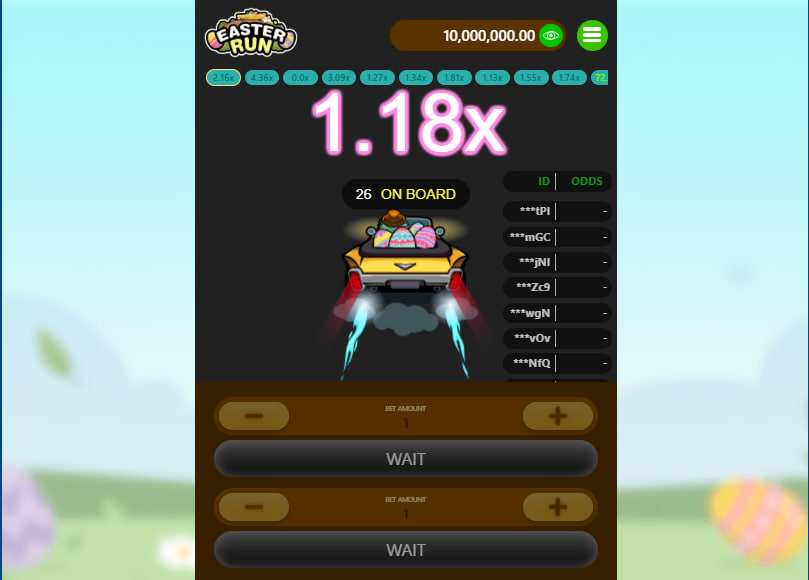
Funky Games introduces “Easter Run,” a title that diverges significantly from conventional reel-based slot machines, presenting instead a dynamic crash game experience. The visual palette is immediately striking, employing a bright, almost saccharine cartoon aesthetic centered around an Easter motif. Players find themselves observing a jaunty yellow vehicle, laden with decorated eggs, speeding along a vibrant green path under a sky complete with a rainbow. This cheerful veneer, however, houses a surprisingly tense core gameplay loop, where timing and nerve are paramount. The atmosphere is a peculiar but effective blend: the lighthearted graphics provide a disarming counterpoint to the continuous risk assessment demanded of the participant.

Core Gameplay Mechanics: The High-Speed Chase
The fundamental principle of “Easter Run” revolves around an escalating multiplier and the player’s decision of when to secure their winnings. At the commencement of each round, after wagers are placed, the car begins its journey, and the multiplier starts its ascent from 0.00x. This multiplier can climb substantially, with the game rules indicating a maximum potential of 150x. The central challenge lies in choosing the optimal moment to activate the “CASH OUT” function, effectively making the character “jump out of the car.” A successful cash-out awards the player their initial stake multiplied by the value displayed at the instant of their action.
The peril in this high-speed endeavor comes from the “bunnies.” While not visually depicted as an aggressive threat in the main gameplay screen provided, the rules explicitly state that if these bunnies “catch up” to the car before the player cashes out, the game round concludes for that wager, and the stake is forfeited. This “crash” mechanic introduces a palpable element of suspense to each round. The longer a player waits, the higher the potential reward, but also the greater the risk of losing the bet entirely. This delicate balance forms the crux of the “Easter Run” engagement.
Strategic Considerations and Player Interaction
“Easter Run” offers a notable feature that significantly enhances its strategic depth: the dual bet system. Players are permitted to place up to two independent bets for any single game round. This facility opens up a variety of tactical approaches. For instance, a player might opt for a conservative strategy with one bet, cashing out at a relatively low, safer multiplier, while allowing the second bet to ride longer in pursuit of a higher, more substantial return. These two bets can be cashed out at entirely different moments, granting a considerable degree of control and risk management.
The betting process itself is straightforward. Players adjust their desired stake amount using simple increment and decrement buttons. A crucial aspect is the betting timer; all wagers must be confirmed before this timer lapses, otherwise, participation in the current round is not possible. This time constraint adds a layer of urgency to the pre-round phase. Once the car is in motion, player interaction is focused solely on the “CASH OUT” button for each active bet. The decision is a continuous assessment: weighing the accumulated multiplier against the ever-present possibility of the round ending abruptly.
Understanding the Numbers: RTP and Payout Potential
A critical metric for seasoned players is the Return to Player (RTP), and “Easter Run” declares a theoretical RTP of 97.00%. This figure represents the anticipated percentage of total wagers returned to players over an extended period of play. A 97.00% RTP is generally considered favorable within the online gaming sphere, suggesting a statistically fair operational framework. It is important to remember that this is a long-term average, and short-term outcomes can vary widely due to the inherent randomness of the game.
The payout structure is directly tied to the multiplier achieved before a successful cash-out. With a maximum multiplier of 150x, the potential for significant returns on a single bet exists. However, this potential is counterbalanced by the risk of the round concluding before a cash-out is initiated, in which case the stake for that bet is lost. The game rules are explicit that the stake is not returned if a player fails to cash out successfully. This dynamic encourages a calculated approach to risk, rather than solely chasing the highest possible multipliers on every occasion.
“Easter Run” by Funky Games is a compelling offering, particularly for players seeking an interactive experience that deviates from traditional slot mechanics. Its core identity as a crash game places emphasis on player agency and timely decision-making. The seemingly simple concept of watching a multiplier rise and deciding when to collect is imbued with considerable tension and strategic possibility, especially with the inclusion of the dual bet system. The vibrant, Easter-themed visuals provide a unique wrapper for this style of game, creating a memorable, if somewhat quirky, package.
The game’s appeal will likely resonate most strongly with individuals who appreciate a greater degree of control over their outcomes and enjoy gameplay centered around risk assessment and management. The high RTP of 97.00% is an attractive feature, and the potential for substantial multipliers adds to the excitement. While the theme might appear lighthearted, the underlying mechanics demand focused attention. “Easter Run” is a well-executed example of the crash game genre, offering a stimulating alternative for experienced players looking for something beyond spinning reels. It earns a recommendation for those who favor direct involvement in the unfolding of game rounds and appreciate the strategic nuances that such a system allows.