
Dragon & Tiger by TaDa Gaming is a high-speed card showdown utilizing 8 decks and a unique 1560X Crit multiplier. Set in a minimalist Asian-themed environment, this table game pits two sides against each other in a pure high-card battle where K is high and A is low. Featuring volatile side bets on point totals and a brutal 50% penalty on Ties, it offers a fast-paced grind for players seeking raw RNG action without complex rules.

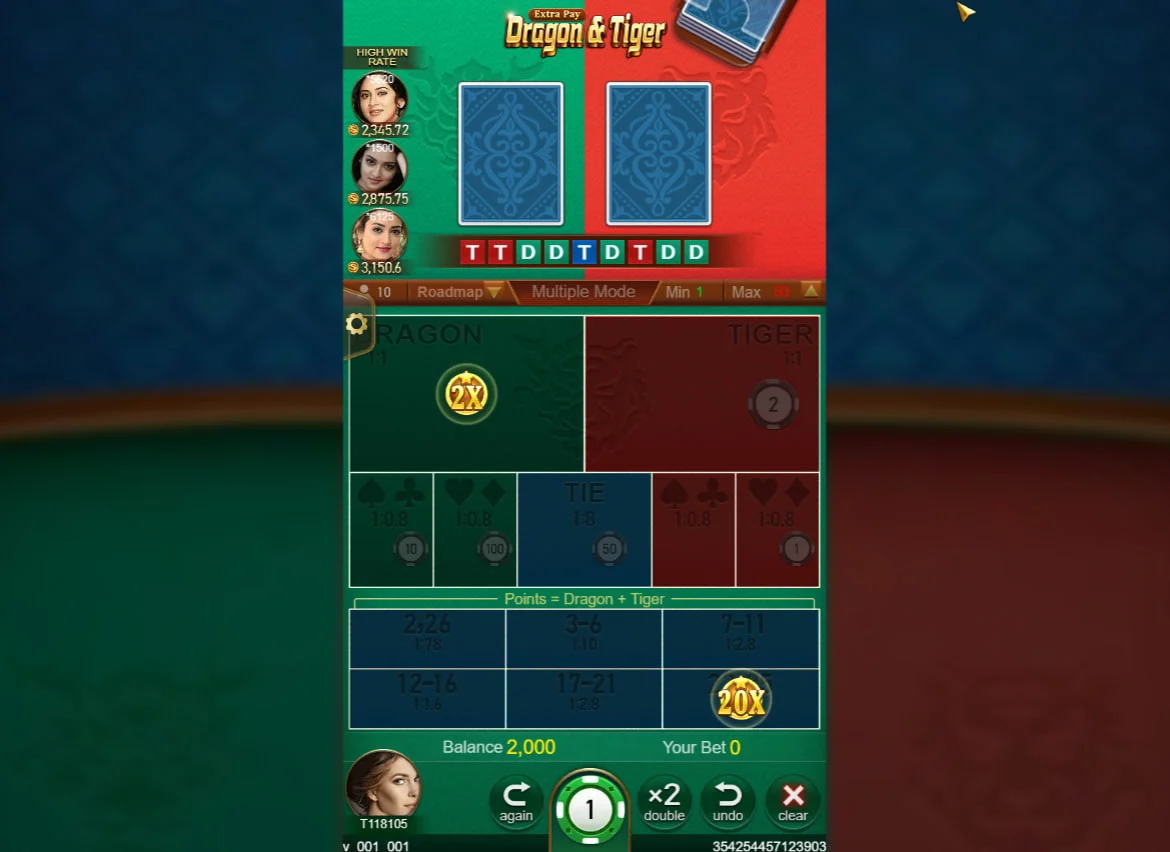
TaDa Gaming built this around a simple ranking where K is high and A is low. Unlike traditional Baccarat, suits are irrelevant, and the focus is purely on the point value. The table layout is clean, dominated by two massive betting zones and a lower grid for more volatile side bets. While the base game offers a 1:1 return on Dragon or Tiger, the real draw is the Extra Pay feature. Before cards are even dealt, a Crit trigger can randomly activate, potentially boosting the maximum payout to a staggering 1560X. This transforms a low-volatility high-card game into a high-variance monster that can deliver sudden, massive spikes in profit.
The betting interface is designed for grinders who value speed over flash. You have dedicated buttons for Rebet, Double, and Clear, allowing you to cycle through rounds in seconds. For those playing in single-player mode, the Start button puts you in total control of the tempo, though the pressure remains high. If you are the type of player who finds standard table games too slow, this version offers the aggressive pacing and multiplier potential usually reserved for modern video slots. Still, the simplicity is a double-edged sword; there are no complex strategies to master, just pure reliance on the luck of the draw and the frequency of those Crit triggers.
The Math Behind the Claws and Scales
Dragon & Tiger operates on a mathematical model that rewards simplicity but punishes the careless. The standard 1:1 payout on the main positions seems safe until you hit a Tie. When the cards match in rank, the house takes a massive bite, returning only 50% of your bet. This 1/2 return on a Tie is a significant drain on your bankroll over long sessions, as the Tie itself only pays 8:1 or 13:1 depending on specific table settings, which rarely offsets the loss of half your main stake.
You are betting against an 8-deck shoe, which significantly increases the complexity of card counting or pattern tracking. The game provides a history bar showing recent outcomes like TTDDTDTDD, creating an illusion of trend-following. But with 416 cards in play, these patterns are often noise designed to lure you into “due” bets. The point total bets offer a different layer of risk, with specific ranges like 2-26, 3-6, or 22-25 providing higher odds for those willing to speculate on the combined value of both cards.
Breaking the Blind Spots: Technical Realities
The Extra Pay mechanic is the only reason to choose this version over a standard casino table. After bets are closed, the system can randomly assign a multiplier to any bet on the board. While the documentation claims a 1560X maximum potential, these high-tier Crits are statistically rare. Most multipliers will be much smaller, serving more to keep your head above water than to provide a life-changing win. It is a system designed to keep you engaged during long dry spells where the 1:1 payouts barely cover the cost of the session.
Why the Betting Limit is Your Biggest Enemy?
The game imposes a strict maximum bet of 50 on most positions, including Dragon, Tiger, and the Tie. For high rollers, this is an immediate deal-breaker. You cannot use aggressive recovery strategies like a deep Martingale because you will hit the 50-unit ceiling almost immediately. This limit forces a grind-heavy playstyle, where you are dependent on the Crit multipliers to see any significant movement in your balance. It is a clear sign that the developer wants to limit their liability on those 1560X spikes.
The Hidden Cost of Point Totals
Betting on point ranges like 7-11 or 17-21 might seem like a way to diversify, but these are high-friction bets. The probability of hitting a specific point range is much lower than a simple 1:1 win, and without a Crit trigger, the base payouts for these ranges often don’t justify the risk. Grinders should view these as lottery tickets rather than core components of a winning strategy. The 30-second timer also acts as a psychological anchor, pushing you to fill the board with sub-optimal side bets just to “feel” like you have more skin in the game.
The Grinder’s Field Notes
The single-player mode is where this game actually shines for serious players. By removing the wait times associated with other players, you can analyze the history grid and manage your bankroll without outside interference. However, the game is also available in Multiple Mode, where you can tap other players’ profiles to see their bets. This creates a social pressure environment where you might be tempted to follow a “hot” player into a losing streak.
- The 8-deck shoe makes the game highly resistant to basic card counting.
- A Tie result results in a 50% loss of your main stake, which is a brutal house edge.
- The Crit multiplier is applied after bets close, making it a pure RNG surprise.
- Malfunctions automatically complete the game, but a disconnection after the bet is placed still leaves the result valid.
- The ranking is strictly K, Q, J, 10, 9, 8, 7, 6, 5, 4, 3, 2, A.
- Hotkeys for Rebet and Double are essential for high-speed sessions.
- The “Extra Pay” logo is always visible, but the activation is entirely random.
Dragon & Tiger is a game of attrition. You are looking for that one 1560X Crit while trying not to bleed out on the 50% Tie penalty. It is a mechanical, fast-paced experience that rewards those who can handle the swingy nature of high-card gambling. If you want deep strategy, look elsewhere; if you want raw speed and the chance for a massive multiplier on a simple bet, this is the shoe for you.
FAQ
What is the maximum payout in Dragon & Tiger by TaDa Gaming?
The game features an Extra Pay Crit mechanic that can boost payouts up to 1560X your bet.
How does a Tie result affect my bet?
In the event of a Tie, bets on Dragon or Tiger lose half their value, returning only 50% to the player.
Where can I find the Dragon & Tiger demo version?
The slot is available for free play on the Respinix.com website.
Which card has the highest rank in this game?
The cards are ranked from K (highest) down to A (lowest).
Is there a time limit for placing bets?
Yes, players have 30 seconds to place their bets before the round begins.