
Dragon Hunter by KA Gaming is a high-volatility slot on a 5×4 grid with 100 fixed lines. It features a unique Progressive Feature, where you collect frames over a 7-spin cycle for a massive Wild transformation. With a 96% RTP and a Free Games round with up to 10 Roaming Wilds, this Asian-themed game demands strategy to master its powerful mathematical engine.

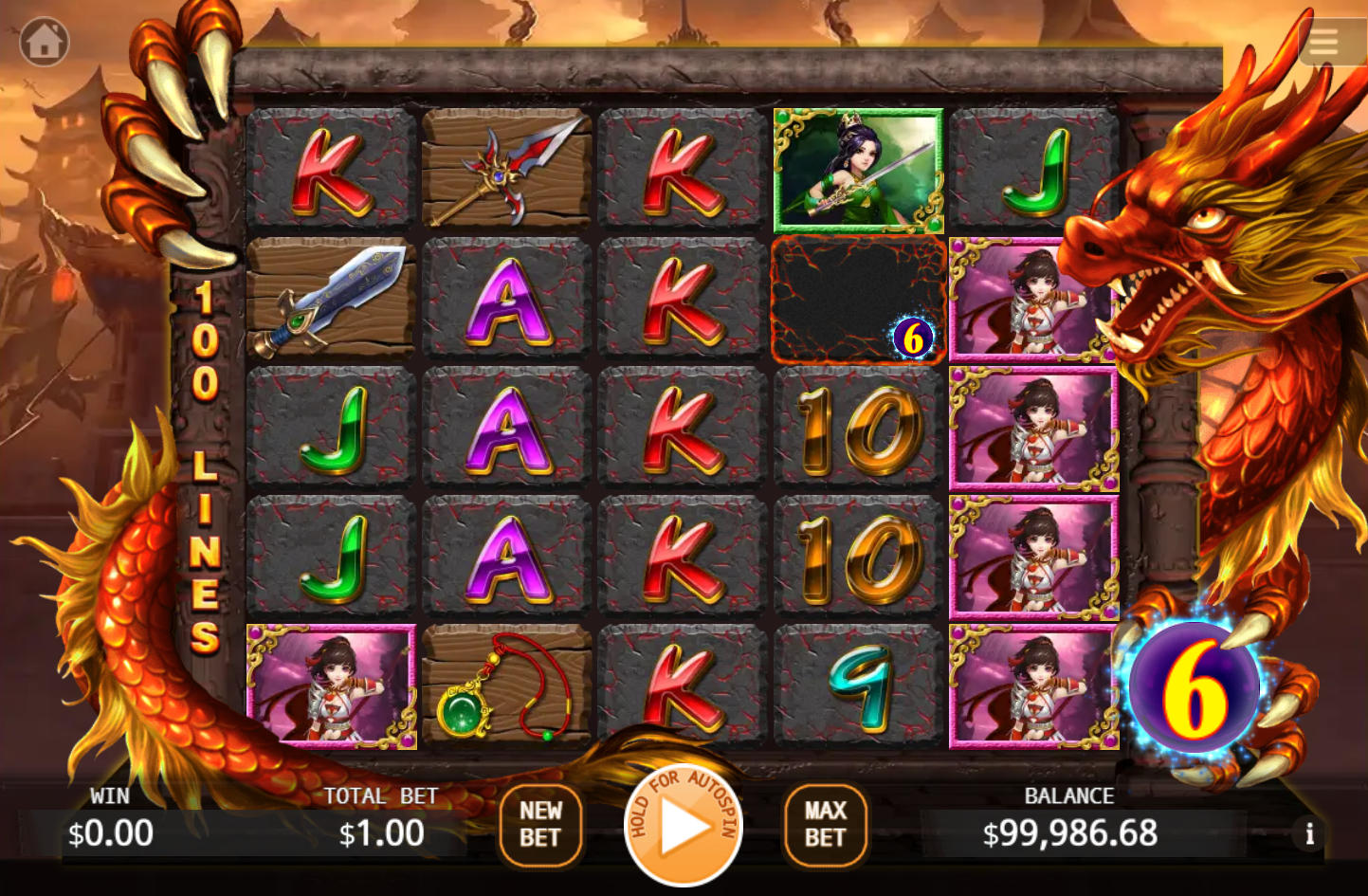
The entire experience is a carefully constructed mathematical system. Unlike typical slots where each spin is an independent event, Dragon Hunter introduces a “Cycle of 7” that creates a unique rhythm and a psychological pull. This design choice, combined with the sheer number of paylines, results in frequent, small wins that sustain the balance while building anticipation for the cycle’s powerful seventh-spin climax. This makes it a standout product in the developer’s portfolio, often mistaken for an arcade-style game but revealing itself as a pure, strategy-driven video slot.
The Progressive Feature is the central mechanism that defines every aspect of the Dragon Hunter base game, operating as a strict 7-spin algorithm. This system creates a stateful memory where the game remembers marked positions on the reels, culminating in a guaranteed wild transformation on the final spin of the cycle.
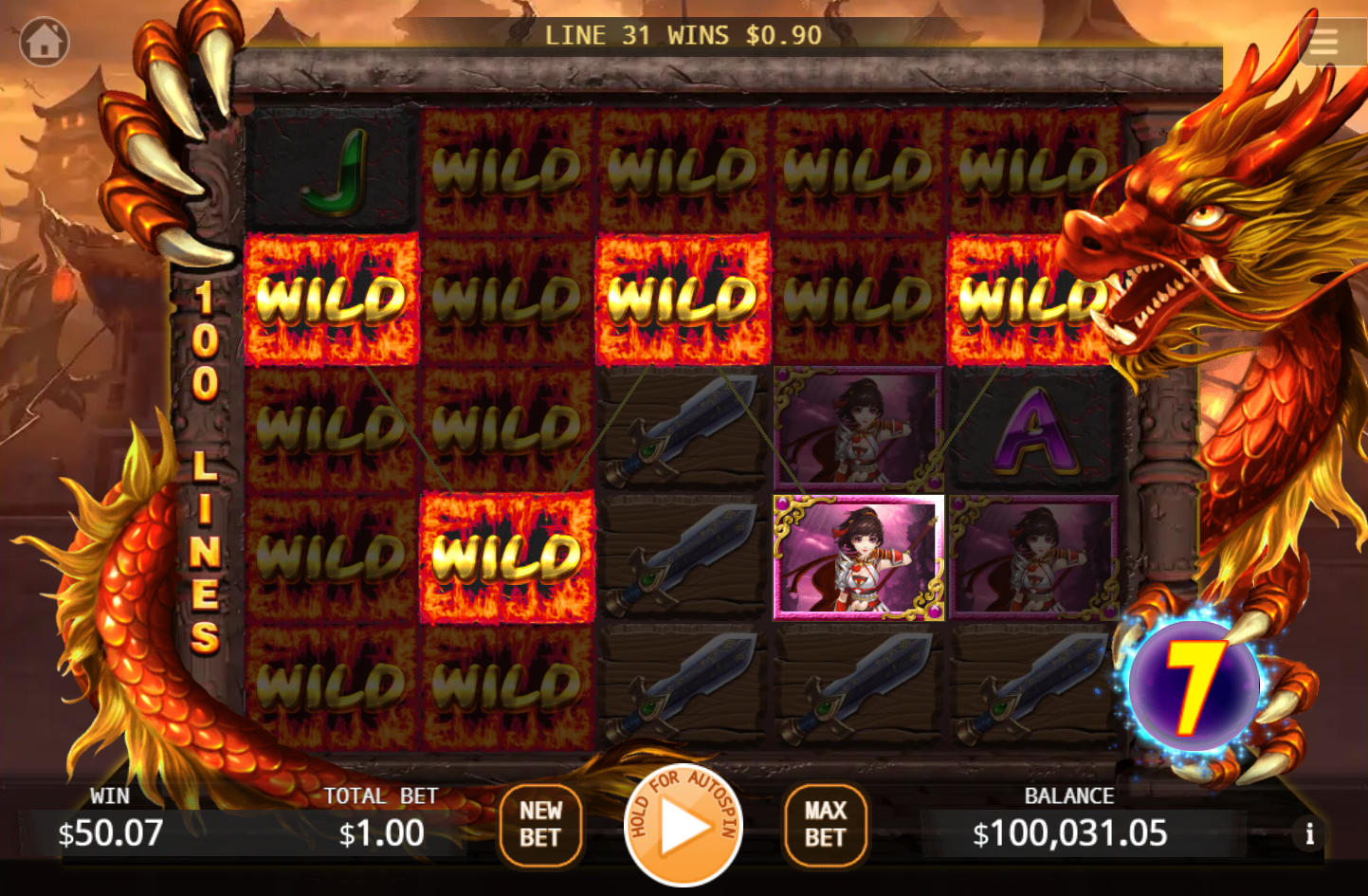
The process begins when a special Progressive symbol, a golden dragon head, lands on the reels. It marks its position with a golden frame and then disappears, leaving a persistent “trace” on the grid. This accumulation phase continues for six spins, allowing the player to collect multiple frames across the 20-cell grid. The culmination occurs on the seventh spin, where every marked frame transforms into a Wild symbol, often creating a network of winning combinations across the 100 paylines. After the win calculation, the board is cleared, and the spin counter resets to one, beginning a new cycle. This mechanic is tied to a “Bet Level Bucket,” a critical feature where the game saves your accumulated frames separately for each specific bet amount. Changing your stake mid-cycle instantly resets all progress for that bet level.
What is the Progressive Feature?
The Progressive Feature is a non-random, deterministic accumulation mechanic that unfolds over a fixed cycle of seven spins. Its purpose is to create a predictable yet exciting climax where collected reel positions are converted into high-value Wild symbols.
This system is the game’s primary engine for generating significant wins in the base game. During spins 1 through 6, players are in an “investment” phase, landing Progressive symbols to mark cells. On the seventh spin, the “payout” phase is triggered. All marked cells become Wilds simultaneously, creating the potential for massive stacked wins across dozens of lines. This structured approach is what sets Dragon Hunter apart from slots that rely solely on random number generation for big hits.
How State Memory Affects Your Bet
The game’s state memory is rigidly tied to your exact bet amount, a system designed to prevent advantage play. This means that if you accumulate five frames on a $1.00 bet and then switch to a $2.00 bet, the frames from your $1.00 session vanish from the screen.
However, they are not lost forever. The game saves that progress in the $1.00 “Bet Level Bucket.” If you return to the $1.00 bet level later in your session, your five accumulated frames will reappear, and the cycle will resume from where you left off. This feature is a double-edged sword. On one hand, it requires players to maintain a consistent bet to capitalize on their progress. On the other, it introduces a deep strategic layer, as players must manage their bankroll to complete the cycles they have invested in. The non-linear bet scale, which includes unusual increments like $7.00 and $8.00, may be a nod to Chinese numerology, adding another layer of cultural context to the game’s design, given KA Gaming’s Taiwanese roots.
What triggers the Progressive Feature?
The feature is always active and does not require a trigger; it is the fundamental rule of the base game. Every spin you make is part of a 7-spin cycle, with the counter displayed prominently on the right side of the reels.
The active part of the feature—the accumulation of frames—is triggered by landing the Progressive symbol (the golden dragon head) anywhere on the 5×4 grid. This symbol’s only function is to mark its position. It does not offer a payout and does not substitute for other symbols. The true climax is not a random event but a guaranteed one: the seventh spin of the sequence. This deterministic nature gives the player a sense of control and forward momentum, even though the placement of the markers themselves remains random.
The Math Behind 100 Paylines
Dragon Hunter’s use of 100 fixed paylines fundamentally alters the game’s economic model, shifting it away from large individual line hits toward an expectation of simultaneous, small wins. This high-density payline structure is enabled by the 5×4 grid, which provides the necessary geometric space to draw 100 distinct paths without making them visually incomprehensible.
The mathematical consequence of this design is that the value of any single payline is incredibly low. With a $1.00 total bet, each line is effectively valued at just $0.01. This is why even the top-paying Red Dragon symbol awards a seemingly minuscule 2.1x the total stake ($2.10) for a five-of-a-kind combination. The game is not designed for single-line victories; its math relies on Massive Stacking, where stacked symbols or the wild transformation on the 7th spin activate 20, 30, or even 50+ lines at once. This additive effect is the only way to achieve a significant return, a concept that can be misleading for players accustomed to traditional 10 or 20-line slots. Many spins result in a “Loss Disguised as Win” (LDW), where the win animation and sounds play for a total payout of $0.18 on a $1.00 bet—an 82% loss.
Are all 100 lines always active?
Yes, all 100 paylines are fixed and permanently active on every spin. The player has no option to adjust the number of active lines to 50 or 10. This is a core design decision that ensures the mathematical model remains consistent.
This fixed nature is crucial for the Progressive Feature’s effectiveness. The guaranteed Wilds on the seventh spin would have a much lower impact if they could only connect symbols on a handful of active lines. By forcing all 100 lines to be active, the game ensures that the wild placements have the maximum possible chance to link symbols and generate a substantial payout, justifying the player’s “investment” over the previous six spins.
Payout Structure for High-Paying Symbols
The paytable in Dragon Hunter is intentionally compressed to accommodate the 100-line system. The symbols are divided into three distinct tiers, with a significant value gap between them that underscores the game’s high volatility.
The Top Tier consists solely of the Red Dragon, which pays 2.1x for five symbols and is the only symbol in the game that pays for a two-of-a-kind combination (returning 3% of the stake). This tiny return is critical for feeding the player’s balance during “empty” spins. The Mid Tier includes the Green and Blue warrior symbols, both valued at $0.90 for five—a steep drop of over 2.3 times from the Red Dragon. The Low Tier royals (A, K, Q, J, 10, 9) offer payouts between $0.60 and $0.24 for a full line. This structure means that wins without the help of multiple stacked symbols or wilds are almost always below the initial stake.
How Does the Free Game Feature Work?
The Free Game feature is triggered by landing three Scatter symbols simultaneously on reels 1, 3, and 5. This binary trigger awards a fixed batch of 12 free spins and nothing less; landing more Scatters is impossible due to their limited placement. The feature cannot be retriggered, a balancing mechanism to cap the potential payout from what is an extremely powerful bonus round.
Once activated, the gameplay shifts dramatically away from the base game’s cycle mechanic. Instead of accumulating frames, the bonus relies on an injection of Roaming Wilds. At the start of the round, the game randomly adds 5, 7, or 10 Wild symbols to the reels. These Wilds are persistent, remaining on the screen for all 12 spins. However, they are not static; they change their positions with every free spin, preventing “dead zones” and ensuring dynamic winning opportunities throughout the round. Getting the maximum of 10 wilds is an exceptionally rare event that covers 50% of the grid, virtually guaranteeing a massive payout on every single spin.
Vlad Hvalov’s Tip: The biggest mistake players make in Dragon Hunter is changing their bet mid-cycle. The ‘Bet Level Bucket’ system is unforgiving. Pick a bet level you can sustain for at least 3-4 full cycles (21-28 spins) and stick to it to leverage your accumulated frames.
How to Get Maximum Results in Dragon Hunter
Maximizing results in Dragon Hunter requires discipline and a complete shift in mindset from typical slot gameplay. Success is not about chasing random jackpots; it is about systematically leveraging the deterministic 7-spin cycle and managing your bankroll to survive the high volatility between feature activations.
The primary strategy revolves around cycle completion. Since changing your bet resets your progress, the most effective approach is to choose a sustainable bet level and commit to it for multiple 7-spin cycles. Leaving the game on the 5th or 6th spin is mathematically disadvantageous, as you forfeit your “investment” in the upcoming Wild transformation. This feeds into a psychological trap known as the “Sunk Cost Fallacy,” where you feel compelled to “finish the job.” A disciplined player uses this to their advantage by ensuring they always see their cycles through. Your bankroll should be sufficient to weather at least 50-100 spins to give you a fair chance at triggering the Free Games and completing several profitable 7-spin cycles.
Dragon Hunter’s Unseen Engine
Beyond the visible mechanics, Dragon Hunter runs on a series of subtle rules and design choices that define the player experience. These hidden details reveal a highly technical and deliberate product.
- Psychological Loop: The Cycle of 7 is a masterclass in player retention. It creates a powerful “Sunk Cost Fallacy,” where players who have accumulated frames feel psychologically compelled to complete the cycle, significantly increasing session time.
- Target Audience: The $1.00 minimum bet deliberately excludes micro-stake players. This positions the game for two specific audiences: “Grinders” who understand the math and are willing to play long sessions to maximize cycle efficiency, and “High Rollers” with bankrolls of $100-$200 or more.
- Advantage Play Prevention: The “Bet Level Bucket” system, which ties cycle progress to a specific stake, is a crucial defense against abuse. It prevents players from accumulating frames on a minimum bet and then raising the stake for the 7th spin payout.
- “Fat Finger Error” Risk: The close proximity of the “MAX BET” and “SPIN” buttons is a potential UX flaw that could lead to accidental, high-cost wagers.
- Lack of Gamble Feature: Unlike many classic slots, there is no “Risk Game” or “Gamble” button. The game’s volatility is contained entirely within its core mechanics.
Final Verdict
Dragon Hunter is a deceptively complex slot that masquerades as a simple Asian-themed game. It is a testament to KA Gaming’s ability to build slots around a core mathematical concept rather than just a visual theme. The combination of the 100-line payout system and the rigid 7-spin cycle creates a unique gameplay rhythm that requires patience and strategic bankroll management. This is not a slot for a casual player seeking quick, random thrills.
The game is a pure-blooded video slot, and any classification of it as a “fish shooting game” is incorrect. Its systems are transparently explained in the rules, yet their psychological impact is profound. It successfully uses the Sunk Cost Fallacy to retain players, while the high volatility and powerful roaming wilds in the bonus round provide the potential for massive wins that experienced players seek. The fairness of its math is backed by the reputation of KA Gaming, whose games are subject to testing by independent labs like eCOGRA and GLI.
Ultimately, I recommend Dragon Hunter to “grinders” and analytical players who enjoy understanding and exploiting a game’s system. Its demand for a consistent betting strategy and the patience required to see cycles through will not appeal to everyone. However, for those who appreciate a technically robust and mathematically intricate design, Dragon Hunter offers a deeply engaging and rewarding experience. This title is a strong example of KA Gaming’s design philosophy: build a solid mathematical engine first, then wrap it in an attractive theme. It clearly demonstrates their “firm hand” in creating games with unique and compelling core loops.
FAQ
What is the Progressive Feature in Dragon Hunter?
It is a core mechanic where you play in 7-spin cycles, collecting golden frames that all turn into Wild symbols on the final, seventh spin for a big potential payout.
Is Dragon Hunter a high volatility slot?
Yes, it has high volatility, meaning wins can be infrequent but have the potential to be very large, especially during the Free Games or on the 7th spin of a cycle.
Can you retrigger the free spins in Dragon Hunter?
No, the Free Game feature cannot be retriggered. You are awarded a fixed set of 12 free spins when you land three scatter symbols.
What is the RTP of the Dragon Hunter slot?
The theoretical Return to Player (RTP) for Dragon Hunter is 96%, which is standard for most KA Gaming slots and aligns with the industry average.
Where can I play the Dragon Hunter demo for free?
The Dragon Hunter demo slot is available for free play on the Respinix.com website, allowing you to test the mechanics without any risk.