
“Devil’s Deal” by Retro Gaming offers a thematic journey into a classic casino ambiance with an infernal undercurrent, presented through a direct, retro-inspired visual style. The game unfolds on a traditional 5×3 reel structure, incorporating 20 fixed paylines to determine winning outcomes from left to right. Its core gameplay involves matching symbols like dice, playing cards, and a titular devil, alongside standard card ranks. A key strategic element is the “Retro Bet,” an optional wager that fixes a Wild symbol in the center of the grid, significantly altering play dynamics. The primary bonus attraction is a Free Spins round, where players can gain up to 50 initial spins, with the potential for the Retro Bet’s sticky Wild to persist throughout this feature, enhancing win possibilities. Mystery symbols also contribute to the gameplay by transforming into identical paying symbols.
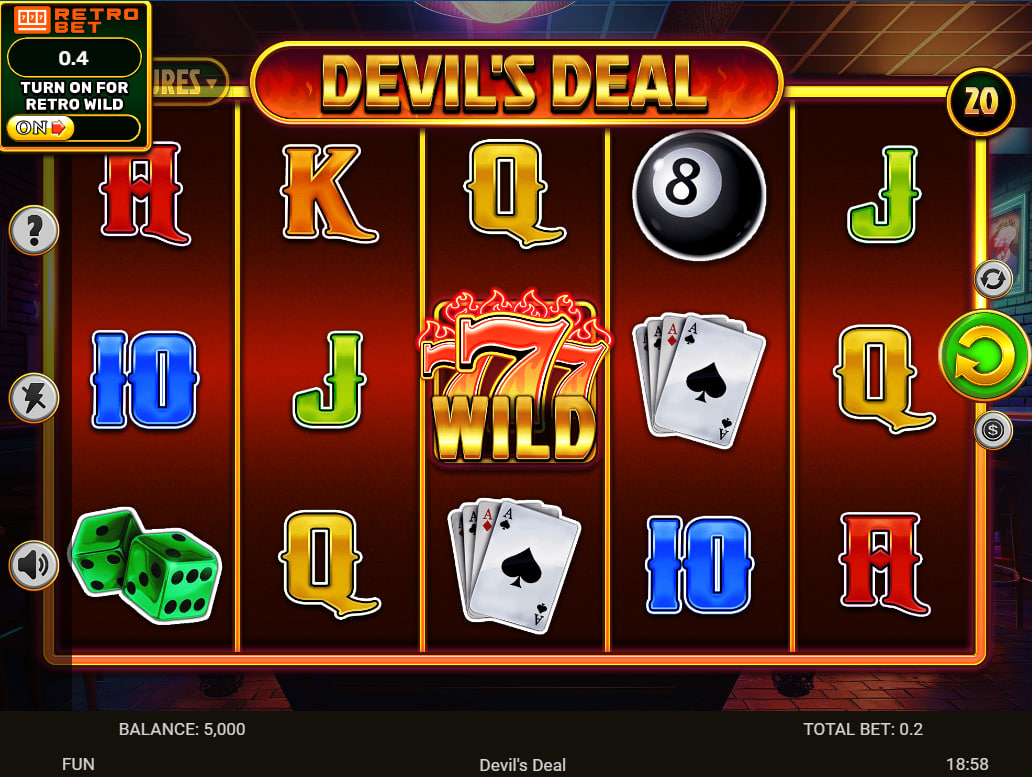
Devil’s Deal relies on a high-friction environment where the base game serves as a brutal filter for non-grinders. The symbols are standard gambling fare: dice, cards, and billiards, with the red-hot Wild 7 being the most coveted asset on the board. Winning combinations form across 20 fixed paylines, and while the hit frequency stays consistent, the real variance comes from how you choose to engage with the Retro Bet engine. The design is stripped back, favoring clear visibility and fast spin cycles over cinematic fluff, making it a specialized choice for players who value session efficiency.
The central mechanic that separates this from a standard fruit machine is the Retro Bet feature. When you flip this switch, your total bet doubles—moving from a base of $0.20 to $0.40—but your payouts remain anchored to the original $0.20 stake. In exchange for this mathematical premium, you get a sticky wild symbol locked dead-center on the third reel. This drastically alters the hit pattern, turning the middle of the slot into a permanent bridge for winning lines. It turns the game from a random scatter-hunt into a strategic defense of your balance, where you pay extra for the “safety” of a guaranteed wild.
Visually, the game uses a dark, crimson-heavy palette that keeps the focus on the high-value symbols. The flaming Pitchfork serves as the scatter, and landing three or more triggers a multiplier-based payout rather than just a simple entry into a bonus round. Specifically, five scatters will net you a x20 multiplier on your total bet, providing a massive buffer for your session. This design philosophy is aimed at the veteran who hates distractions. The UI is clean, with the Retro Bet toggle placed prominently on the left, ensuring you never lose track of your current burn rate.
The Underworld Ledger
Analyzing the data from hundreds of simulated spins reveals that Devil’s Deal is a game of two distinct halves. The mathematical core is built around high-symbol values, with the top-tier symbols paying out significantly even for four-of-a-kind combinations. However, the mystery symbols add a layer of unpredictability that can either salvage a dead spin or frustrate the player.
- The Retro Bet doubles the cost of entry but keeps the paytable static, effectively halving the relative value of each win in exchange for higher hit consistency.
- Mystery symbols transform only after the reels have completely stopped, adding a slight delay to the reveal of the final win state.
- The Wild 7 symbol is a total substitute for everything except the pitchfork scatters, which are the only path to the x20 bet multiplier.
- The paytable reveals a top-heavy reward structure: five of the highest symbols pay 150 credits, while the lowest tier drops down to 7 credits for three symbols.
- Betting starts as low as $0.20, but the total bet display adjusts instantly when features are toggled, preventing accidental over-betting.
- The game uses a fixed 20-line architecture, meaning you cannot reduce lines to save bankroll; you must play the full grid.
Critical Investigation of the Infernal Engine
There is a technical depth to Devil’s Deal that casual players might overlook, particularly regarding the trade-offs of the manual features.
Is the Retro Bet a Mathematical Trap?
The Retro Bet feature is a classic example of paying for stability. By doubling your bet to $0.40 while the payouts remain at the $0.20 level, you are essentially paying a 100% premium for a single sticky wild. For the grinder, this is a calculated risk; the sticky wild in the center significantly increases the frequency of three and four-symbol wins. However, if your goal is a massive single-hit profit, the Retro Bet actually makes it harder to reach a positive ROI because your win-to-cost ratio is halved. It is an efficiency tool, not necessarily a luck-booster.
How do Mystery Symbols Impact the Grind?
Mystery symbols in this game act as blockers until the very last millisecond of the spin. Unlike other slots where mystery symbols might reveal during the roll, here they wait until the reels are stationary. This creates a specific rhythm where the player must wait for the reveal to see if a dead-looking board suddenly connects. It tests player discipline, as the visual payoff is delayed, making it less satisfying for those who prefer instant gratification but highly effective for players who enjoy the “reveal” tension.
Ergonomics and Efficiency for the High-Volume Player
The UI is built for speed. Retro Gaming has included specific ergonomic choices that favor the long-session player.
Where are the Shortcuts for Grinders?
The game lacks a traditional “Turbo” button in the main view, but the spin cycle itself is natively fast. The Retro Bet switch is the most critical ergonomic element; it is positioned away from the main spin button to prevent accidental triggers, yet it is large enough to be flipped instantly during a session change. The balance and total bet displays are high-contrast, ensuring that even during a fast-paced session, you can see the $0.20 to $0.40 jump clearly.
Does the Symbol Economy Support Long Sessions?
The symbol hierarchy is surprisingly balanced. With the top symbol paying 150x for five and the bottom paying 7x for three, the game avoids the “all or nothing” trap of many modern high-variance slots. The cards and dice symbols appear frequently enough to keep the balance afloat, while the 8-ball and cards provide the mid-tier spikes needed to survive a long grind. This is a slot for the technician who manages their bankroll with precision rather than the player chasing a single life-changing spin.
FAQ
Activating this feature doubles your current total bet to place a permanent sticky wild symbol in the center of the third reel.
Landing five pitchfork scatter symbols anywhere on the reels awards a payout of x20 your total bet.
These symbols remain hidden until the reels have completely stopped, at which point they all transform into the same matching icon.
No, the Wild symbol replaces all other symbols on the paytable except for the pitchfork scatter.
The full demo version of this slot is available for free play on the Respinix.com website.