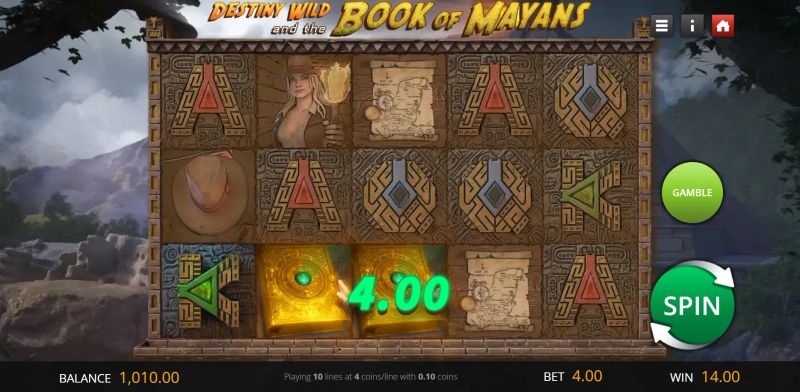
Genii took the well-worn Book of Ra blueprint and slapped a Mayan filter over it. Destiny Wild and the Book of Mayans drops you behind a fedora-wearing adventurer carrying a lit torch, with misty cordillera peaks looming behind a stone-carved 5×5 grid. It’s pulpy and a little camp, in a good way.
The math runs on only 10 paylines. That’s deliberately stingy. Low-line Book clones lean almost everything on the bonus, so don’t expect the base game to hand you steady scraps. Bets stretch from $0.01 to $25.00 across five chip sizes, which keeps the game friendly for cautious players and high-rollers both. The grid is taller than the classic 5×3 Book template, and that extra row makes the expanding symbol feature genuinely scary in the right way.
The Book of Mayans glyph does double duty. It substitutes for every regular pay symbol, and it counts as scatter for the bonus trigger. Land three, four, or five anywhere and you collect 10, 15, or 25 free spins. Before the round kicks off, the game randomly picks one of the nine base symbols. That symbol becomes special. When it lands during free spins, it expands to cover the entire reel, and it pays from any position on active lines rather than strict left-to-right. Pull the deity or the second Mayan icon as your special, and a single screen can rewrite your session.
And here’s the catch. Free spins can’t retrigger, so your bonus is whatever you got, no extensions. That’s a real shame given how rare the trigger feels with such a thin payline grid. 10,450 coins sits as the marketed ceiling, which is honestly modest by 2026 standards. Modern Mayan slots routinely promise 10,000x or 20,000x. This one caps closer to four-figure multipliers on max bet. Sure, the math is honest. Also, it’ll feel small to anyone chasing screen-shattering wins.
What saves it? The red/black plus suit gamble. After every win, you can punt for double or quadruple, ladder-style, until you crack or hit the cap. It’s classic Genii, and it adds a tactile risk layer the base reels lack. Recommended for fans of Novomatic-era Book mechanics who want a quieter, more retro pace than today’s mega-volatile clones.