Deal with Death from Hacksaw Gaming is a dark, high-volatility 5×4 slot featuring a dual-mode system. Players navigate a grim atmosphere where the Joker symbol transforms standard paylines into a poker-based grid. With a massive 20,000x max win potential exclusive to its poker and bonus modes, the game utilizes hand multipliers and global boosters to drive payouts. This title blends traditional slot mechanics with random card generation for an intense, unpredictable gambling experience.
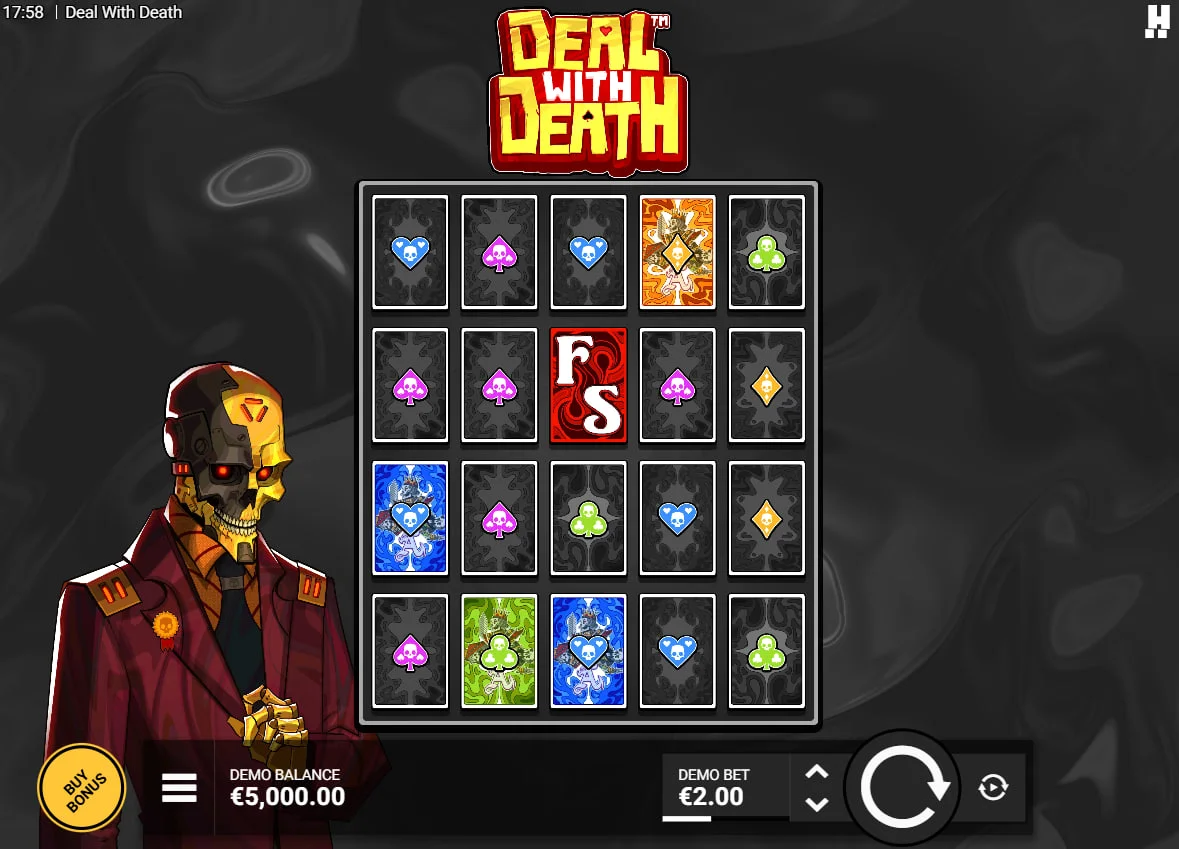
Classic Mode serves as the entry point, operating on a 5-reel, 4-row grid where you hunt for standard payline wins. But this mode is a war of attrition designed to bleed your balance while you chase the Joker. The math here is restrictive because the Max Win of 20,000x is explicitly locked away from the base game. You are spinning in a cage until a Joker symbol lands to flip the script into Poker Mode. Once the transition hits, every symbol on the grid morphs into playing cards. The game stops looking at lines and starts evaluating the five cards on each of the four rows as individual poker hands. It is a brutal mechanical shift that completely alters how you perceive value on the reels.
The Joker is the undisputed engine of this machine, but its behavior changes based on your current state. In the standard grind, it acts as a simple wild, though the developer limits you to landing only one at a time. The real chaos erupts when the Poker Mode Jokers take over. A Regular Joker is a chameleon, automatically transforming into the specific card needed to maximize the payout for its row. This removes any ambiguity about your win potential. However, the Hand Multiplier Joker is where the variance truly spikes. It attaches a multiplier between 2x and 10x to a specific row before turning into a card. If you are grinding at a $2.00 bet, a 10x multiplier on a high-tier poker hand can instantly shift the session from a loss to a massive recovery.
Design-wise, the game leans into Hacksaw’s signature gritty aesthetic, featuring a gold-masked reaper and a muted, oppressive color palette. The transformation animation is sharp, turning the low-pay suit symbols into functional cards with a skull-themed aesthetic. This isn’t for the casual player looking for bright lights and cheerful sounds. This is for the grinder who understands that the base game is just a cost of entry for the Poker Mode volatility. If you hate the idea of a slot that forces you into a secondary game mode to see the real potential, this will frustrate you. But for those who want a hybrid experience where poker logic dictates the bankroll growth, the 20,000x ceiling provides a massive incentive to keep the reels moving.
The Reaper’s Ledger
The transition between modes isn’t just a visual gimmick; it is a fundamental shift in how the RNG calculates your return. While the developer keeps the exact bonus frequency under wraps, the high-variance nature of a 20,000x payout suggests you will face significant dead spin streaks in the base game. You are effectively paying a premium for the chance to see the Joker.
Is the Triple Trouble Joker the Ultimate Payoff?
The Triple Trouble Joker is the most complex mechanic in the kit because it utilizes a delayed activation. After the initial poker wins are paid out, this symbol triggers a total collection and shuffle of every card on the 5×4 grid. It then deals back the three best possible hands from that pool in ascending order. This means your biggest win comes last, creating a structured crescendo of payouts that can salvage a disastrous round. It is a rare trigger, but it is the primary vehicle for reaching the upper limits of the 20,000x potential.
How do Global Multipliers Stack?
Global Multipliers are the silent killers of the house edge in this game. Unlike the Hand Multiplier which is localized to one row, the Global Joker applies its 2x to 10x value to every winning hand on the grid. If you land multiple multipliers, the game uses additive logic. A 5x and a 10x won’t multiply each other into a 50x; they add up to a 15x. While less explosive than multiplicative systems, this provides a more stable floor for multi-line wins across the four rows of the poker grid.
The Dead Man’s Hand
This section breaks down the technical nuances that dictate whether your session ends in a payout or a total wipeout. Understanding these hidden mechanics is the only way to manage the brutal variance inherent in this math model.
- The 20,000x maximum win is strictly prohibited in Classic Mode, meaning any spin without a Joker is mathematically capped at a much lower payout.
- Poker Mode does not use a physical 52-card deck; every position is randomly generated, allowing for impossible hands in a real deck, like five of a kind or multiple identical suits.
- The Hand Multiplier Joker only lasts for a single spin and does not carry over, making it a “hit or miss” feature that demands immediate results.
- A gold Buy Bonus button is positioned on the UI for direct access to features, likely offering different entry points into the high-volatility Poker Mode.
- Keyboard shortcuts often include holding the spacebar or using the “R” key for rapid spins, a feature designed for grinders looking to bypass the base game animations quickly.
- The FS symbol indicates a free spins round exists, though the documentation focuses primarily on the Joker-led mode transitions.
- Regular Jokers activate before hand calculations, ensuring the software always picks the highest possible payout card for the player.
FAQ
What is the maximum payout in Deal with Death?
The game offers a maximum win of 20,000 times your base bet, achievable only in Poker Mode or bonus features.
How does Poker Mode trigger?
Landing a single Joker symbol on the grid flips the game from Classic Mode into Poker Mode.
Does the game use a standard 52-card deck?
No, all cards in Poker Mode are randomly generated and do not correspond to a physical deck of cards.
Where can I find the Deal with Death demo version?
The free demo version of this slot is available for testing on Respinix.com.
How do multipliers work in this game?
Hand Multipliers apply to specific rows, while Global Multipliers add together to boost all winning hands on the grid.