iMoon’s Crash Over Under presents a distinctive entry in the online probability game sector. This title foregoes traditional reel mechanics, centering instead on player prediction regarding an ascending multiplier visualized on a graph. Before each round begins, participants select a specific numerical threshold. They must then decide whether the unpredictable final multiplier will ultimately land above or below this chosen point. The atmosphere maintains a clear, numerical focus, featuring a clean graph and prominent multiplier display against a dark background. Strategic depth arises from calibrating the prediction point against the inherent probability and associated payout structure. Betting on surpassing a high value carries lower likelihood but greater reward if successful, while predicting below a low value is often probable but yields smaller returns. This game caters to players analyzing probabilities rather than reacting to unfolding events.
The landscape of online interactive betting games continues to evolve, pushing beyond the conventional reel-spinning or card-dealing formats. One prominent example of this innovation is the rise of “crash” style games, where players track a rising multiplier, aiming to cash out before an inevitable “crash” resets the round. While many games in this genre focus on timing and reaction, iMoon introduces a compelling twist with Crash Over Under, presenting a variant that shifts the core gameplay from reflexive timing to predictive strategy.
This particular iteration from iMoon takes the familiar rising curve and infuses it with a binary prediction element. Instead of solely deciding when to secure a payout, players are asked to anticipate the round’s ultimate outcome relative to a chosen point. This fundamental alteration creates a distinct experience, one that requires a different mindset than traditional crash games. It removes the split-second decision pressure of clicking a cash-out button and replaces it with a calculated forecast made before the multiplier even begins its ascent. This review delves into the mechanics, unique features, and overall player experience offered by iMoon’s contribution to this increasingly popular genre.
Core Gameplay: The Over Under Prediction
At its heart, Crash Over Under retains the signature visual of a graph line (or ball, in this game’s graphical representation) ascending a curve, correlating directly with a continuously increasing multiplier. A round begins with a betting phase, during which players must place their wagers. However, the crucial divergence occurs in the nature of that wager. Unlike standard crash games where a bet is placed with the intent to cash out at a desired multiplier, Crash Over Under requires a different kind of foresight.
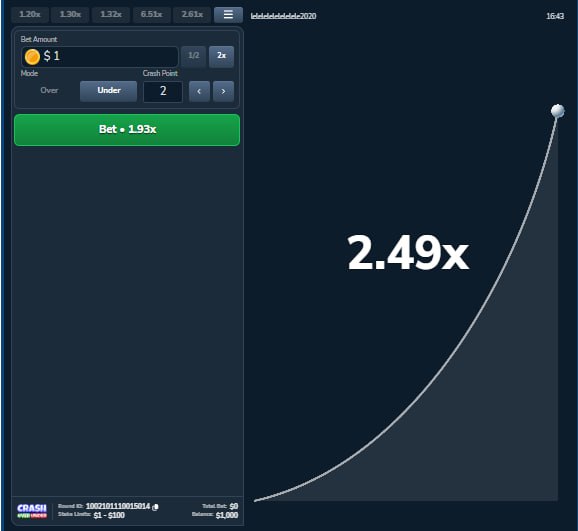
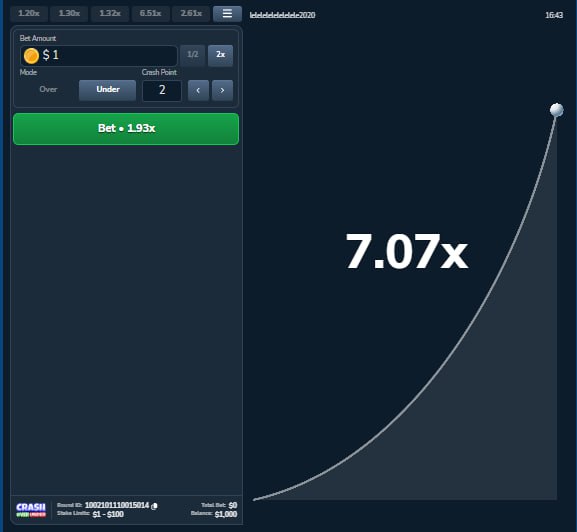
Players must first select a specific multiplier value, designated here as the ‘Crash Point’. This point serves as the threshold for their prediction. Once the point is chosen, the player then decides whether they believe the graph will ultimately “crash” Over this selected value or Under it. The game visibly presents options like ‘Over’ and ‘Under’ alongside a selectable numerical value (which is shown to range from 2 to 24 in the interface elements provided). For instance, a player might select a Crash Point of 5x and then place a bet on ‘Over’. Their wager is then confirmed before the round starts.
Once the betting phase concludes, the graph begins its ascent, and the multiplier increases from 1.00x upwards. This phase is identical to other crash games visually – the number grows, potentially offering substantial returns. However, the player’s active participation ceases once the round begins. They are observers, waiting to see if the graph’s trajectory validates their pre-round prediction. The round ends either when the player’s selected multiplier is reached (relevant if they bet ‘Over’ or ‘Under’ relative to that point) or when the graph crashes at some point before reaching the maximum theoretical multiplier (which can be quite high, though the selected prediction points are limited). If the graph surpasses the player’s chosen Crash Point before crashing, any ‘Over’ bets on that point win. If the graph crashes before reaching the chosen Crash Point, any ‘Under’ bets on that point win. If you are unsure about the precise functionality of the Over/Under bet relative to your chosen point, consulting the in-game help files accessible within the free demo version can provide detailed clarity on outcome resolution.
This predictive structure fundamentally alters the player’s engagement. It’s less about reaction speed and more about probability assessment and risk tolerance based on the likelihood of the multiplier exceeding or falling short of a specific threshold. The outcome is binary: the multiplier either finished above the chosen point or below it in that particular round.
Distinct Features: Binary Prediction and Risk Profiles
The standout feature distinguishing iMoon’s Crash Over Under is undeniably its core betting mechanism. Shifting from reactive cash-out to proactive prediction creates a unique risk-reward dynamic that sets it apart within the crash game genre. In a standard crash game, a player has granular control over their cash-out point, balancing potential return against the increasing risk of a crash. Here, that granular control is replaced by a single decision made upfront: Over or Under a pre-selected number.
This binary nature means outcomes are simpler to understand in principle, but the decision-making process requires a different form of strategic thinking. Choosing a low number for the Crash Point (like 2x, as seen in the interface) means betting ‘Over’ is relatively likely to succeed, but the payout associated with such low multipliers will be smaller. Conversely, selecting a high number (like 15x or 20x) for the Crash Point means betting ‘Over’ is far less likely to occur, as the graph crashes frequently before reaching such heights. However, the payout multiplier if it does go Over a high threshold will be significantly larger. This mirrors the inverse relationship between probability and payout found in many betting formats.
Betting ‘Under’ on a low Crash Point (like 2x) would be a very low probability win, as the multiplier typically exceeds 2x quickly, meaning most rounds would go ‘Over’ 2x. Betting ‘Under’ on a high Crash Point (like 20x) becomes much more probable, as crashes below 20x are frequent. However, the payout for betting ‘Under’ would logically decrease as the selected point increases, reflecting the higher probability of the outcome. This balancing act between the chosen Crash Point’s value, the Over/Under prediction, and the associated payout structures forms the strategic depth of the game. It’s a fascinating implementation of probability where the player explicitly sets the probabilistic hurdle they are attempting to clear or avoid.
The selection range for the Crash Point (2-24) is a key element influencing strategy. Players can choose relatively safe, low-point predictions or venture into high-risk, high-reward scenarios. The decision hinges on a player’s comfort level with probability and variance. It is less about reading the rhythm of the graph (which is fundamentally random in fair games) and more about placing bets based on the general statistical likelihood of multipliers exceeding or falling below certain values over time. This approach offers a refreshing twist for players who find the timing aspect of traditional crash games stressful or prefer a more statistically driven betting structure.
Atmosphere, Visuals, and Interface Design
Crash Over Under presents a minimalist and functional aesthetic. The visual focus is entirely on the central game mechanic: the ascending line graph displaying the current multiplier. The background is a deep, unobtrusive dark blue or black, ensuring the dynamic white graph line and the prominently displayed white multiplier figure stand out clearly. The interface elements – the bet amount control, the selectable Crash Point value, and the distinct ‘Over’ and ‘Under’ buttons (shown in green) – are clean and logically placed.
This design philosophy prioritizes clarity and performance over elaborate thematic dressing or distracting animations. There are no complex backgrounds, intricate symbols, or character animations typical of slot games. The animation consists solely of the graph line tracing its upward path and the multiplier number rapidly increasing. This simplicity is not a drawback; it is entirely appropriate for a game type centered purely on numerical outcomes and player prediction. The focus is kept laser-sharp on the essential information: the rising multiplier and the player’s chosen parameters.
The use of color is restrained but effective. The green bet button and possibly the Over/Under options provide clear calls to action within the otherwise dark, numerical display. The graph itself, a clean white line against the dark background, provides immediate visual feedback on the round’s progress and the speed of the multiplier’s increase. The lack of heavy graphics likely contributes to smooth performance, which is beneficial in any online betting environment, even one based on prediction rather than reaction. The overall effect is one of straightforward functionality and a clear presentation of the game’s data.
Sound, if present, is likely minimalist as well, designed to provide subtle cues rather than an immersive soundscape. Given the predictive nature of the gameplay, an overly complex audio design would be unnecessary and could potentially detract from the focus required for strategic decision-making regarding the Crash Point selection. The visual design strongly suggests that the primary interaction is with the numbers and probabilities, supported by a clean graphical representation of the core process.
Game Mechanics: Understanding the Cycle
Understanding the full cycle of a round in Crash Over Under is key to appreciating its mechanics. Each round operates independently, driven by an unpredictable “crash” point. The cycle can be broken down into distinct phases:
Betting Phase: A timer counts down, during which players must place their bets. Within this phase, players select their desired wager amount, choose a Crash Point from the available range (2 to 24), and then select either ‘Over’ or ‘Under’. The interface clearly displays these options, allowing quick adjustments before the phase ends. This phase requires calculation based on desired risk and potential return, anticipating the statistical outcome of the upcoming round relative to the chosen threshold.
Ascent Phase: Once the betting timer hits zero, the game round begins. The graphical representation (the ball on the curve) starts its ascent from the base (typically 1.00x). Simultaneously, the multiplier number prominently displayed increases rapidly. This phase continues until the unpredictable crash event occurs. Players simply watch the multiplier climb, observing its trajectory. There is no player input possible during this phase, reinforcing the predictive nature of the game.
Resolution Phase: The round concludes when the multiplier graph crashes. At this point, the final multiplier achieved by the graph before the crash is determined. The game then compares this final multiplier against the Crash Point selected by each player. Bets are settled based on the ‘Over’ or ‘Under’ prediction made. If a player bet ‘Over’ a Crash Point of 5x, and the graph crashed at 7x, their bet wins. If they bet ‘Under’ 5x and the graph crashed at 3x, their bet wins. If the graph crashed at 4x when they bet ‘Over’ 5x, their bet loses. Payouts for winning bets are calculated by multiplying the original bet amount by the multiplier corresponding to the chosen Crash Point if the prediction was correct (i.e., betting Over 5x implies a potential payout related to the 5x point if successful, not the crash point of 7x in the example above – the payout is based on meeting/exceeding the threshold). The in-game rules accessible via the help function will provide the precise payout calculations for each successful prediction at varying Crash Points.
Inter-Round Phase: A brief pause follows the resolution, displaying the results before the next betting phase begins. The history section of the interface typically shows the results of previous rounds, providing players with data on recent outcomes, though it’s crucial to remember that each round’s crash point is independently determined.
This structured cycle, driven by the initial binary prediction, distinguishes Crash Over Under from its more reaction-focused cousins. The emphasis is entirely on the quality of the player’s pre-round statistical judgment.
Developer Context: iMoon’s Contribution
iMoon, as the developer behind Crash Over Under, positions itself within a segment of the online gaming market that focuses on simple, provably fair (often implicit in this genre, though specific details require checking the game’s information directly), and mechanically distinct games. While specific details about iMoon beyond their game portfolio might be less public compared to larger slot providers, their offering of Crash Over Under indicates an understanding of emerging trends in online betting.
Developing a variant of the popular crash game genre requires identifying a core mechanic that can be tweaked or expanded upon to create a fresh experience. iMoon has achieved this by isolating the element of prediction and making it the central interactive choice, rather than the timing of an action during the round. This design choice suggests a focus on appealing to players who enjoy analyzing probabilities and making strategic decisions before an event unfolds, perhaps drawing parallels to fixed-odds betting structures rather than skill-based or reaction-based gaming.
The existence of games like Crash Over Under highlights the ongoing evolution of online betting content providers. They are not solely focused on traditional reel-based slots but are exploring new game formats that leverage different types of player engagement and risk profiles. iMoon’s contribution here is to offer a clear, simple interface housing a mechanism that significantly alters the standard crash game formula, providing a distinct option for players seeking variation in this fast-growing category. It’s an example of how developers can take an existing concept and re-engineer the core interaction to create a fundamentally different player challenge. For players specifically interested in exploring the permutations of the crash game concept, iMoon’s take provides a notable point of comparison.
In conclusion, iMoon’s Crash Over Under presents a compelling alternative within the realm of crash-style online games. By shifting the core interaction from reaction-based timing to a pre-round, binary prediction regarding the final multiplier relative to a chosen point, it offers a strategic depth and player experience distinctly different from the standard format. While visually minimalist, its design is functionally sound, focusing on the clear presentation of the critical numerical information. This game is well-suited for players who appreciate probabilistic betting, enjoy analyzing potential outcomes before a round commences, and are looking for a crash game experience centered on prediction rather than split-second decisions. It stands as a clear example of how subtle mechanical changes can create a fresh and engaging variant of a popular genre.