
Play’n GO delivers a pristine casino dice simulation with Craps, shedding traditional reels for an authentic table experience. Operating on a variable volatility scale from low to very high, the game features a maximum theoretical RTP of 99.55%. Players navigate complex wagering options across the Come-Out and Point phases, utilizing specialized mechanics like zero-advantage Odds Bets and an interactive assistant. Three interchangeable visual skins complete this optimized digital desktop title.

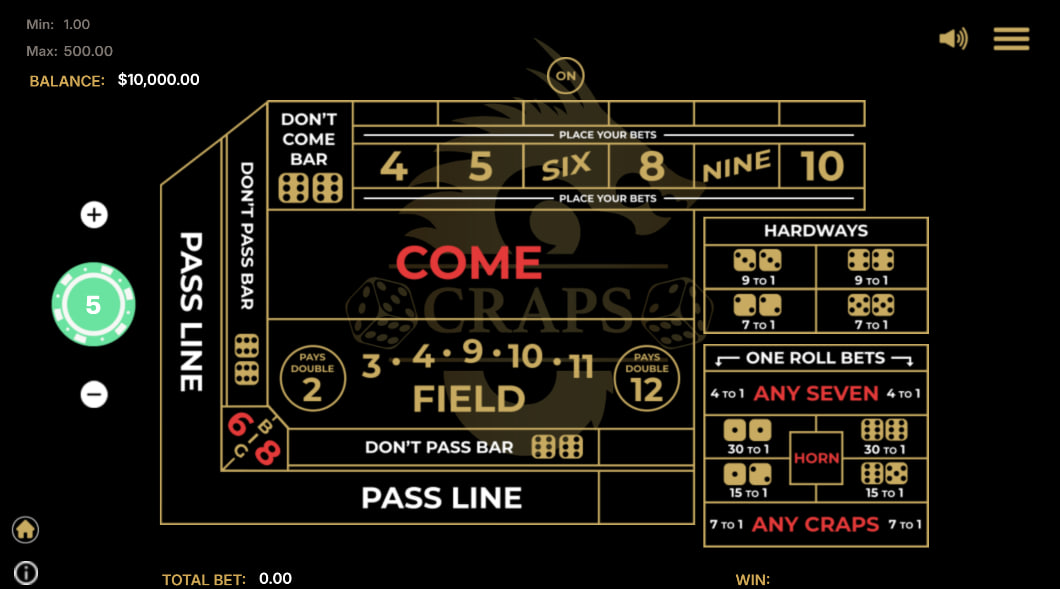
Surviving a session requires a clinical understanding of how the table functions during separate betting phases. The action breaks apart into the initial Come-Out phase and the subsequent Point phase. Your primary survival tool is the Pass Line bet. This option triggers an immediate even-money payout if the initial roll hits a 7 or an 11. But rolling a 2, 3, or 12 instantly wipes your stake out during this phase. Any other number establishes a permanent Point. An orange token labeled ON marks the established number. This action switches the table state into a grueling test of endurance where you must roll that specific value again before a 7 appears.
Chasing the maximum return requires utilizing the Odds Bets function. This utility unlocks exclusively after the table establishes a Point. You place this secondary stake directly behind your original Pass Line wager. This specific mechanic stands out because it pays out at true mathematical probabilities. The casino retains zero house edge on this portion of your money. Grinders rely on this feature to offset the losses accumulated during cold streaks. But balancing your bankroll becomes highly volatile if you deviate from these core areas and start scattering chips across the high-friction segments of the felt.
Casual players looking for simple entertainment will hate this setup. The absence of traditional wild symbols and free spin rounds removes the passive nature of typical slot play. Every round demands active decision-making on every single roll. The visual implementation reinforces this clinical environment by offering three distinct layout visual styles. You can swap between Vintage dark wood, Classic green felt, and Modern blue aesthetics through the configuration menu. The dice animations replicate realistic physics. Still, the fast-roll toggle allows serious players to bypass the rolling drama entirely to maximize the hourly roll volume. Independent testing bodies like GLI verify the random generation integrity, ensuring that the theoretical return ceiling remains fixed.
Unmasking the Structural Traps and Ergonomic Hurdles
Every digital dice simulation hides mechanical friction beneath its sleek aesthetic presentation. Grinders must look past the glowing felt to understand exactly how the software structures its payout distribution.
Why Do Proposition Bets Offer Horrible Long-Term Value?
The central panel showcases attractive payouts like 30:1 for Aces or Boxcars, but these options function as pure bankroll drains. While a standard Pass Line wager maintains an elite return configuration, these single-roll wagers drop the underlying efficiency significantly. A roll of Any Seven pays a mere 4:1. This payout represents an enormous mathematical disadvantage when compared to the actual six-to-one odds of hitting a seven.
Steering your chips into these high-variance spaces turns a calculated strategy into pure desperation. The software highlights these payouts to exploit player impatience during long dead-roll sequences. You can watch your balance bleed away rapidly if you try to chase a 15:1 payout on Yo-11 or Ace-Deuce instead of grinding the even-money lines.
Does the Integrated Interactive Assistant Safeguard Your Bankroll?
The virtual guide built into the left side of the display purports to help you navigate active table conditions. But this feature frequently acts as a subtle psychological nudge to keep players active during high-friction cycles. It constantly updates to show which fields are open. This dynamic visual cue encourages you to stack additional chips on the table.
Relying blindly on these visual prompts often leads to over-betting. The software presents the data clearly, but it fails to warn you that maintaining multiple active Place Bets simultaneously exposes your entire balance to a single devastating Seven Out. True table mastery means ignoring the helpful interface suggestions and sticking to strict betting limits.
The Ledger of Raw Probabilities
Navigating this high-return environment requires memorizing concrete technical details that remain obscured during standard gameplay. The following records isolate the technical parameters and hidden design elements discovered during extensive session tracking.
- The highest theoretical payout efficiency reaches 99.55% but only when combining a standard Pass Line wager with full Odds Bets.
- Single-roll propositions like Aces and Boxcars pay 30:1 but carry the highest mathematical volatility on the entire layout.
- The table layout features a specialized Field bet area covering 2, 3, 4, 9, 10, 11, and 12, offering customized 2:1 and 3:1 payouts on extreme values.
- The software limits the betting scale strictly between a minimum of $0.50 and a maximum cap of $500 per position.
- The configuration panel allows instant switching between three visual variants called Vintage, Classic, and Modern without altering the underlying physics.
- An established Point is visually managed by a physical ON token that shifts dynamically across the top numbers of the layout grid.
FAQ
What is the maximum return percentage in Craps by Play’n GO?
The game provides a top theoretical return configuration of 99.55% when you back your primary wagers with full odds.
How do the separate gameplay phases function in this dice game?
Every session begins with an initial come-out roll to establish an active target point before transitioning into the main point phase.
Where can I find the demo version of Craps?
The free play version of this dice simulator is fully accessible on the website Respinix.com.
What are the table betting limitations for single rounds?
The layout accommodates table wagers ranging from a minimum constraint of $0.50 up to a maximum limit of $500.
Does this game feature traditional slot paylines or wild symbols?
No, this title functions as a pure digital dice simulation without any traditional reels, lines, or wild icons.