
Bounty Raid 2 from Red Tiger Gaming is a high-volatility Wild West slot featuring a 5-reel layout packed with progressive bounty outlaws. Operating at a 92.7% RTP that includes progressive jackpot pools, the game focuses on a cash-collection engine driven by sheriff and bounty hunter scatters. Players experience a persistent stateful system where five tiers of bandits lock onto the reels, boost their stake multipliers by up to 50% per spin, and trigger an intense hold and respin feature.

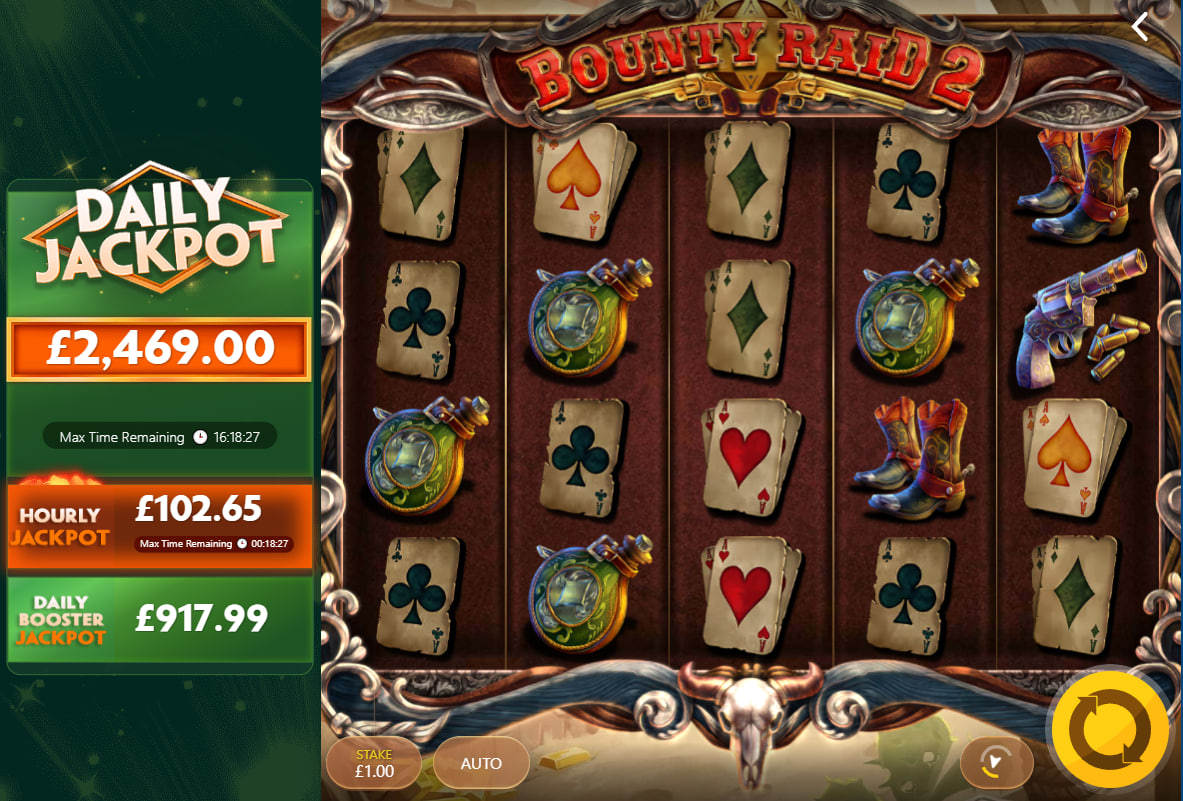
The mathematical backbone reveals a gritty setup tailored for grinders who understand high-friction math models. Operating with a tight 92.7% return-to-player threshold, the math includes both the base gameplay and the overhead progressive jackpot contributions. Casual spinners will notice their balance drop quickly during prolonged flat streaks because the regular paytable acts purely as a stabilizing mechanism while you chase the bonus. Bets are capped between a minimum of 0.10 and a maximum of 5.00, meaning high-stakes players cannot force massive line wins through brute financial size. The true prize capability peaks at a calculated maximum multiplier of 2372.3x your total stake.
Instead of traditional wild symbols filling the lines, the dynamic focuses entirely on five distinct outlaw scatter targets. Every bandit carries a fixed stake multiplier that remains dormant until specific collection events take place. Land a low-tier Outlaw 1 and you get a small prize between 1x and 3x your bet. The values climb steadily through Outlaw 2 at 4x to 10x, Outlaw 3 at 11x to 15x, and Outlaw 4 at 16x to 20x, before reaching the elite Outlaw 5 who carries a premier base prize between 21x and 25x your stake.
The primary friction comes from the fact that these cash values are completely useless on their own. They require a sheriff symbol to land anywhere on the outer reels to capture and award the total accumulated screen value. If you spin and fail to land a lawman, those cash figures vanish unless a locking trigger activates. A bandit can randomly lock in place for up to 5 consecutive spins during the base game. Every single spin that passes while an outlaw is locked increases their personal bounty reward by a random increment of either 10%, 20%, 30%, 40%, or 50% of the initial value. This progressive creep turns simple holdovers into significant assets, keeping the balance afloat during tough sessions.
A major chain reaction happens when multiple fugitives land directly adjacent to each other. If a sheriff or bounty hunter hits the reels on that exact spin, the highest-valued bandit copies their bounty across to all touching outlaws. This duplication also triggers if any adjacent target gets a random percentage bump, forcing them to stay locked for at least one additional spin. When this happens, their new payouts scale based on the superior copied initial value, creating massive clusters of matching premium awards.
Breaking Down the Hold and Respin Frontier
The real high-dispersion action shifts into overdrive when the central column triggers the primary bonus mode. The bounty hunter acts as a massive 1×4 sized scatter symbol that only lands on the middle reel to initiate the hold and respin feature. This character cannot share the grid with a sheriff during the same spin, creating a sharp mechanical barrier where you are either collecting instantly or locking down for the long haul.
Once she lands in full view, the engine locks every single outlaw present on the board and transitions into a separate bonus arena. You start the sequence with 3 free respins where the entire grid is cleared of card suits, pistols, and boots, leaving only empty spaces and oncoming outlaws. Landing any new outlaw resets the available respin counter straight back to 3.
The feature contains an algorithmic safety valve designed to protect against frustrating dead streaks. If a spin results in absolutely no new outlaws landing, the bounty hunter can randomly fire her gun to reset the respin meter back to 3 anyway. Any outlaws that were already locked during the base game carry over directly into this round, but they disappear the moment the feature concludes. The bonus session continues until you spend 3 consecutive rounds without any new arrivals or gunshots, or when all twenty positions on the grid are filled with outlaws. At that exact point, the system totals up every single visible cash multiplier and pays out the complete sum.
Deciphering the Progressive Networks and Time Limits
The left side of the screen houses a multi-tiered jackpot system that runs completely independently of the standard paytable mechanics. These progressive pots are built by taking a percentage from every single bet across all linked network games. Part of your contribution fuels the immediate growing jackpot values, while another portion funnels directly into a seed fund to guarantee a minimum payout baseline for the next winner.
Winning one of these pots requires landing three matching jackpot symbols or triggering a random game feature. This action takes you to a dedicated jackpot wheel spin to determine your specific prize tier. The size of the wheel segments is purely cosmetic and does not reflect actual mathematical winning odds. Instead, your real mathematical chances of hitting a pot scale directly with your stake size. Multipliers from the base game or bonus rounds can never be applied to these progressive awards.
The most stressful element for a strategic player is the specialized time jackpot. This progressive pot tracks a strict countdown timer and is mathematically guaranteed to pay out before a specific date and hour. As the prize pool approaches its advertised expiration time, the system automatically scales up the winning odds. These odds hit a full 100% certainty the absolute second the deadline is reached. However, a major stake restriction applies here. Only the first 2.00 of your total wager is eligible to win the time jackpot, while any excess stake amount is funneled directly into the standard progressive jackpot pot.
The Hidden Mechanics of Western Outlaws
The underlying game engine uses a stateful architecture that remembers your exact grid progress forever. Every single locked symbol and progressive multiplier is saved at the specific stake level you are playing. If you change your wager from 1.00 to 5.00, the grid resets to reflect your history at that higher level. Returning to your original stake instantly restores your previous locked layout. This persistence applies to promotional free spins as well, meaning your main session state is preserved until the marketing rounds finish.
Why is the Time Jackpot a Technical Trap for High Rollers?
The 2.00 stake threshold creates a major mathematical inefficiency if you bet at the maximum 5.00 limit. Because the software limits time jackpot eligibility to the first 2.00 of a bet, high rollers are subsidizing the progressive pot without increasing their odds of hitting the urgent time-sensitive prize. This rule penalizes aggressive betting styles during the final hours of a countdown. To optimize efficiency, you must adjust your wager down to match the eligibility cap when chasing a dying timer.
How Does Symbol Proximity Distort the Paytable Value?
The adjacency rule creates situations where a low-tier outlaw can become incredibly valuable simply by standing next to a premium target. Because a high bounty transfers instantly to touching symbols when a lawman lands, the actual layout geometry matters more than the initial spin results. A cluster of low-value cards and a single high outlaw can outperform a full screen of disconnected mid-tier bandits. This mechanic shifts the focus from simple reel wins to structural proximity.
Is Your Session Safe from Sudden Internet Dropouts?
The game uses a two-phase protocol to manage connection failures. If you disconnect before an outcome is finalized, the server generates the random result in the background and displays it in your history once you reconnect. If you lose connection after the result occurs but before the animation plays, the system syncs your wallet instantly and shows the outcome upon refreshing. This background processing ensures that a network crash will never rob you of a legitimate bonus payout.