
Arabian Dream is a video poker game from Spin2Win with a Joker, Magic Number multipliers, a 3-reel Magic Slot, Replay, and a High/Low gamble layer. It suits players who want more control points than standard draw poker gives them, because the return range moves from 93.05% to 96.65% and the better value path depends on how you use Replay and feature logic. If plain poker cabinets feel too dry but full slot chaos feels empty, this one makes sense in demo mode first.

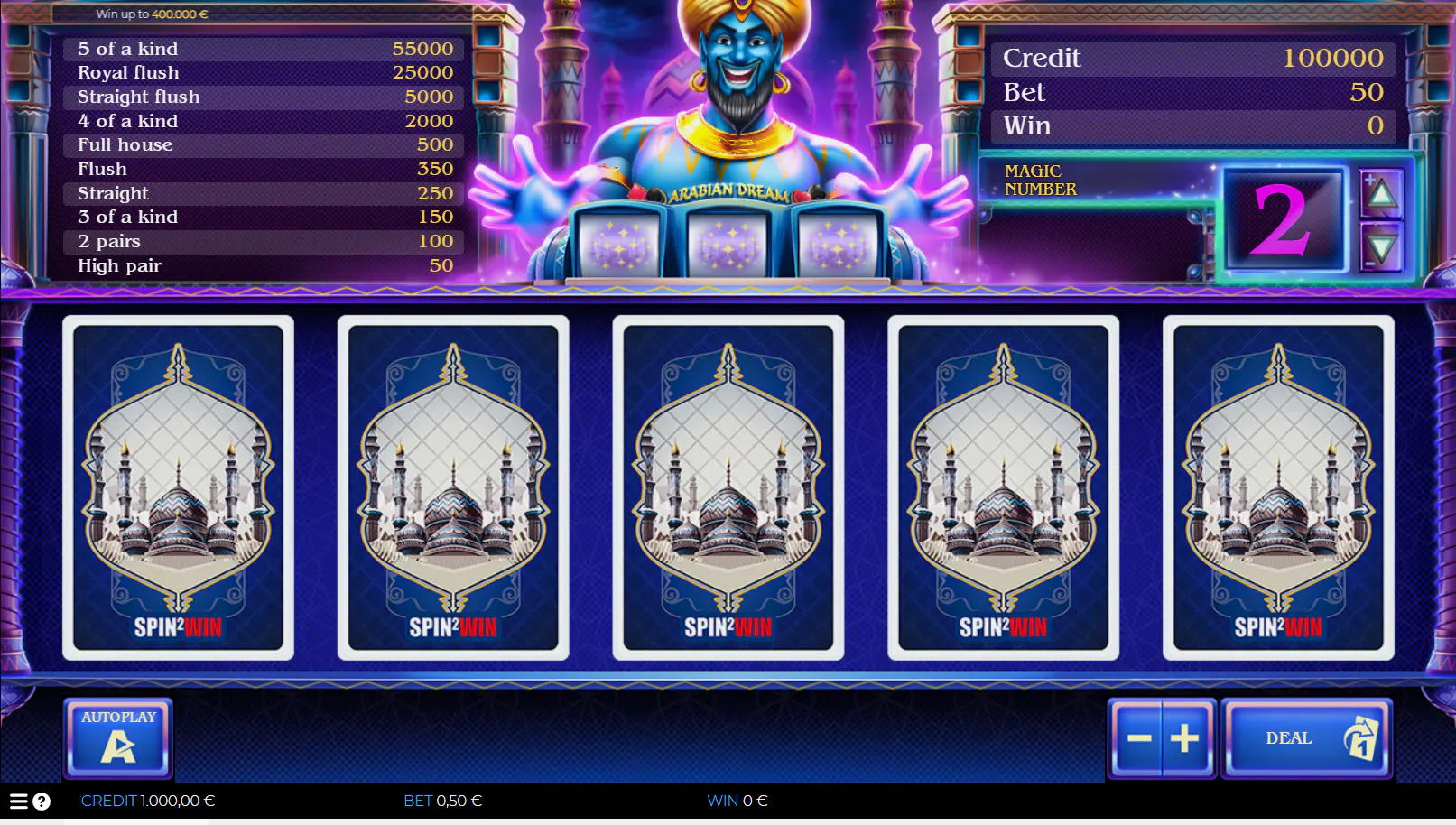
The first thing that separates this game from plain video poker is the structure of a round. You hit Deal, get five cards, keep what matters, and move to Draw. If there are wins, the game may open High/Low. If there are wins, it may also open Replay. And before any of that, a 3-reel Magic Slot has already set the multiplier mood for the hand. That is a lot of plumbing for a poker machine. It gives Arabian Dream more moving parts than the average single-draw card title, and it also means the base game never really stays base for long.
The paytable sets the ground floor fast. High Pair pays x1, Two Pair x2, Three of a Kind x3, Straight x5, Flush x7, Full House x10, Four of a Kind x40, Straight Flush x100, Royal Flush x500, and Five of a Kind x1,100. Five of a Kind exists because the deck runs 53 cards with a Joker included. That one change already bends the math away from classic video poker logic. The file states that the client is only a virtual representation of video poker and that the odds of individual combinations do not match a classic video poker model.
That line matters more than the genie artwork. A lot of card games cosplay as poker while still paying like poker. Arabian Dream does not do that. The studio says the math is fixed-odds, and the published return range proves how hard the side systems lean on the result. With best strategy, Replay play, and a Magic Number choice of 10, the RTP reaches 96.65%. On the low end, the same game sits at 93.05%. A spread of 3.60 percentage points is huge inside one title. It means the player’s decisions and enabled features shape the value in a very real way.
The Magic Number layer is where this game starts getting slippery. Before a new round, you choose a number from 2 to 10. If your winning hand contains one or more visible cards with that value, excluding Joker, the win gets multiplied. One rules table shows Magic Number values scaling from 1 to 4 with multipliers x2, x4, x8, and x16, while the descriptive section frames the choice window as 2 to 10. So the file gives a clean idea and a messy rule presentation at the same time. The core point still lands: this game lets you bias the payout structure toward a selected rank and chase boosted wins through card value matching.
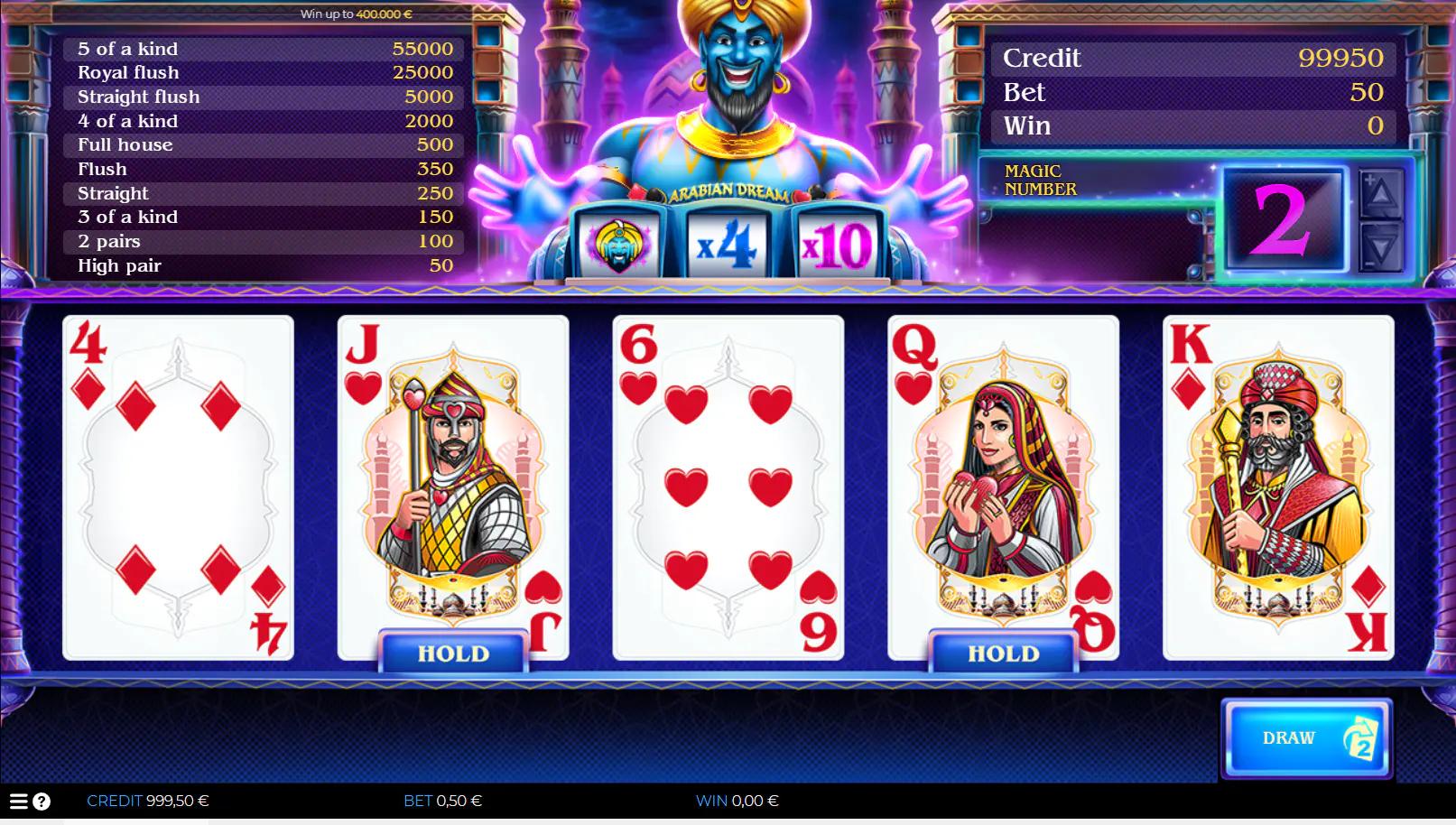
The Magic Slot does even more damage to plain-poker expectations. At each Deal phase, a 3-reel slot activates and lands one symbol per reel. The possible reel symbols are x2, x4, x6, x8, x10, and Genie. If all three shown symbols match, that multiplier applies to winnings in the current hand during Draw and Replay. If the three symbols do not match, the multiplier is x1. So the game hangs a slot-style result over a poker hand before the hand even finishes. It feels less like sitting at Jacks or Better and more like arguing with a fruit machine wearing a fez.
This is also where Arabian Dream gets better than the theme suggests. A bad theme can be ignored. Bad math cannot. Here the math toys are at least doing real work. A Straight that normally pays x5 becomes x50 under x10. A Full House jumps from x10 to x100. A Royal Flush at x500 becomes x5,000 before any other layer joins the party. And the paytable screenshots show exactly how that scales in credit form at a $0.50 sample bet: High Pair 50 credits, Two Pairs 100, Three of a Kind 150, Straight 250, Flush 350, Full House 500, Four of a Kind 2,000, Straight Flush 5,000, Royal Flush 25,000, Five of a Kind 55,000. Those are not decorative multipliers. They reshape what each hit means.
Then the Genie Bonus steps in and breaks the normal loss cycle. If the Magic Slot lands Genie-Genie-Genie and the hand is losing, the game converts that dead hand into a random winning hand with an x1 multiplier. The rules are blunt about it: Genie Bonus can only trigger on a losing hand. That restriction stops it from stacking onto an existing winner and going stupid. Good. Without that brake, the game would drift into cartoon nonsense. With it, the feature feels like a controlled bailout instead of a charity shower.
The Replay option adds another layer that most themed poker titles do not bother with. The rules state that after a win, the Replay button offers a further draw from previously drawn cards. That one detail is easy to miss, but it is one of the most important pieces in the whole machine because the max RTP of 96.65% is explicitly tied to playing the Replay phase and choosing Magic Number 10. That is the studio telling you, in plain math, where the value lives. Ignore Replay and you leave equity on the table. Treat the game like one-and-done draw poker and you are playing the weaker version of it.
The High/Low gamble is nasty in the right way. After a win in Draw or Replay, you can double the amount by guessing whether the next card is higher or lower than 7. You can do this up to five times. If the card is 7, the result is a tie and play continues. If Joker is drawn, winnings are doubled again. If all five attempts are won, the winnings are further doubled. You can also press 1/2 and gamble only half the amount. That is a lot of flexibility for a side feature that could have been dumb and disposable.
But the gamble round is not cheap bonus clutter. It is a real volatility switch. A wrong call burns the amount in play. High/Low is also disabled during autoplay, which tells you the studio knows this part needs direct input and sharp timing. The Ace is always low, another detail that matters because it changes gut reads for anyone used to fluid Ace behavior in card side games. This is the point where Arabian Dream stops feeling like “Arabian poker with cute art” and starts feeling like a machine built by people who wanted multiple payout funnels stacked on the same hand.
The jackpot side is even stranger. The game may include both Jackpot and Super Jackpot if the casino enables them. Jackpot takes 1% of the bet to grow its value. Super Jackpot takes 0.25% of the bet. Both can only be won during the Draw phase in a losing session. Neither can be won during Replay or High/Low. They also cannot be won at the same time. The file says Jackpot RTP contribution is 1.00% and Super Jackpot RTP contribution is 0.25%, though operator settings may modify those values. This is brutal and clever. The machine pays extra attention to losing hands, then hangs two separate jackpot ladders off them.
That design changes the mood of bad rounds. A dead Draw phase is not always dead. It still carries random jackpot equity, and that equity scales with stake. The rules say the chance of winning the Super Jackpot is directly proportional to the bet size, while the standard Jackpot uses equal chances among active players in the group. Those are two different philosophies inside one cabinet. One rewards wager size more directly. The other spreads the shot evenly among active players. Both jackpots ignore the $400,000 cap, because the rules say the max payout limit does not apply to Jackpot and Super Jackpot.
The theme work is solid enough, but I am not handing out medals for silk curtains and palace domes. The genie, the princesses, the sultans, the minarets on the card backs, and the Middle Eastern soundtrack do their job. They keep the screen from feeling sterile. More importantly, the art ties into mechanics that matter. The genie is not wallpaper. He is the Joker, the Magic Slot face, and the rescue trigger in Genie Bonus. That is functional design. When a visual mascot carries three separate jobs in the rules, the theme finally earns its seat.
Who will hate this game? Anyone who wants clean, classic video poker without side machinery. Arabian Dream is too busy for that crowd. Between Magic Number selection, Magic Slot multipliers, Genie rescue logic, Replay, High/Low, operator-enabled jackpots, and variable RTP tied to play quality, the game asks the player to think through more branches than a standard hold-draw cabinet. On the other side, pure slot players chasing huge cinematic bonuses may also bounce off. The screen still resolves around card values, hold choices, and paytable reading. If that core loop bores you, no genie can save the session.
The most honest comparison is not to an Arabian slot. It is to other poker titles that bolt gimmicks onto a card hand and hope the player forgives the clutter. Arabian Dream does better than that because the gimmicks interact with payout logic instead of sitting on top of it. Magic Number changes the value path. Magic Slot changes the multiplier lane. Replay affects the top RTP path. High/Low changes post-win risk. Jackpot and Super Jackpot attach extra life to losing Draw phases. Each add-on touches the math. That is the difference between a bloated poker reskin and a game with an actual system.
My read is simple. Arabian Dream is a poker game for players who want layers, side paths, and control points instead of a clean textbook card model. The bet range of $0.05 to $10.00 keeps it accessible. The RTP ceiling of 96.65% gives disciplined players a reason to stay. The floor of 93.05% punishes lazy play. The $400,000 max single-game payout is strong, and both jackpots sitting outside that cap give the title another kick. I would take this over a plain themed poker cabinet every time. I would not hand it to someone looking for pure classical video poker, and I would definitely not pretend the rules are cleaner than they are.
Smoke Behind the Lantern
Arabian Dream looks playful, but the machine underneath is harsher than the art style admits. Once you strip away the genie grin and the palace trim, the game reveals itself as a layered payout engine with several operator-sensitive switches and a noticeable skill gap between casual and optimal play.
There is also a market angle worth noting. The file says the game was designed for the Italian-speaking market, and that helps explain the hybrid shape. This is not a U.S.-style purist poker cabinet. It feels built to keep familiar card logic alive while feeding it extra hooks, more prompts, more side bets, and more visible event points per round.
- The deck uses 53 cards, including a Joker, which allows Five of a Kind.
- The theoretical RTP ranges from 93.05% to 96.65% when using best strategy.
- The highest RTP path is tied to Replay play and Magic Number 10.
- The bet range runs from $0.05 to $10.00.
- The maximum single-game payout is $400,000, and that cap does not apply to Jackpot or Super Jackpot.
- Jackpot adds 1% of the bet to its pool and contributes a theoretical 1.00% RTP.
- Super Jackpot adds 0.25% of the bet to its pool and contributes a theoretical 0.25% RTP.
- Both Jackpot and Super Jackpot can only be won during the Draw phase in a losing session.
- High/Low can be attempted up to five times, supports half-win betting, and treats Ace as low.
- Autoplay is limited to 500 games, works only on PC, and disables High/Low plus Replay access.
FAQ
What is the RTP of Arabian Dream?
Arabian Dream lists a theoretical RTP range of 93.05% to 96.65%, depending on strategy and feature use.
Is Arabian Dream a classic video poker game?
No, it uses a 53-card deck, fixed-odds math, Magic Slot multipliers, Replay, and Genie Bonus.
How does the Magic Slot work in Arabian Dream?
Three matching Magic Slot symbols apply a multiplier from x2 to x10, while three Genie symbols trigger Genie Bonus on a losing hand.
What is the maximum win in Arabian Dream?
The maximum payout for a single game is $400,000, while Jackpot and Super Jackpot sit outside that cap.
Can you gamble winnings in Arabian Dream?
Yes, the High/Low feature lets you gamble a win up to five times and even stake only half the amount before each attempt.
Where can I find a demo version of Arabian Dream?
The attached materials confirm the game is available on desktop and mobile casino platforms, but they do not name a Respinix demo page.