
Andar Bahar by TaDa Gaming is a high-speed digital rendition of the traditional Indian card classic. Set on a functional 1-row layout using a 52-card deck, the game focuses on matching a central card’s value. With a 2x payout on Andar and 1.9x on Bahar, it offers a medium-volatility experience with an RTP around 96%. Key features like the Skip Bet and dual-phase betting windows cater to grinders looking for efficiency and transparency in a clinical, performance-oriented environment.

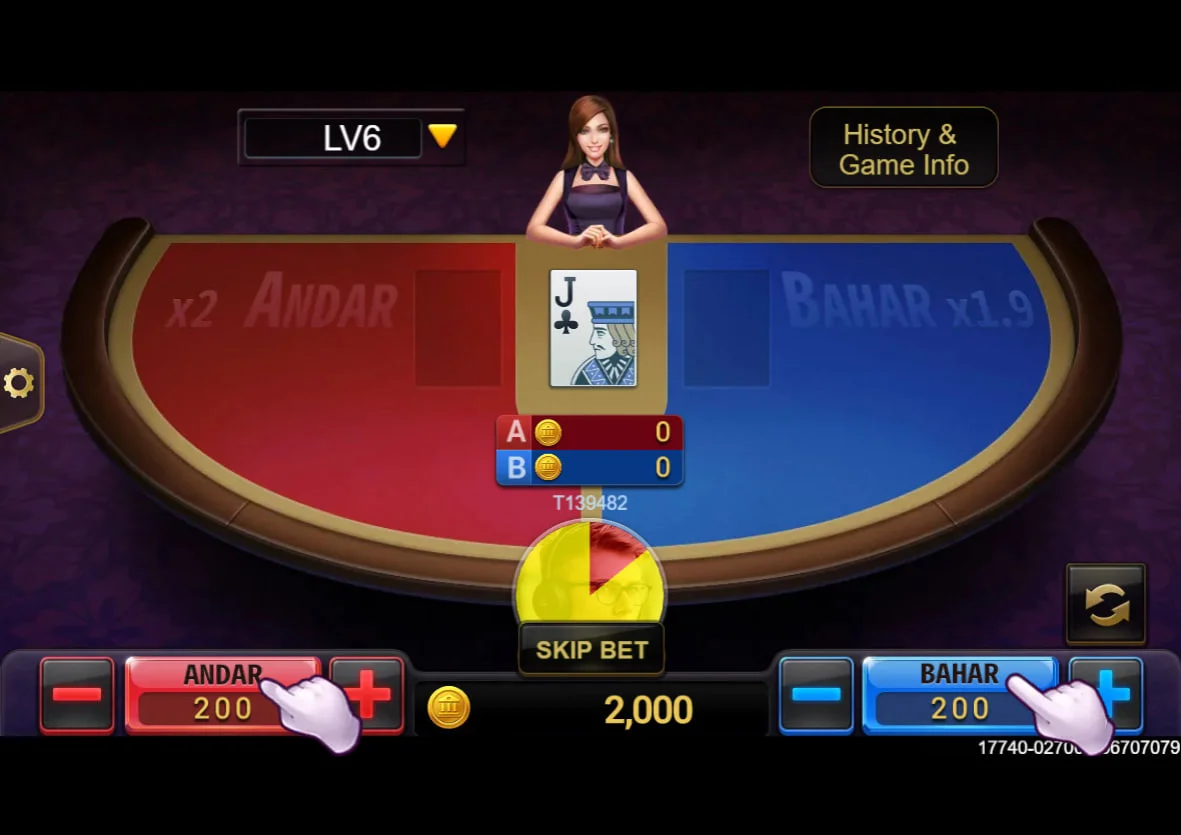
Walking into a session with a $2,000 balance reveals a game built for speed and efficiency. The interface is dominated by the central card, which serves as the winning number, and the mechanics are stripped down to the essentials: cards are dealt alternately into the Andar and Bahar positions until a match appears. The immediate reshuffle after every single round keeps the variance honest, preventing any card-counting fantasies and ensuring that the house edge remains a constant, grinding presence. You feel the weight of every draw as the coin stacks grow on the winning side, while the losing bets vanish into the system’s void with zero ceremony.
TaDa Gaming’s take on this tradition leans heavily into player synergy, showing live win animations and avatars that create a sense of shared risk. Seeing other players hit a win on Andar while your Bahar bet fails adds a layer of social friction that keeps the session from feeling clinical. The visual layout uses a sharp red and blue contrast to define the betting zones, ensuring that even at the fastest turbo speeds, you never lose track of where your capital is allocated. It is a brutal, fast-paced environment where the absence of distractors forces you to focus entirely on the math of the next draw.
Critics of table games often point to the slow pace of live dealers, but this digital version solves that with a “Skip Bet” feature that allows for aggressive grinding. If you are looking for a relaxing experience with complex bonus rounds, this is the wrong room. This is for the player who wants to churn through hundreds of rounds per hour, leaning into the 2x payout of Andar to keep the balance afloat. The design is purely functional, prioritizing the speed of the animation and the clarity of the payout result over artistic flair, which might alienate casual players looking for a spectacle but serves the high-volume grinder perfectly.
The Pit Boss’s Ledger
Navigating the technical architecture of this session reveals several layers of functional design that prioritize transparency and long-term session tracking.
- The game utilizes a standard 52-card deck that is completely reshuffled after every individual round to maintain mathematical unpredictability.
- Payouts are strictly bifurcated, offering 2x for an Andar win and a slightly tighter 1.9x for Bahar.
- A dual-phase betting window exists, requiring an initial bet to be locked in before the final bet opportunity becomes available.
- The system includes an automatic completion mechanism that resolves bets even if a player’s connection drops mid-draw.
- Recent history logs track both the winning number and the specific position of the match for every round.
- A level-based indicator (LV5/LV6) suggests a progression system or table limit tiering that rewards consistent volume.
- The “Skip Bet” button is a dedicated UI element designed to bypass the countdown and accelerate the transition between rounds.
Under the Hood: Mathematical Blind Spots
Deep-diving into the game info reveals a betting structure that is far more restrictive than it appears at first glance. While the table looks open for any strategy, the internal logic dictates a rigid sequence of participation that can trap an unobservant player.
Why is the Initial Bet a Mandatory Hurdle?
The documentation explicitly states that the “Initial Bet” must be placed before the “Final Bet” is even an option. This is a technical gatekeeper designed to prevent players from “sniping” the final bet only when the odds seem to have shifted after the first few cards are drawn. By forcing capital into the pot early, the game ensures it has skin in the game from the player before any information about the draw’s length is revealed. This effectively raises the barrier to entry for strategic hedging, making it a high-friction environment for those trying to play solely on the second betting window.
Is the 1.9x Bahar Payout a Mathematical Trap?
Standard table logic often suggests a 50/50 split, but the 1.9x payout on Bahar compared to the 2x on Andar highlights a built-in house premium. This 0.1x difference might seem negligible over ten spins, but for a grinder running 500 rounds, it represents a significant drain on the total return. The game alternately places cards, yet the Bahar position carries a heavier mathematical tax, likely because the first card in the sequence often lands there, slightly altering the probability of a quick match. If you are not accounting for this disparity, your bankroll will bleed out much faster on the blue side of the table than the red.
FAQ
What is the difference between the Initial and Final bet?
The Initial Bet is placed before the round starts, while the Final Bet becomes available only if the first two cards dealt do not match the center card.
How much does Andar pay compared to Bahar?
Winning bets on Andar return 2x your wager, whereas Bahar wins provide a slightly lower payout of 1.9x.
Is the deck reshuffled after every win?
Yes, the 52-card deck is completely reshuffled by the system after the conclusion of each game round.
Where can I find the Andar Bahar demo version?
The free-to-play demo of this card game is available on the Respinix.com website.
Does this game feature a progressive jackpot?
No, TaDa Gaming’s Andar Bahar focuses on fixed odds payouts based on the position of the winning card.