
Air Racer by Gamanza Games redefines gameplay by swapping reels for a focused crash mechanic. The game utilizes a minimalist aviation theme, creating an atmosphere of pure tension centered on a single, escalating multiplier. Your core objective is to cash out your wager before the plane concludes its flight, which ends the round. This design leads to a player-driven volatility, where your timing and risk tolerance directly shape the game’s variance. With a high theoretical RTP of 97%, the statistical framework is transparent. The standout feature is the capacity to place and manage up to three independent bets per round. This function, combined with the strategic Auto Cash Out setting, transforms a simple concept into a test of nerve and tactics. Air Racer provides an experience for players who value direct agency and strategic decision-making over passive observation.


Gamanza Games introduces Air Racer, a title that diverges from the conventional structure of reel-based slot machines. This game belongs to the “crash” genre, a category that shifts the focus from passively watching symbol combinations to actively making time-sensitive decisions. The entire experience is built around a single, escalating multiplier and the player’s nerve to determine the optimal moment for action. What sets this particular title apart is not just its minimalist aesthetic but its implementation of multi-layered betting options, which transforms a simple concept into a framework for varied risk management strategies. It’s a format that trades paylines and wild symbols for a direct test of timing and risk assessment.
Strategic Depth through Advanced Betting Features
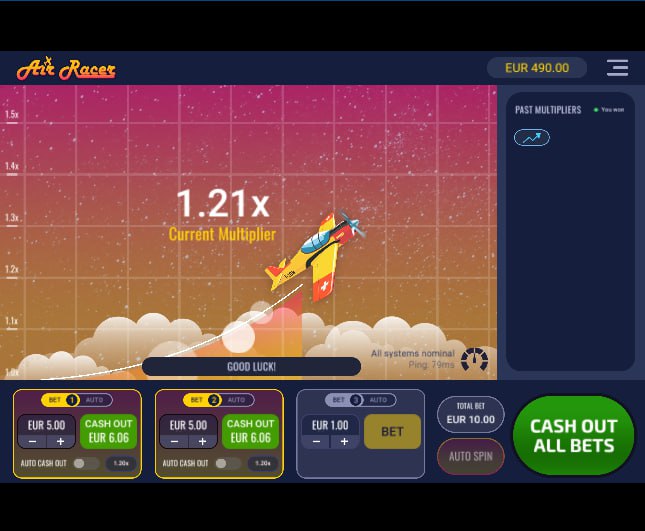
The operational core of Air Racer is straightforward, yet the features built around it allow for a considerable degree of tactical play. The game’s primary distinction lies in its capacity to handle multiple, independent bets within a single game round. A player can initiate a round with one, two, or even three separate wagers. This functionality is the cornerstone of any advanced approach to the game.
The significance of this is that each of the three bets can be cashed out individually. This opens the door to sophisticated risk-hedging tactics. For example, a player might place three bets of equal value. The first bet could be designated as a low-risk cash-out, aimed at a modest multiplier like 1.5x. Successfully cashing this out could potentially cover the initial stake of all three bets, effectively making the remaining two bets a “free ride” toward higher multipliers. One of the remaining bets could target a medium multiplier (e.g., 5x-10x), while the last is left to pursue a much larger, high-risk, high-reward outcome. This ability to segment risk within one game cycle is a powerful tool for disciplined players.
Furthering this strategic layer are the Auto Cash Out and Autoplay functions. The Auto Cash Out feature allows a player to pre-set a specific multiplier value at which the system will automatically secure the winnings for a given bet. The minimum value for this function is 1.01x. This is not merely a convenience; it is an instrument of self-discipline. It removes the element of in-the-moment hesitation or greed that can often lead to losing a round. For players who have a clear strategy, such as consistently targeting a 2x multiplier, this tool ensures that the strategy is executed without emotional interference.
The Autoplay feature streamlines the process for a predetermined number of rounds. However, to activate it, a player must first define an Auto Cash Out value for all active bets. The game will then execute the rounds automatically, cashing out each bet if and when its pre-set multiplier is reached. The interaction between these automated settings can seem complex, especially when managing three different bets with three different auto cash-out targets. If you are uncertain about the precise configuration of Auto Cash Out for multiple bets, it is advisable to launch the demo Air Racer version and consult the official in-game help file, typically accessed via an “i” or “?” icon, for a complete breakdown of its functionality.
Core Gameplay and the Decision-Making Process
The gameplay loop of Air Racer is a distilled exercise in tension and release. Each round begins after bets are placed, with a small plane taking off and a multiplier starting its ascent from 1.00x. As the plane flies, the multiplier increases, initially slowly, then accelerating. The player’s objective is to click the “Cash Out” button before the plane randomly flies off the screen, which constitutes the “crash” and the end of the round. If the player cashes out successfully, their bet is multiplied by the value displayed at that exact moment. If the plane disappears first, the bet for that round is lost.
This mechanic creates a dynamic that is fundamentally different from traditional slots. The outcome is not determined by a final, static result on the reels. Instead, the player is a participant in a constantly evolving event. The central conflict is internal: the desire to let the multiplier grow versus the fear of losing the entire stake. The game becomes a psychological battle against one’s own risk tolerance. Cashing out at 1.20x yields a small but secure gain. Waiting for 20x offers a substantial reward but carries a much greater risk of the round ending prematurely. This continuous calculation of risk versus reward is the heart of the Air Racer experience. The direct agency a player has—the physical act of clicking the cash out button—makes each win feel earned and each loss a direct consequence of a decision made moments before.
Visual Presentation and Atmospheric Design
Gamanza Games has opted for a clean, stylized, and uncluttered visual presentation. The aesthetic feels modern and functional, avoiding the ornate or heavily themed graphics common in many video slots. The background is a simple, pleasant gradient, shifting from a warm pink to a sunset orange, which provides high contrast for the key game elements. The central focus is the small, cartoon-style airplane, which is animated smoothly as it traverses the screen.
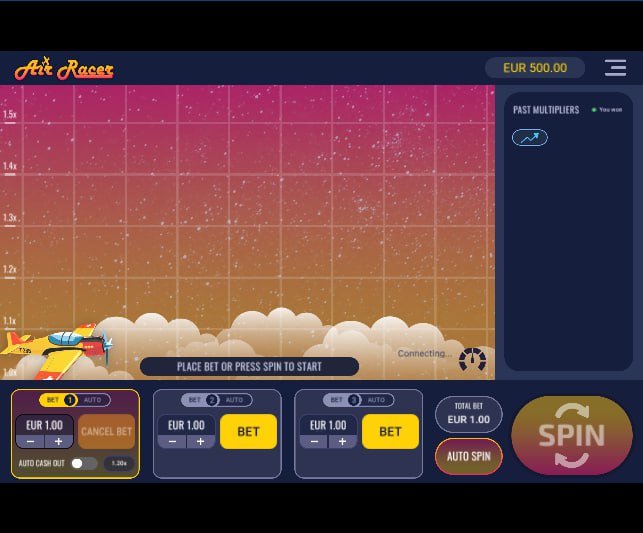
There are no distracting side animations or complex visual effects. The interface is designed for clarity and rapid decision-making. The growing multiplier is the largest and most prominent element on the screen, rightfully drawing the player’s full attention. The bet and cash-out buttons are large, clearly labeled, and change color to provide instant feedback—for instance, turning from a “Bet” button to a green “Cash Out” button once the round is active.
The most effective visual effect is the subtle acceleration of the plane. As the multiplier climbs into higher values, the plane’s movement and the accompanying visual trail it leaves behind intensify slightly. This serves as a non-intrusive visual cue that the stakes are rising, amplifying the tension of the round without adding distracting clutter. The overall design philosophy appears to be “form follows function,” ensuring that nothing on the screen detracts from the core task of watching the multiplier and making a timely decision. This minimalist approach is highly effective for a game that relies so heavily on player focus and quick reactions.
Technical Considerations and Game Parameters
Air Racer is defined as a real-time game, and the developer, Gamanza Group AG, explicitly notes the importance of a stable internet connection. They recommend a connection with a ping of no more than 200ms. This is not a trivial detail. Due to the game’s nature, any significant latency between the player’s action (clicking “Cash Out”) and the server’s registration of that action can be the difference between a win and a loss. This technical transparency is a credit to the developer and essential information for any serious player.
The game operates with a stated Return to Player (RTP) of 97%. In a crash game context, this theoretical figure represents the average percentage of all wagered money that will be returned to players over a massive number of game rounds. It is important to understand that in this format, the volatility is almost entirely player-driven. A player who consistently cashes out at low multipliers (e.g., 1.10x to 1.30x) is engaging in a low-volatility strategy. Conversely, a player who exclusively aims for multipliers above 50x is playing an extremely high-volatility game. The game’s structure allows you to define your own variance.
The absolute ceiling for a round is a maximum multiplier of 10,000x. If a round reaches this value, any remaining active bets are automatically cashed out. This serves as the game’s jackpot-level cap, providing a fixed ultimate goal, however improbable, for those willing to let a bet ride to its absolute limit. The betting range is accommodating, with a minimum bet of €0.10 and a maximum of €100 per betting slot, allowing for a wide spectrum of bankroll management styles.
When assessed within the broader landscape of online gaming, Air Racer should not be compared to video slots. Its peers are other titles in the crash game genre. In this context, its multi-bet system is a significant feature. While many crash games offer a two-bet option, the provision for three simultaneous wagers provides a more nuanced platform for strategy. It allows players to construct more complex risk management models within a single round, a feature that will be appreciated by analytical players.
The game is exceptionally well-suited for a specific type of player: one who prefers agency and direct control over their outcomes. For those who find the passive nature of spinning reels unengaging, Air Racer offers a compelling alternative that puts the most critical decision of every round squarely in their hands. The psychological tension it generates is a different brand of excitement from landing a bonus round on a slot. It is a more sustained, focused tension that rewards discipline and quick thinking. The clean interface and transparent mechanics make it an excellent entry point for those new to crash games, while the multi-bet functionality provides the depth needed to keep seasoned players engaged. It’s a polished and well-executed example of how minimalist design can belie a surprisingly layered strategic framework.