
Gamanza’s Air Racer Classic presents a pure crash game experience, shifting the focus from reels and symbols to direct risk management. The game’s atmosphere is minimalist and functional, centered on a single aircraft ascending against a data grid. Its core action involves players placing up to three bets per round and deciding the optimal moment to cash out as a win multiplier continuously climbs. The central tension is built around securing a profit before the plane abruptly vanishes, an event that forfeits any remaining stakes. This dynamic is governed by a clear mathematical model with a stated 95% RTP. Strategic control is significantly enhanced through an Auto Cash Out feature, which allows for presetting multiplier targets for each bet. This system, especially when paired with Autoplay, transforms the game into an exercise in disciplined, pre-planned strategy. Air Racer Classic is fundamentally a test of timing and nerve, rewarding calculated decisions over passive observation.


Gamanza’s Air Racer Classic positions itself squarely outside the domain of conventional reel-based slots. It forgoes paylines, symbols, and familiar bonus rounds in favor of a singular, high-stakes mechanic rooted in timing and risk assessment. The game belongs to the “crash” genre, a category that distills the gambling experience into a direct confrontation between escalating potential and sudden loss. Its appeal is not found in elaborate narratives or character-driven features, but in the stark, quantifiable tension of a constantly rising multiplier and the player’s decision of when to exit. This is a game built for a player who appreciates direct control and a clear, immediate correlation between their choices and the outcome of each round.
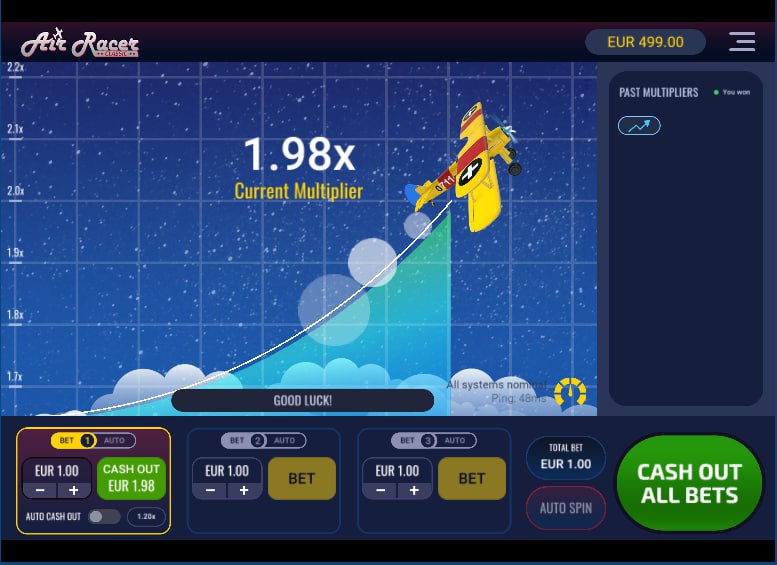
Core Gameplay and Strategic Decision-Making
The entire game cycle of Air Racer Classic revolves around a single event: a plane’s ascent. At the start of a round, players place their bets. Once bets are set, a stylized yellow aircraft begins its journey across the screen, and with it, a win multiplier starts climbing from 1.00x. The multiplier’s increase is not linear; it accelerates, growing faster as the value gets higher. The player’s objective is to activate the “Cash Out” button before the plane abruptly flies off the screen, an event that concludes the round. If successful, the player’s stake is multiplied by the value displayed at the exact moment of cashing out. If the plane flies away before the player acts, the stake for that round is lost. This creates a compelling psychological loop where patience is rewarded with higher potential gains but punished by a greater risk of total loss.
What elevates the gameplay beyond a simple test of nerve is the implementation of a multi-bet system. Players are not limited to a single wager per round. Instead, up to three independent bets can be placed simultaneously. This feature fundamentally alters strategic possibilities, transforming a simple binary choice into a platform for nuanced risk management. A player might designate one bet as a low-risk, early cash-out target, aiming to secure a small profit or cover the stakes of the other two bets. A second bet could be aimed at a medium-range multiplier, while the third is left to pursue a high-value, high-risk outcome. This layered approach allows for hedging and portfolio-style thinking within a single game round, a level of strategic depth rarely seen in chance-based games. The success of this strategy hinges entirely on the player’s discipline and their ability to execute their pre-defined plan for each of the three bets amidst the growing pressure of a rapidly increasing multiplier.
Automated Systems as Instruments of Control
To complement the manual, reactive nature of the core gameplay, Air Racer Classic incorporates two significant automation tools: Auto Cash Out and Autoplay. These are not merely convenience features; they function as instruments for executing a consistent, pre-determined strategy and removing the element of in-the-moment emotional decision-making, which is often the primary cause of strategic failure in games of this type.
The Auto Cash Out function is arguably the most powerful strategic tool available. Before a round begins, a player can assign a specific multiplier value to each of their active bets. Once the in-game multiplier reaches this pre-set target, the system will automatically cash out that specific bet. The minimum value for this function is 1.01x, and it can be set as high as 1,500.00x.
The Autoplay feature works in concert with the Auto Cash Out system. It allows players to set a specific number of game rounds to run consecutively without manual input. When Autoplay is active, the game will automatically place the pre-configured bets for each round. For this feature to be effective, it must be paired with the Auto Cash Out system. Otherwise, every round would result in a loss, as no manual or automatic cash-out command would be given. The combination of Autoplay and Auto Cash Out facilitates a “set-and-forget” approach, where a player can define a complete strategy—number of rounds, bet amounts, and cash-out targets—and observe its execution over a longer session. This is particularly useful for those who wish to test a specific statistical approach or simply prefer a less hands-on experience.
Aesthetic and Interface Design
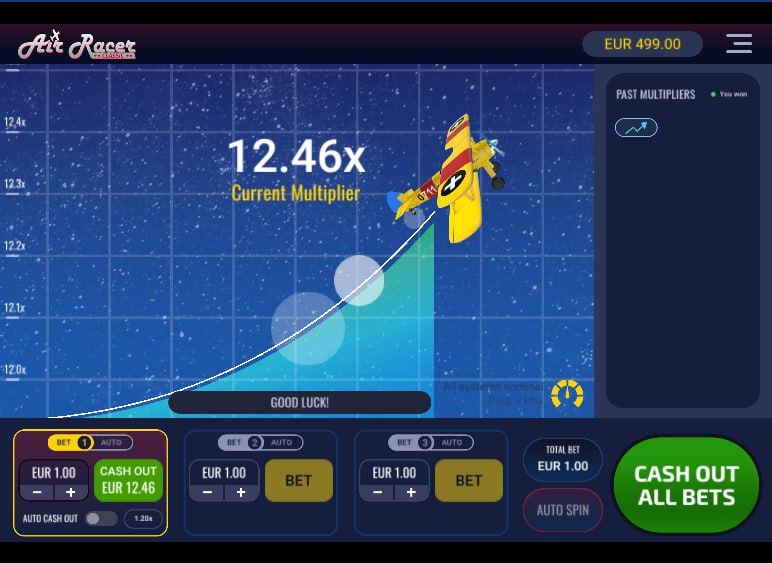
The visual presentation of Air Racer Classic is deliberately minimalist and data-centric. There are no lavish backdrops, intricate symbols, or animated characters. The interface is clean and functional, resembling the heads-up display of a flight simulator or a financial trading platform. The background is a simple grid with a parabolic curve, against which the action unfolds. The primary visual focus is the flight path of the yellow plane and the relentlessly climbing green multiplier number at its peak.
This spartan design is a deliberate choice that serves the gameplay. By removing all thematic distractions, the game forces the player’s attention onto the only things that matter: their bet amounts and the current multiplier. The animation is smooth and purposeful. The plane’s steady ascent builds anticipation, while its sudden disappearance is designed to be jarring, punctuating the end of the round with finality. The user interface elements are logically placed and clearly legible. Bet controls are at the bottom, the history of previous multiplier outcomes is often displayed for analytical review, and the large “Cash Out” buttons are prominent. This clarity ensures that during moments of high tension, there is no ambiguity in the game’s state or the player’s available actions. It is a design philosophy that prioritizes function over ornamentation, resulting in an experience that feels more like operating a precise instrument than playing a traditional game.
The Technical and Mathematical Framework
Beneath the simple exterior of Air Racer Classic lies a precise mathematical model. The multiplier’s journey begins at 1.00x and can theoretically reach a maximum of 10,000x. According to the game’s rules, should a round ever reach the absolute maximum multiplier of 1,000x on the server-side, any remaining active bets will be automatically cashed out—a ceiling that protects both the player and the system from unbounded outcomes. Winnings are calculated and paid out to two decimal places, ensuring arithmetical precision.
The game operates with a stated Return to Player (RTP) of 95%. In a crash game, this figure represents the theoretical statistical return across an immense number of game rounds, encompassing all possible outcomes from early cash-outs to total losses. It is an aggregate metric, not a predictor for any single session, which remains governed by chance and player choice. A critical technical consideration highlighted by the developer is the need for a stable, low-latency internet connection. The rules specifically note that a high ping (over 200ms) can introduce delays between the player’s “Cash Out” command and its execution on the game server. In a game where fractions of a second can determine the outcome, this is a vital piece of information. A sluggish connection can lead to a “slip,” where the plane flies away in the interval between the button press and server registration. This dependency on network performance is a defining characteristic of real-time crash games and a practical factor for any player to consider. The entire system is underpinned by a “malfunction voids all pays and plays” clause, a standard fail-safe for all regulated gaming products.